 11
11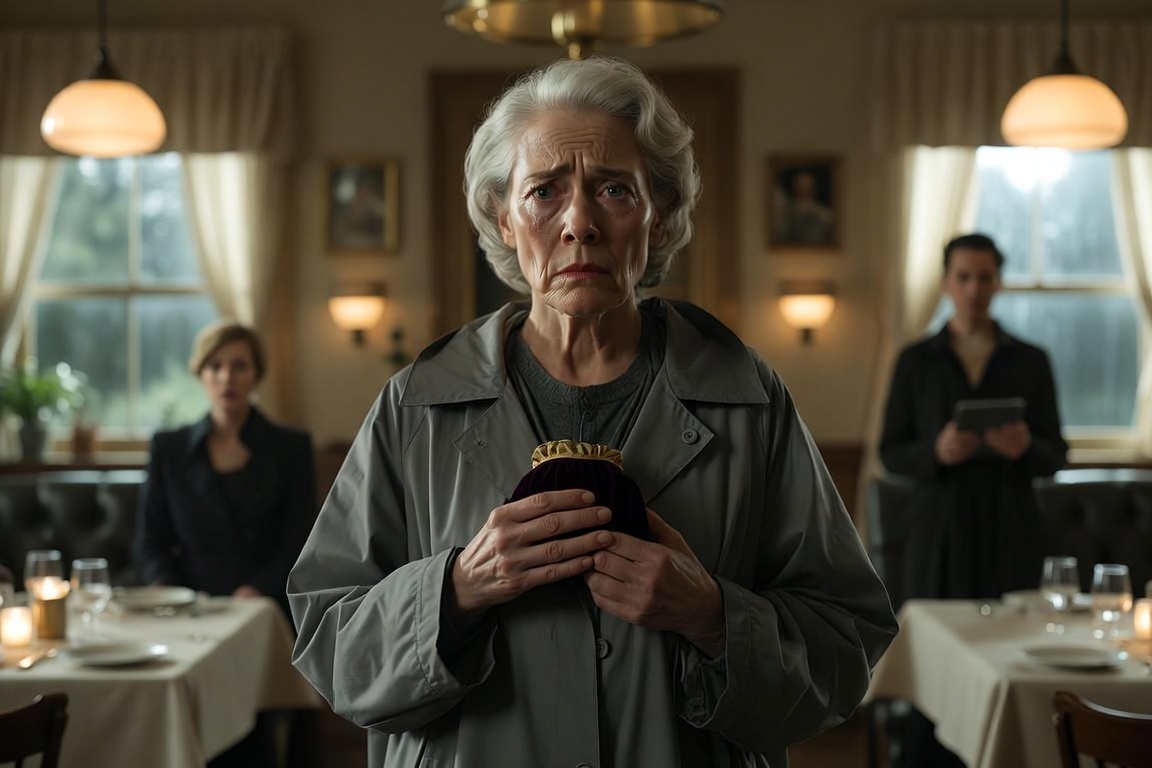
The rain had started before the lunch rush, tapping against the glass walls of Harrington Bistro like nervous fingers. Inside, everything looked expensive enough to make people speak softly. Brass lamps glowed above cream booths. White plates flashed under warm lights. The bar shelves reflected amber and gold. It was the kind of place where people noticed shoes before faces, watches before hands, and confidence before kindness.
Margaret Lane stood near the host stand in a damp gray coat, holding a folded napkin in one hand and a small velvet pouch in the other. She was sixty-nine, with silver hair pinned low and careful, tired eyes, and the soft posture of someone used to making herself smaller in public spaces. Her coat was plain. Her handbag was old. Her shoes had rain on them.
At the center booth, near the fireplace, a brass reserved sign sat beside two water glasses.
Margaret looked at it for a long second.
Tessa Monroe saw that look and moved in quickly. Tessa was the restaurant’s floor captain, polished in a black uniform, hair in a perfect bun, lips fixed in a professional smile that did not contain warmth.
“That table is not for walk-ins,” Tessa said.
Margaret blinked. “I know. I only wanted to leave something there.”
Tessa’s gaze dropped to the velvet pouch. “You can leave lost items at the front.”
Margaret’s fingers tightened. “It is not lost.”
Nearby, a few guests looked up from their menus. Nobody wanted to watch, but everyone listened. Public discomfort has a way of making a room silent without anyone admitting they caused it.
Margaret took one small step toward the booth.
Tessa stepped in front of her.
“Ma’am,” Tessa said, her voice lower now, “this is a private reservation for an important guest. We cannot have people wandering around the dining room.”
The words were smooth. The judgment was not.
Margaret’s face changed. Not anger. Not surprise. Something worse. Recognition. As if this was not the first time someone had looked at her and decided she could not belong.
She glanced at the old framed photograph above the fireplace. It showed the bistro twenty-five years earlier, smaller and less glamorous, with a young couple standing in front of a hand-painted sign. The man in the photo wore a chef coat. The woman beside him wore an apron and held a baby.
Margaret touched the velvet pouch.
Tessa noticed the movement and reached for the reserved sign. She turned it slightly away from Margaret, a tiny action that felt louder than a slap.
Margaret’s eyes filled. She looked down fast, trying to hide it.
From behind the host stand, Julian Park, the young assistant manager, froze with his reservation tablet in his hand. He had seen the same framed photo during training. He had heard the owner’s speech about the couple who built the restaurant. He had not connected it yet, but something about Margaret’s face made him uneasy.
Tessa gave a tight smile. “Please wait by the door.”
Margaret nodded once. She did not trust her voice.
Then the kitchen door opened.
Claire Harrington stepped out carrying a stack of menus. She was forty-two, dressed in a navy blazer over a cream blouse, her dark hair cut to her shoulders. She owned the bistro now, but she still moved like someone who had cleared tables as a teenager. Her expression shifted the moment she saw Margaret standing near the fireplace with Tessa blocking her.
The menus slipped slightly in Claire’s hands.
“Mom?” Claire said.
The word landed across the dining room.
Tessa’s smile disappeared.
Margaret looked up, and her face crumpled for one second before she forced it calm again. “I did not want to interrupt lunch.”
Claire walked toward her quickly, not caring who watched. She took Margaret’s wet coat sleeve in both hands. “Why are you standing here?”
Margaret looked toward the booth. “I brought your father’s ring.”
Claire went still.
The room seemed to forget how to breathe.
Margaret opened the velvet pouch. Inside was a simple gold wedding band, worn thin at the edges. She placed it on her palm like it might break.
“He said the fireplace table was where he first believed the restaurant would survive,” Margaret whispered. “I thought it should be here today.”
Julian’s eyes went to the framed photo, then back to Margaret. The woman in the photo was younger, but there was no doubt now. She was the one beside the founder. The one who held the baby. The one who had been standing in the room like a stranger.
Tessa looked as if the floor had shifted under her heels.
Claire turned toward her. She did not shout. That made it worse.
“This table is reserved every year for my father,” Claire said. “And for my mother.”
Tessa opened her mouth, then closed it.
Margaret wiped one tear from her cheek with the back of her hand, embarrassed by the attention. “Please do not make trouble.”
Claire’s eyes softened. “You are not trouble. You are the reason this place exists.”
The line moved through the room with quiet force.
A man at the bar lowered his glass. A woman at the nearest booth looked away, ashamed of having watched too easily. Julian placed the tablet down and stepped back from the host stand as if making room for the truth.
Claire pulled out the fireplace booth seat herself.
Margaret hesitated. Her hand trembled around the ring.
Tessa moved back, cheeks pale, her posture smaller now. She had judged a coat, a pouch, wet shoes, and a quiet voice. She had missed the entire history of the room.
Margaret sat slowly. Claire placed the wedding band beside the reserved sign, directly under the old photo.
For a moment, mother and daughter looked at the ring together.
“He would have hated all this attention,” Margaret said.
Claire gave a tearful laugh. “He would have pretended to.”
Margaret smiled then, the kind of smile that carries grief and love in the same breath.
Tessa stepped forward carefully. “Mrs. Lane, I am sorry. I should have asked.”
Margaret looked at her. There was no cruelty in her face, but there was no quick comfort either.
“Yes,” she said softly. “You should have.”
That was all.
Claire nodded to Julian, who quietly moved Tessa away from the dining room floor. No scene. No public punishment. Just a consequence clear enough for everyone to understand.
The bistro slowly returned to movement, but the mood had changed. The guests did not look at the fireplace booth the same way again. It was no longer just the best table in the room. It was a memory kept alive in public.
Margaret sat with her hands folded beside the ring. The rain outside blurred the windows, turning the city into silver. Claire stayed beside her, one hand on the back of the booth, not as an owner, but as a daughter.
The woman who had almost been sent to stand by the door became the center of the room without asking for it.
And Tessa, watching from near the host stand with tears she could not hide, finally understood that respect is not something people earn by looking important. It is something decent people give before they know the whole story.


