 11
11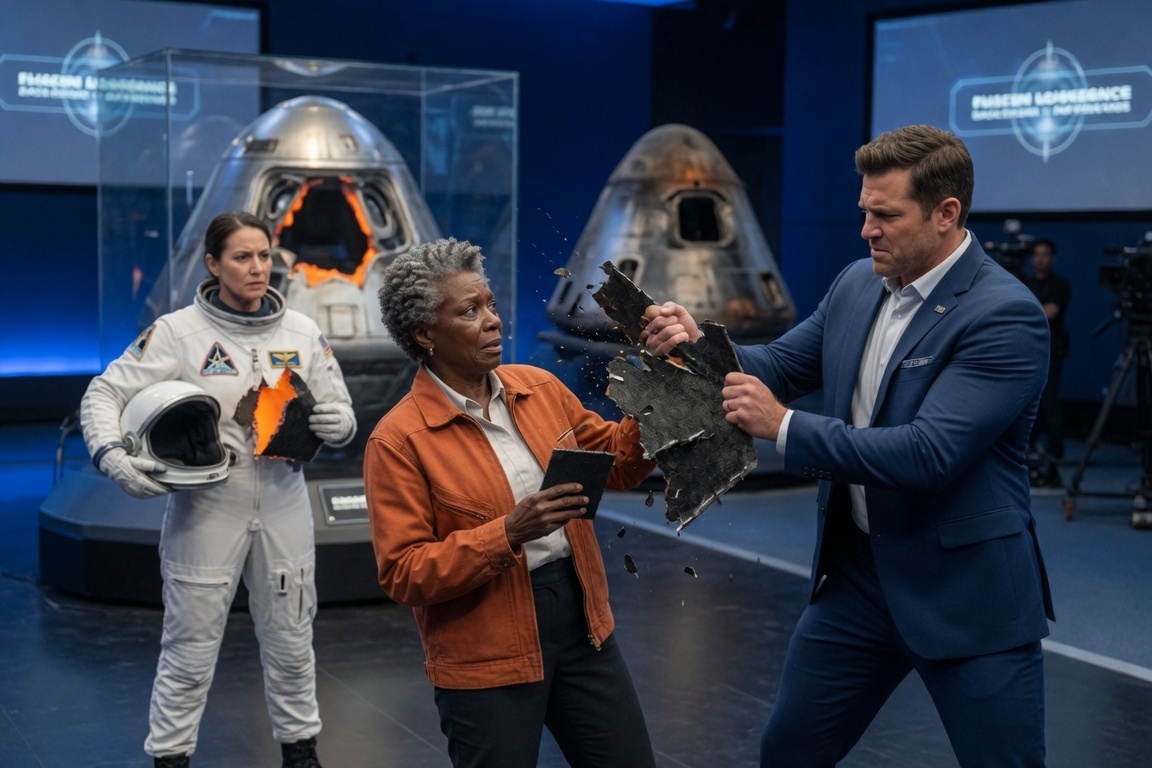
Logan tears Ruth’s black shield sample in half, shoves her off the launch platform, and throws her notebook behind the exhibit barrier. The violence was brief and public. Logan Price did not ask why I was there. The decision had already been made from my age, clothing, and the worn object in my hands.
The event continued for one stunned second, as though the aggression were another scheduling problem.
I studied materials because survival often depends on something nobody notices. A heat shield is not dramatic during launch. It matters when a spacecraft returns through temperatures capable of destroying it. Engineers build for the moment when applause has ended and the vehicle must endure what the audience cannot see.
During Maya’s final mission, debris damaged part of the capsule’s external protection. The layered material Ruth developed allowed the crew to reposition a backup panel and survive reentry. The orange core inside the sample became central to the emergency repair, but public coverage credited the spacecraft as though it had protected itself.
Age had changed how strangers interpreted my body. A slower step looked like confusion. A careful grip looked like weakness. An old tool suggested I could not understand the modern world, even when that world had been built from knowledge people like me developed. I had learned to remain calm around assumptions. Physical humiliation felt different. It turned dismissal into something the entire room could see and still choose not to stop.
The company opened a museum celebrating innovation and invited me to donate the original test sample. Logan believed the worn black material looked unimpressive beside the polished capsule. He tore it, shoved me from the platform, and discarded my notebook before Maya entered the gallery.
I could have defended myself by listing titles, awards, famous students, emergency records, or patents. None of it should have been required. A senior worker deserves balance, belongings, and personal space without proving a dramatic history. Respect that appears only after an important person intervenes is not real respect. It is fear of consequences.
The clue remained visible after the aggression: the torn material reveals the same layered orange core displayed in the capsule’s emergency repair section. It looked small beside the polished event. That contrast gave it power. One damaged object held years of sacrifice and care. The antagonist had tried to remove the person and accidentally exposed the evidence.
Commander Maya Stone recognized the clue. The event stopped. Their posture changed before the crowd understood: shoulders turned, steps accelerated, and attention moved away from the cameras. Authority stopped protecting the image. It was being used to stop further harm.
The reversal followed clearly: Maya removes her helmet, stops the countdown, and places the recovered capsule panel beside Ruth’s sample. Commander Maya Stone placed themself between us, making the new boundary visible. Logan Price’s confidence collapsed because the history no longer required a speech. I remained in the same practical clothes, with the same lined face and shaken hands. The room changed its understanding. I did not need to transform.
I refused to turn the ending into revenge. The aggression needed consequences beyond embarrassment. We examined the process and culture rewarding fast removal over respectful verification. Non-graphic violence often begins with language about efficiency or image, then escalates because nobody interrupts the first grab.
To ensure lasting justice, the company implemented real changes:
Witnesses mattered too. Several people had seen the first hostile movement and frozen. Some looked toward supervisors. Others protected cameras or equipment. Their hesitation showed why intervention rules matter. A safe event cannot rely on the victim remaining calm until somebody famous recognizes them. Staff and bystanders need permission to stop obvious physical mistreatment immediately.
Maya placed the scorched capsule panel beside the torn sample. Both looked damaged because both had performed their purpose under extreme conditions. The museum had wanted a perfect story about technology. The final display showed something more honest: people came home because imperfect-looking material had been designed carefully enough to survive.
The apology came later. I listened, but I did not make the aggressor’s shame the center of the story. Real regret accepts consequences, repairs what was damaged, and changes how the next unknown older person will be treated. Nobody should have to reveal a celebrated connection before another person’s hands are kept off their body and belongings.
People shared the story because the reversal felt satisfying. I understood why. A powerful person had finally seen what everyone else missed. The deeper truth was simpler. The shove, slap, or destroyed object was wrong before the clue appeared. Hidden importance can make a twist. Visible humanity should have been enough to stop the action.
I returned home with the same wrinkles, slower steps, and worn object I had carried in. The violent moment did not make me fragile, and the recognition did not make me powerful. Both moments exposed the room. One person saw age and used force. Another saw history and used authority to protect. The future depended on which behavior the institution chose to teach.
The damaged prop remained part of the permanent display or record. Nobody replaced it with a perfect replica before the story was documented. Its crack, scuff, torn edge, or repair line showed both the aggression and the recovery. Younger visitors could see that history is not only preserved through polished objects. It is also preserved by refusing to hide what happened to the people who carried them.


