 11
11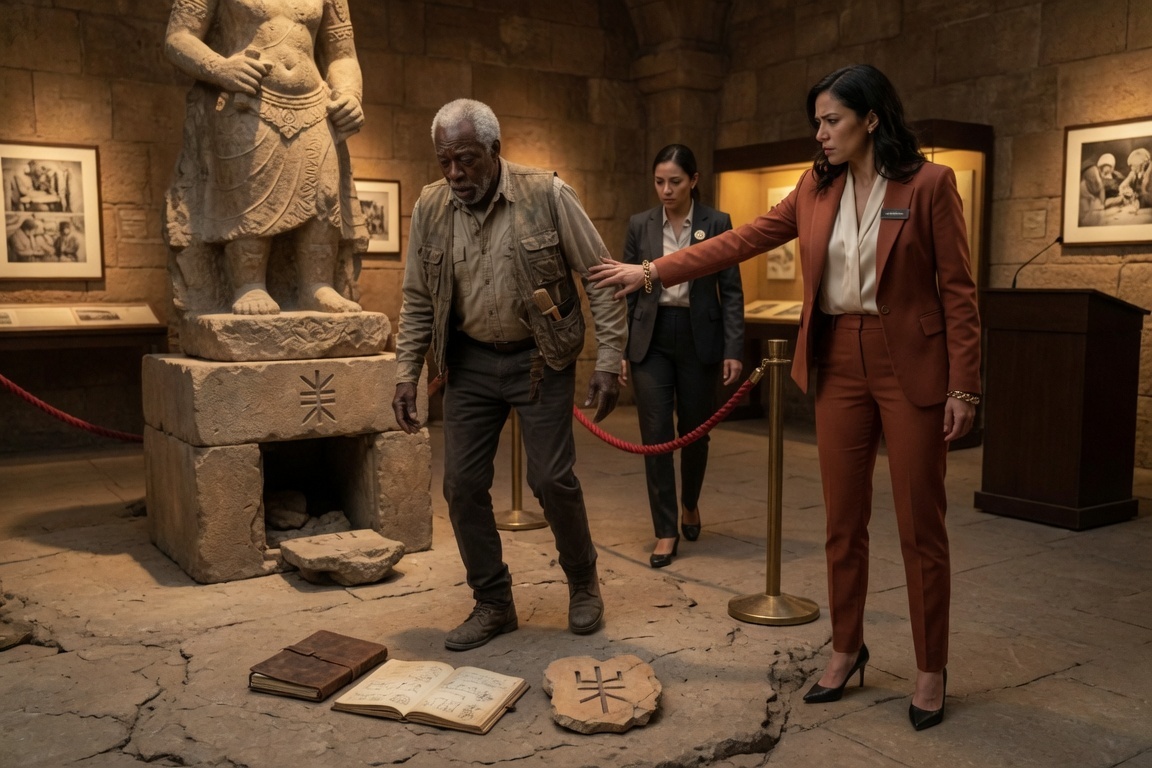
The first thing that hit the floor was my notebook.
Vivian’s hand landed on my shoulder before I reached the statue. She shoved me backward, not hard enough to injure me, but hard enough to tell everyone watching that she believed she had the right. The velvet rope caught behind my knees. My notebook slipped from my fingers and opened across the sandstone tiles.
I had carried that notebook for forty-one years.
The first pages were written in pencil because ink dried too quickly in the desert heat. Later pages held maps, names, weather notes, supply lists, and sketches of walls that no longer existed above ground. Near the back was a photograph of six exhausted people standing beside the first carved stone we uncovered. Five of them were now gone.
Vivian did not know any of that. To her, I was an elderly man in dusty boots walking too close to a donor podium.
The museum opening had been designed to feel expensive. The walls were new, the lighting was warm, and every object sat behind clean glass. Visitors would see the ancient city as a collection of beautiful discoveries. They would not see the weeks when sand filled our food, the months when funding disappeared, or the local workers who kept digging after outside experts left.
I had not been the famous archaeologist attached to the project. I was the local excavation supervisor. I knew the land because my father had grazed animals there, and my grandmother had told stories about stones that sang beneath the wind. When a university team arrived, I showed them where water collected after rare rain. That was where we found the first buried wall.
The clay tag that fell from my notebook had once been tied to a storage basket. It carried a symbol shaped like three rising steps. The same mark appeared beneath the museum’s central statue, although most people assumed it was decorative.
Dr. Lena Ortiz knew better.
She had been a graduate student when we opened the statue chamber. The ceiling began to shift during the excavation, and the team wanted to remove the statue immediately. I refused. The base was unstable, and lifting it would have destroyed a compartment beneath the feet. We spent two days building supports from scrap timber. Inside the base, we found the settlement map that proved the site had been governed as a city rather than a temporary camp.
That discovery changed Lena’s career. It also changed the funding, the ownership dispute, and eventually the decision to build the museum near the community instead of moving every major object to the capital.
Yet on opening night, my name appeared only once in small print near the exit.
I was invited by Lena, but the printed card never reached me. She sent a driver, and I arrived carrying the notebook because I wanted to place it beside the statue for one photograph. Vivian saw dust on the canvas cover. She told me contractors had a separate entrance. When I tried to explain, she gripped my shoulder and pushed.
The clay tag landed beside the statue base.
Lena crossed the gallery before I could stand. She did not begin by announcing my identity. She stepped between us and looked directly at Vivian until the sponsor lowered her hand. Then Lena picked up the tag and pressed the three-step carving beneath the statue.
A narrow compartment opened.
Inside was the original excavation photograph, the brass brush I had used to clear the first inscription, and a folded map with my handwriting across every edge. Lena had placed them there for the opening reveal. The museum had planned to surprise me, but the surprise arrived after the room had already shown what it thought of an old worker without a visible title.
Lena took the founder plaque from the compartment and placed it in my hands.
I wanted to refuse the word founder. Museums are not built by one person. They are built by diggers, conservators, translators, drivers, cooks, guards, donors, researchers, and communities willing to protect what others would sell. I told Lena the plaque should carry the entire field team’s name.
She agreed.
Vivian apologized beside the statue. She said she had believed I was interrupting the donor photographs. I told her that was exactly the problem. She had decided a photograph mattered more than asking one question. She had looked at dust and seen disorder. The museum existed because generations of people had been willing to touch dirt carefully.
The opening ceremony changed that night. Lena moved the donor speeches later and invited the surviving field workers to stand near the statue. The excavation photographs came out from the archive. The museum added audio recordings in which workers described the site in their own words, not only through academic summaries.
Vivian’s company still funded the conservation wing. Money mattered. But the donor agreement was rewritten so sponsorship could not control historical credit or remove local voices from public events.
My notebook now rests inside a glass case near the entrance. It is open to a page stained by rain and sweat. The cracked clay tag sits beside it. Visitors often stop because the objects look ordinary compared with the statue.
That is the point.
History usually enters the world through ordinary hands. It arrives in notebooks, buckets, tired backs, and someone noticing a symbol before powerful people understand its value.
The final photograph from the opening shows me in the same dusty boots Vivian tried to remove from the frame. Lena stands beside me. The statue rises behind us. The founder plaque lists six names, including those who never lived to enter the museum.
Nothing about me became more important when the compartment opened.
The room simply learned where to look.
The museum’s records later revealed another omission.
The field workers had been paid through temporary contracts that did not identify their roles. Some were listed only as labor. Yet those same workers had recognized soil changes, protected fragments during transport, and translated local names that guided the excavation.
Lena invited every surviving worker and family representative to review the new exhibit language. We sat around a long table with photographs spread between us. Some corrections were academic. Others were personal.
One photograph had been labeled “unidentified worker beside storage wall.”
His name was Joseph Mensah.
He had died during the second excavation season after returning home from illness. His daughter recognized the scarf around his neck. She told the museum that Joseph had built the shade structure protecting the first painted wall from direct sun.
His name entered the exhibit.
That change mattered more to me than my own plaque.
Vivian attended the review without photographers. She listened while families described what it felt like to see relatives reduced to anonymous background figures inside a museum funded by their labor.
Her company created a conservation grant for local trainees. The grant did not carry her name. She said that was part of learning the difference between supporting history and placing herself in front of it.
Months after the opening, I returned early one morning before visitors arrived.
A school group entered while I stood near the notebook case. Their teacher pointed to the cracked clay tag and asked why something so small deserved a display.
One child answered before I did.
“Because it opened the truth.”
I smiled.
The tag had opened a compartment. The shove had opened a larger question.
Who gets remembered when history becomes beautiful enough to sell tickets?
The museum does not answer perfectly. But now the people who dug, translated, carried, cooked, mapped, and protected are no longer hidden behind the word discovery.
Discovery is not a moment. It is a chain of attention. Break one link, and the story becomes easier to celebrate and less true.


