 11
11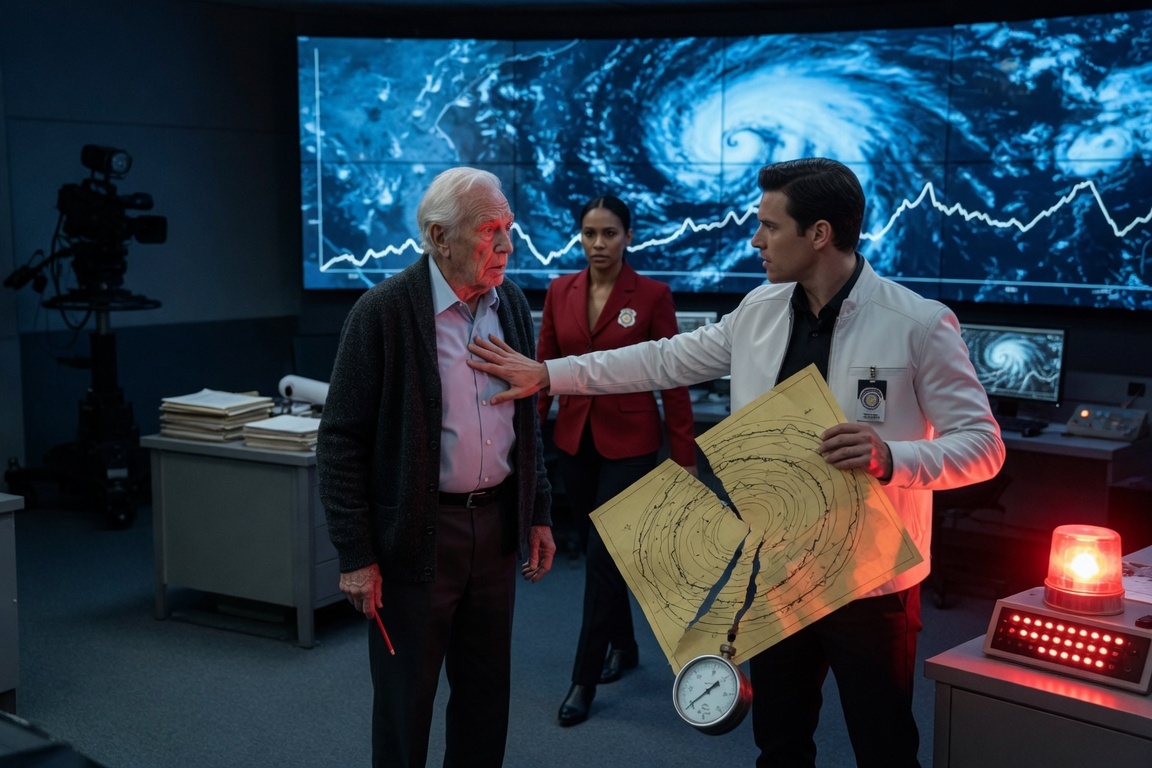
The chart tore more loudly than I expected.
Blake held one half in each hand, the red line split between them. He had already asked me twice to move away from the radar wall. The anniversary broadcast was running late, sponsors were waiting, and an elderly man with a paper chart did not fit the visual language of the new weather center.
Then he pushed me.
I caught the edge of the archive table. The vintage pressure gauge rattled beside my wrist.
For thirty-five years, I drew storms by hand.
That sentence sounds romantic now, but there was nothing romantic about it. We used satellite images, pressure readings, ship reports, wind direction, cloud height, and every available instrument. The pencil was simply where those pieces became one decision.
A hand-drawn line forced the forecaster to commit.
Automated models can produce dozens of paths. Human judgment still decides which path deserves action.
Blake grew up in a world of animated radar. He was talented, fast, and excellent on camera. He also believed anything without a digital label belonged in the archive.
I had been invited to the anniversary program for a short segment about the coastal supercell of 1996. That storm changed the city’s warning system. The official forecast expected the strongest winds to remain offshore. I disagreed because the pressure pattern curved inward while the upper winds stalled. I drew a red line toward the eastern neighborhoods and argued for early sirens.
The decision was unpopular. The storm arrived along my line.
Chief Maya Lewis was a young emergency coordinator then. She helped evacuate a school before the roof failed.
At the anniversary broadcast, I noticed the same pressure behavior forming again.
The live model showed the storm weakening. The pressure gauge from the archive had been connected for demonstration, and its needle began dropping faster than the studio display reflected. I unfolded a chart and drew the curve.
Blake thought I was interrupting the segment.
He told me the modern system had already cleared the city. I asked him to look at the pressure fall near the river. He glanced at the paper, laughed toward the crew, and said viewers did not need antique forecasting.
When I stepped closer to the radar, he tore the chart.
The push came next.
Maya saw the gauge move.
Her face changed before the sirens did.
She picked up the lower half of the chart and placed it against the video wall. The torn red curve lined up with a narrow band of wind hidden beneath the larger radar colors. It was not proof by itself. It was a warning that the model had underweighted a local pressure effect.
Maya ordered an immediate verification from the river station.
The reading confirmed it.
She moved Blake away from the console and activated the city warning system.
The studio lights turned red. The anniversary program disappeared. Emergency information replaced the celebration.
I redrew the missing section of the line.
The storm reached the eastern district twenty-three minutes later. Windows broke, trees fell, and several streets flooded. No fatalities were reported in the warned zone. People had moved indoors because the sirens arrived before the strongest wind.
Blake apologized after the broadcast. He did not blame stress or the camera schedule. He said he had treated age as evidence that my methods were obsolete.
I told him my paper chart was not superior to technology.
The lesson was not analog versus digital. The lesson was attention.
The pressure gauge mattered because somebody noticed it. The red pencil mattered because it forced a human being to connect signals instead of assuming the brightest screen already contained every truth.
The center changed its training program. Retired forecasters began running pattern-recognition workshops with younger teams. Every automated alert could be challenged by a documented human review. Historical storms became active case studies rather than anniversary decoration.
Blake remained on air. Removing him would have created one clean consequence and avoided the harder work. Instead, he completed emergency-forecast training and spent six months with field stations outside the studio.
The torn chart was preserved.
It hangs beside the radar wall, not because paper saved the city alone, but because arrogance nearly delayed the warning.
Visitors see a red line divided by tape.
On one side is experience.
On the other is technology.
The repair runs through both.
The review also changed the anniversary exhibit itself.
Until that day, the center presented old forecasting tools as charming objects from a slower era. The pressure gauge sat beneath a label describing equipment replaced by modern sensors. After the storm, the label was rewritten.
It now explains that redundancy is not nostalgia.
A gauge, field report, handwritten chart, satellite feed, and automated model can disagree. Safety grows when the disagreement is examined instead of erased.
Blake asked me to co-host one training broadcast.
I refused the word co-host.
I was not returning to television, and I did not want the story to become an old expert defeating a younger presenter. Blake had skills I never developed. He could explain complex radar images clearly within seconds. He understood how viewers moved between television, phones, and social platforms during emergencies.
I asked him to teach me that.
In return, I taught him to draw a pressure field without software.
The exercise frustrated him. He kept wanting to see every possible answer before choosing a line.
That was the lesson.
Forecasting is not certainty. It is responsibility under incomplete information.
Months later, another severe-weather day arrived. This time Blake paused during the broadcast and showed viewers two possible paths. He explained why the local pressure pattern made one more dangerous for the city. He did not mention me.
He did not need to.
The method had become his.
I watched from home with the repaired chart hanging on the wall behind him. The red line was still visible beneath the tape.
Some viewers later wrote that the torn chart looked dramatic. To me, it looked useful.
It reminded the center that tools do not become obsolete simply because they are quiet. It reminded me that experience also becomes dangerous when it refuses to learn from new systems.
The warning succeeded because neither side was enough alone.
The storm produced one more lesson after the sirens stopped.
Public trust depends on explaining uncertainty honestly.
The center released the timeline showing what the automated model predicted, what the gauge recorded, when the human review began, and why the warning changed. Nobody claimed the final path had been obvious.
That transparency mattered because people had received an alert that contradicted the earlier broadcast. Rather than pretending the system had always been certain, the center explained how new evidence changed the decision.
Viewers responded better than expected.
They did not demand perfection. They wanted to know that somebody was still thinking.
I joined the review board for one year, then stepped away. Experience can become another form of authority that resists challenge. The next generation needed permission to question me too.
The repaired chart remains visible, but the pencil beside it is not mine.
It belongs to whichever forecaster is on duty.
The line must always be drawn again. The repaired line now teaches judgment rather than nostalgia.


