 11
11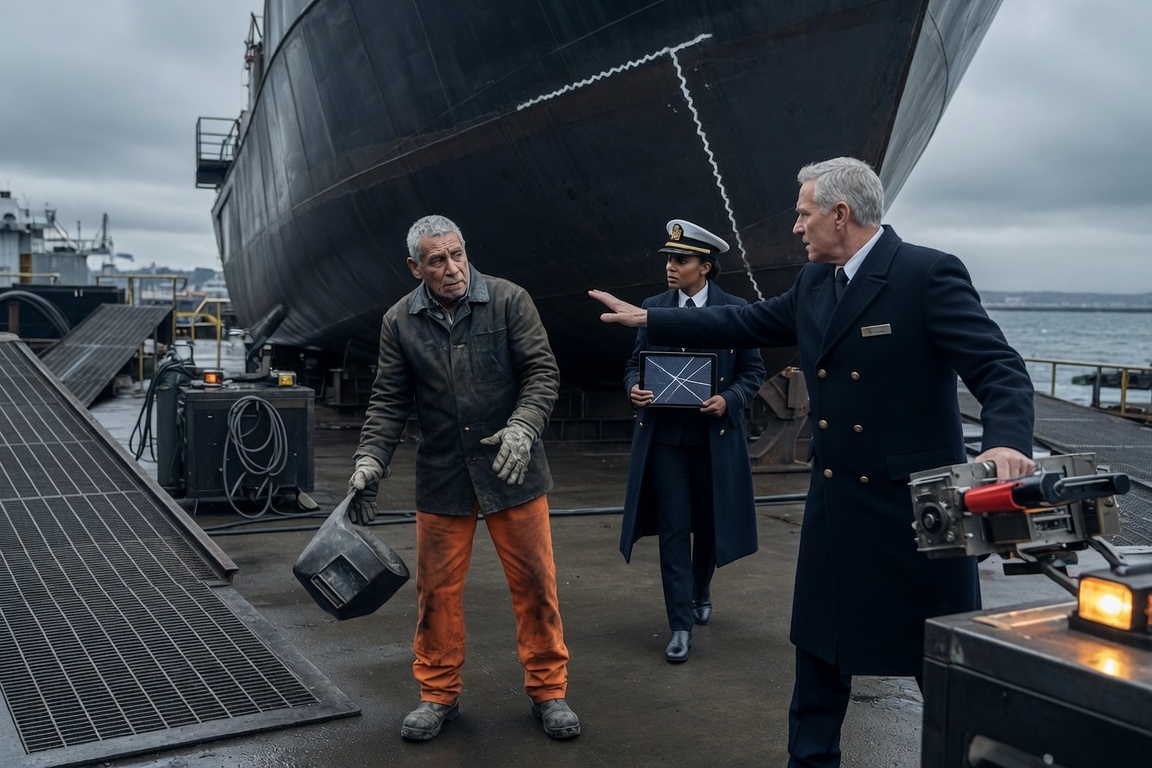
The ship did not move.
That was the first good thing that happened after Grant hit my mask from my hands.
The mask slid across the steel deck, scraping past the ceremonial bottle and stopping beneath the launch control. Grant shoved me back from the ramp and told the camera crew to keep filming. I looked at the white chalk line on the hull.
The ship still did not move.
For forty-seven years, I welded steel that would eventually disappear beneath paint. Good welding is strange work. The better you perform it, the less anyone notices. People admire the vessel’s shape, the clean deck, the name on the side. They rarely think about the seams carrying pressure through every wave.
I retired three months before the research ship was completed.
Two days before the launch, a younger welder called me. He had found an inconsistent reading near the lower support seam. The digital scan looked acceptable, but the metal sounded wrong when tapped. I returned after hours with an inspection mirror.
Beneath the paint, I found a narrow opening where two weld passes met. It was not large. It was large enough. The launch pressure could widen it before the vessel reached open water.
I marked the location with white chalk and submitted a stop request.
Grant Holloway owned the shipyard. The launch had already been delayed twice. Government representatives, research partners, and press crews were arriving. Another delay would cost money and damage his reputation.
My request never reached the final stage.
On launch morning, I stood beside the ramp waiting for the safety inspector. Grant saw me touching the hull and demanded that I step away. I showed him the chalk mark. He said retired workers did not control the schedule.
I picked up my mask because the inspection lamp was still inside it. He struck it away. The shove came immediately after.
Captain Aisha Reed watched from the ceremony platform. She had reviewed the vessel’s construction reports for two years. The white chalk mark meant something to her because my name appeared beside similar marks in the safety archive. I had trained the inspection team to use that shape when a seam required physical verification.
She looked at the launch tablet. The matching section had been marked complete without the stop request attached.
Aisha took the brass key from Grant. He reached for it. She stepped between us and hit the emergency stop.
The launch supports locked. A hydraulic alarm sounded. The vessel shifted less than an inch, then settled back.
I crawled beneath the accessible edge with the inspection mirror. The seam had opened enough for the reflected light to pass through. Nobody spoke. Grant still held the ceremonial bottle. Cameras that had been waiting for a celebration recorded the reason it did not happen.
Repairs took eleven days. The damaged section was removed, rebuilt, and tested under pressure. The younger welder who first heard the problem received formal credit. The launch proceeded safely two weeks later.
Grant apologized publicly. He also faced a board investigation for bypassing the stop request. The shipyard changed its safety system so no executive could remove a technical hold without independent approval. Retired specialists could be called into reviews without being treated as unofficial visitors.
My mask remained scratched from the fall. Aisha asked whether I wanted a new one placed in the shipyard archive. I said no. The archive took the old one. It sits beside the removed seam.
Visitors see a dented mask, a strip of steel, and a white chalk mark. None of them look impressive enough to stop a launch ceremony. That is why they matter. Safety often arrives as an inconvenient person pointing at something small.
The research vessel now crosses deep water carrying instruments designed to study climate, currents, and marine life. Its mission is built around observation. The ship survived its first day because somebody listened to a sound the screen had almost missed.
Grant wanted the launch to prove the shipyard could move forward. Stopping it proved something more important: The yard could still choose responsibility over momentum.
The repaired vessel carried one additional feature after the investigation. A small transparent inspection window was added near the seam location. It allowed engineers and visiting trainees to see the internal structure normally hidden behind paint and panels. The shipyard could have concealed the failure. Instead, it used the seam as a teaching point.
During the first training tour, I stood beside the younger welder who had made the original call. Her name was Lena Morris. She admitted she almost stayed silent because the scan showed acceptable numbers and she had been at the yard less than two years.
“I thought I needed more proof,” she said.
I told her concern is not an accusation. A safe workplace gives people a way to raise uncertainty before they possess a complete explanation.
Lena later became part of the independent review team. Grant Holloway remained owner, but the board removed his ability to override technical stops. He spent several weeks working alongside launch crews without press access. Some workers considered that punishment too light. Others believed removing him completely would allow the company to blame one personality and ignore the system that rewarded his behavior.
The board chose structural limits. That mattered.
A dramatic shove lasts seconds. The conditions behind it can be years old: schedule pressure, financial penalties, hero worship around leadership, and workers learning that caution makes them look difficult. The new process treated delay as data. If a launch stopped, the first question became what triggered the stop, not who should be blamed for slowing the event.
The investigation also traced how my stop request disappeared. It had not been deleted. It had been reclassified as a maintenance note, which placed it below the launch manager’s review threshold. The software followed the category it received. A supervisor had chosen the category because “safety hold” sounded too severe for an issue without digital confirmation.
The shipyard changed the form. Workers no longer had to decide whether concern was serious enough before submitting it. Any uncertainty affecting structural integrity entered the independent queue automatically. That small administrative change may prevent more harm than the public apology.
Systems often fail through ordinary dropdown menus, rushed labels, and people afraid of choosing the option that stops production. The seam looked dramatic after it opened. The lost category was almost invisible. Both belonged to the same failure.
Lena later told new hires that expertise is not permission to ignore procedure. My experience mattered because it entered a system willing to test it. The mirror confirmed the seam. The pressure test confirmed the repair. Respect for older workers should not turn into blind obedience. Good safety culture allows every claim, senior or junior, to be examined without punishing the person who raises it.
On the vessel’s first research journey, Captain Aisha sent me a photograph from open water. The sea was calm. The repaired seam was invisible beneath the paint.
She placed my scratched mask on the control desk for the picture. I laughed when I saw it. The mask had never belonged on a captain’s desk. But the message did.
Safety is not an object. It is the permission to interrupt momentum.


