 11
11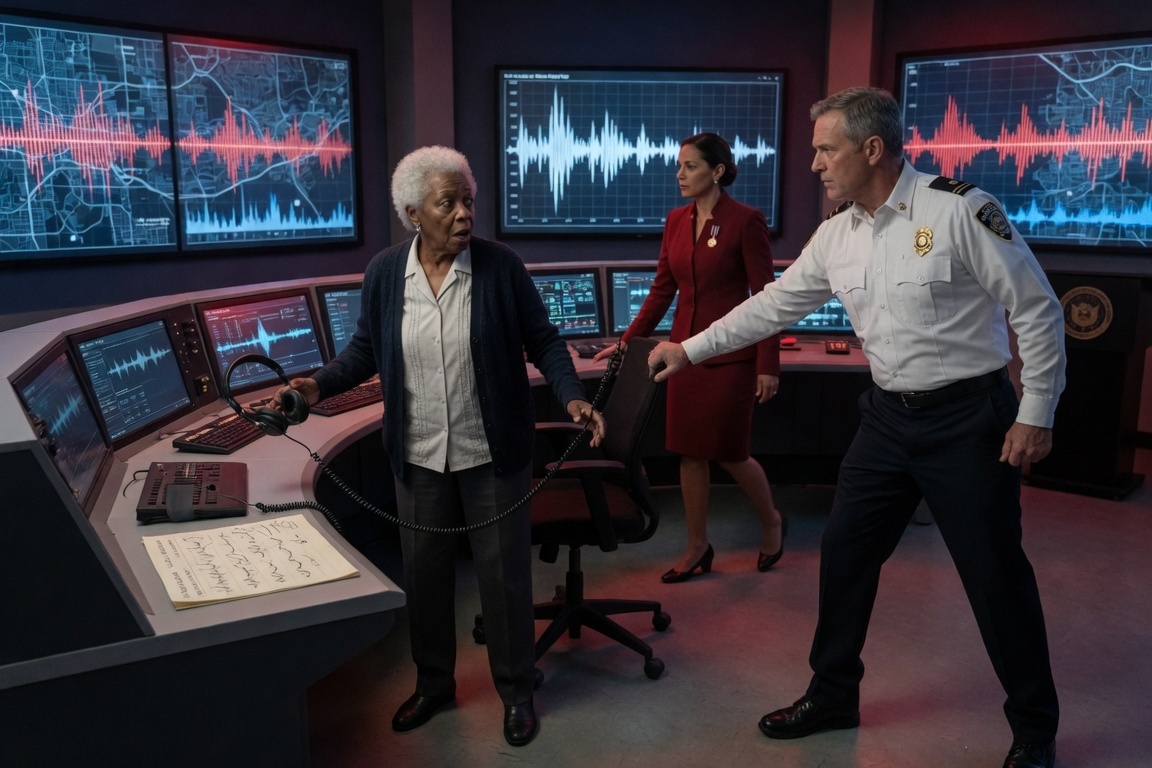
I was twenty-four when I first heard Dorothy James on the emergency line.
I was not in the dispatch center. I was inside an ambulance trapped behind traffic that had stopped moving in every direction. A factory fire had spread chemicals into the air. Three neighborhoods were being evacuated at once. Radio channels overlapped. Drivers panicked. People left vehicles in the road.
Then Dorothy’s voice entered the channel. Calm. Low. Precise.
She did not sound fearless. She sounded like someone who knew fear could be organized.
“North route first. Leave the bridge clear. Repeat only confirmed locations.”
That rhythm moved responders through the city.
Thirty-two years later, I stood inside the new dispatch center as a city commissioner. The anniversary ceremony celebrated digital mapping, automated call routing, and faster response times.
Dorothy had been invited to donate her original headset. Chief Martin Cole did not know who she was.
I saw the confrontation from across the room.
Dorothy sat near the central console, comparing the old wired headset with the new equipment. She touched nothing active. Martin walked over, saw an elderly woman beside a live station, and assumed she had ignored a boundary.
He did not ask her name. He struck the headset from her hands and shoved the chair backward.
The sound of plastic hitting the floor silenced the room.
Dorothy remained standing. That detail stayed with me. Her hands shook slightly, but her eyes moved immediately toward the console, checking whether the headset had damaged anything. Even after being humiliated, she protected the system.
A handwritten card fell from the headset case. It held short phrases and rhythm marks. Dorothy had used them to control the pace of high-pressure calls. One line read like music without notes: speak, pause, confirm, move.
The archive screen behind Martin displayed the waveform from the factory evacuation. I recognized the pattern. I pressed play.
Dorothy’s younger voice filled every console. The room heard the sentence that had cleared the bridge for our ambulance.
Martin stopped moving.
The ceremony had planned to give me the city medal for emergency leadership. I removed it and placed it around Dorothy’s neck.
She tried to refuse. She said dispatchers do not act alone. Call takers, radio technicians, responders, drivers, hospital teams, and residents make the system work.
She was right. I still left the medal there long enough for the photograph.
Dorothy sat at the central console and lifted the old headset. She did not deliver a dramatic speech. She adjusted the earpiece and listened to the room.
“Too many alerts,” she said quietly. “Important voices can disappear when everything sounds urgent.”
That observation led to a six-month review. The center reduced unnecessary internal alarms, added human pacing controls to automated scripts, and created a historical training library using real emergency audio. Retired dispatchers returned as paid instructors.
Martin faced disciplinary action for physical misconduct. He apologized directly and completed de-escalation training before returning to command duties. Dorothy asked that he not be permanently defined by the worst ten seconds of his career. She also refused to excuse those ten seconds.
Both things could be true.
The old headset now hangs beside the central console. New dispatchers hear Dorothy’s factory-evacuation call during training. They are taught to notice what technology cannot measure easily:
I still remember sitting in that ambulance. I remember the traffic, the chemical warning, and the feeling that the city had become too large to escape. Then a woman’s voice gave the fear a sequence. We reached the evacuation center because thousands of people followed the same calm rhythm.
The anniversary had been built to celebrate a modern system. Dorothy reminded us that every system eventually enters a human ear. What happens next depends on the person listening.
Dorothy later taught me something uncomfortable about awards.
“You gave me the medal because you remembered me,” she said. “What about the people nobody remembers?”
The question changed the city’s recognition program. We reviewed old emergency recordings and found dozens of dispatchers whose names had never entered public reports.
Their work was not dramatic enough for anniversary speeches. It was exactly what kept the system human.
The city created a rotating wall of calls selected for judgment and clarity. Families could approve or decline inclusion. Audio was edited to protect privacy. Dorothy served on the review panel for one year. She was strict. She rejected any recording chosen because it made a dispatcher sound heroic while turning a caller’s worst moment into entertainment.
“Teach the decision,” she said. “Do not display the pain.”
Martin Cole eventually became one of her strongest supporters. That did not erase what he did. It showed that accountability can produce a different professional if the person stops defending the original action.
On Dorothy’s final training day, she placed the old headset on a young recruit named Tasha. The headset was too large and connected to nothing. Dorothy asked her to listen anyway.
Tasha smiled, confused.
“Listen before the sound arrives,” Dorothy said.
In dispatch work, anticipation is not prediction. It is making enough mental space to hear what the next person actually needs.
The headset incident also revealed a physical design problem. Older visitors and retired staff had no clearly marked archive station. Historical equipment had been placed beside active consoles for the cameras. Martin’s assumption was wrong, but the room itself had been designed to create confusion.
Dorothy insisted that the redesign not become an excuse for his shove. Both responsibility and environment mattered.
The archive station was moved behind glass with a working demonstration console. Visitors could hear selected recordings without entering active operations. Retired dispatchers received visible credentials that described their role rather than labeling them simply as guests.
Good design cannot guarantee respect. It can remove the convenient excuses people use when respect fails.
Dorothy’s training materials now include blank space. New recruits once received scripts packed with suggested phrases. She removed half of them.
“A script can help you begin,” she explained. “It cannot hear the person.”
The course now grades listening, not only speed. Recruits review where they interrupted, what they assumed, and when silence provided information. Dorothy’s contribution was not one famous evacuation call. It was a way of making room for truth under pressure.
Martin now teaches the first misconduct case in the course. He begins with the video of himself striking Dorothy’s headset away. He does not explain before the footage plays. Recruits watch the assumption form, the hand move, and the room hesitate.
Then Dorothy enters and asks what could have interrupted the sequence earlier.
The lesson is uncomfortable because the answer is rarely one heroic action. A visible archive badge, a respectful question, a colleague speaking up, or a better room layout could each have changed the moment.
Prevention usually has several doors.


