 11
11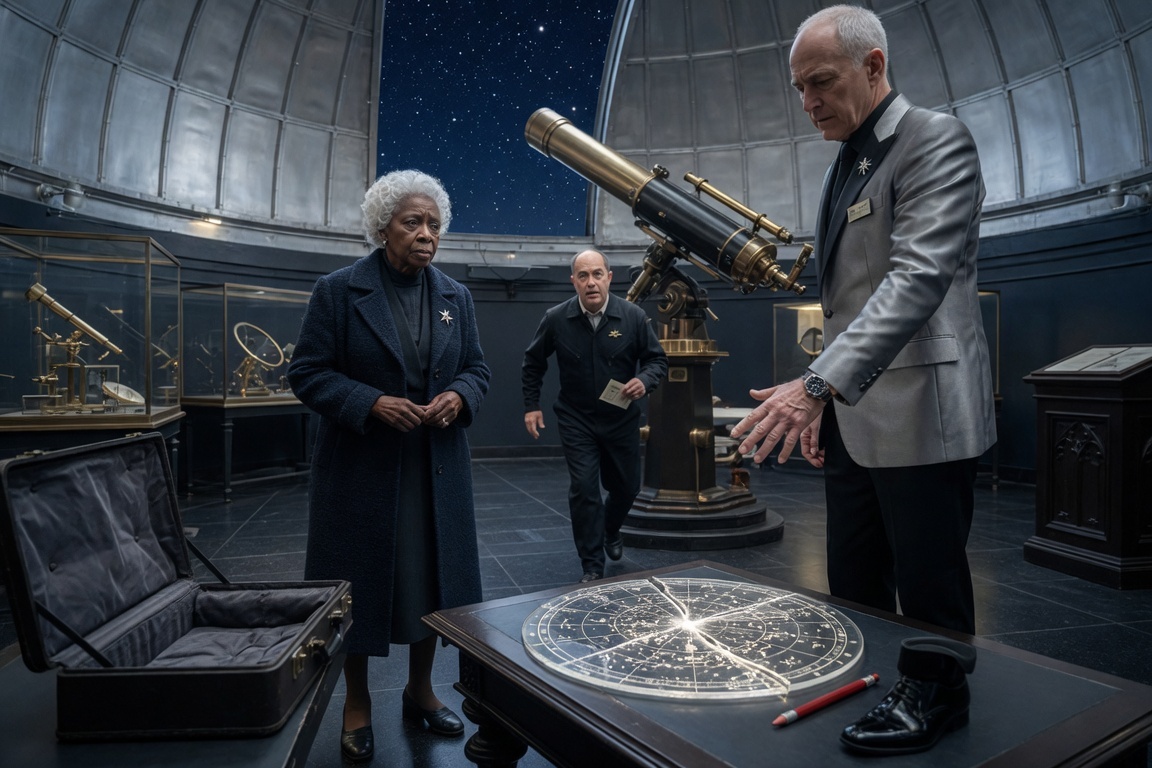
The dome began moving before anyone understood why.
Silver panels rotated above us, opening a thin path to the night sky. Conrad still had one hand on the display table. My glass plate lay beneath it with a crack running through the stars.
I had made that plate in 1987. Back then, the observatory camera exposed light onto glass coated with photographic emulsion. Each plate held hundreds of points that looked identical until someone measured them night after night.
Most nights contained nothing new. That was the work.
I spent eleven years comparing tiny changes nobody else wanted to examine. My colleagues chased brighter objects and larger grants. I watched a faint smudge near the northern edge of a crowded field.
The smudge moved.
Slowly.
Consistently.
I marked the coordinates in red pencil and submitted a preliminary comet observation.
The review committee rejected it.
The plate was noisy. The telescope alignment had drifted. My position at the observatory was temporary, and I was one of the few Black women working in that department. The rejection never mentioned any of that. It simply said the evidence was insufficient.
I kept observing.
Six months later, another telescope confirmed the object. A senior scientist published the orbit. The comet entered the archive under his survey team’s name. I remained in the acknowledgments.
Aaron Lewis was a graduate student then. He watched me compare plates after midnight and learned how to measure movement from damaged images. Before I left the observatory, I gave him one brass console key and told him a simple truth:
“Instruments remember whoever asks a careful question.”
The observatory reopened after restoration, and the celebrated comet was part of the main exhibit. Aaron, now the director, invited me to place my first plate beside the modern digital image. The invitation reached me. The revised exhibit label did not.
Conrad Vale funded the new dome controls. His company logo appeared near the entrance, and his media team controlled the opening schedule. I arrived carrying the padded case.
Conrad saw an elderly woman approaching the telescope platform while press cameras were moving into position. He told me historical objects had to be cleared through conservation staff. I showed him the archive card. He looked at the scratched case rather than the number.
When I tried to pass, he grabbed it.
I held on.
He pulled harder, slammed the plate onto the display table, and pushed me away with his forearm. The glass did not shatter, but a crack crossed the lower corner. My red pencil rolled across the stone floor and stopped against the official comet card.
Aaron saw the numbers side by side.
The opening ceremony stopped.
He moved between Conrad and me, picked up the brass key hanging from my case, and inserted it into the restored console. The dome turned toward the coordinates I wrote in 1987. The telescope screen filled with the comet’s current path.
Then, Aaron layered my plate over the modern data.
The faint smudge aligned.
Every camera in the room captured the same evidence the review committee had once called insufficient. Aaron removed the archive card from the exhibit and placed it in my hands. A new line had been added beneath the comet name:
First recorded on Plate MC-17 by Miriam Cole.
I asked when he had changed it. He said that morning. He had planned a private surprise, but Conrad’s aggression made the correction public.
The observatory board suspended his event authority immediately. His funding remained under review because supporting science did not give him control over scientific history or physical access.
I did not ask for the comet to be renamed.
Discoveries are rarely one clean moment. My plate showed the first movement. Another team confirmed the orbit. Engineers maintained the telescope. Technicians developed the images. The archive protected the records.
Credit needed to become accurate, not simple.
The cracked plate was stabilized rather than replaced. Conservators left the fracture visible. The observatory created an exhibit about rejected observations, including discoveries delayed by hierarchy, bias, damaged equipment, and incomplete evidence. Young researchers can now compare original notes with later confirmations.
Aaron also changed the review policy. Preliminary observations from temporary staff and students now remain attached to later discoveries rather than disappearing after rejection.
Several months later, I returned without cameras. A teenage visitor stood in front of my plate and asked why I kept working after the first rejection.
I told her the sky had not changed its answer because a committee disliked the evidence.
Scientists can be wrong. Institutions can be unfair. Observation still requires patience after both.
We climbed to the telescope platform. The comet was too faint to see directly, but the screen tracked its path. The girl placed one finger near the crack in the plate.
“Does that ruin it?” she asked.
No.
The stars remained measurable on both sides. The crack belonged to the object’s history now. So did the rejection. So did the correction. The comet continued moving without needing any of us to agree on who saw it first.
Human beings needed the record. That was why I had kept the plate.
The correction reached beyond the comet. Aaron asked the archive team to audit every observation attached to temporary staff, technicians, and students. The results were revealing.
Several preliminary records had been detached from later discoveries because the original submission was rejected before confirmation arrived. Some errors were procedural. Others reflected whose uncertainty was considered intelligent, and whose uncertainty was considered incompetence.
The observatory created a linked-record system. A rejected observation no longer disappears when a later team confirms the same event. The archive now shows the full chain: first signal, doubts, failed tests, independent confirmation, and final interpretation.
The history became less heroic and more scientific.
Visitors prefer one person suddenly knowing the truth. Discovery is slower. Someone notices. Someone questions. Someone checks the instrument. Someone else disagrees. The object keeps moving while people argue.
I agreed to advise for one year. My first request was not about my plate. It was about the women who developed photographic plates in the darkroom.
Their names appeared on payrolls, rarely on papers. They mixed chemicals, tracked emulsion batches, and identified defects that could imitate stars. Without them, many measurements were unreliable.
The new exhibit includes their notebooks. One page contains a fingerprint in dried emulsion. Another lists temperature adjustments in handwriting so small visitors need a magnifier.
The display does not claim they discovered the comet.
It shows they made it possible.
My plate eventually traveled to a university for conservation imaging. The crack produced a slight distortion, but the original star positions remained measurable. Students used the damaged plate to learn how physical artifacts can preserve data beyond the life of the equipment that created them.
I visited during the scan. A student asked whether I felt angry watching the comet carry another survey’s name.
Sometimes.
Anger is information too. It tells us where the record and the experience no longer match.
But I did not want the archive rebuilt around my anger. I wanted it rebuilt around traceable evidence. The plate number mattered more than a dramatic speech.
MC-17.
One mark moving through six months of darkness.
One woman continuing to measure after the first answer was no.
The comet will eventually fade beyond the range of our instruments.
The record should not.


