 11
11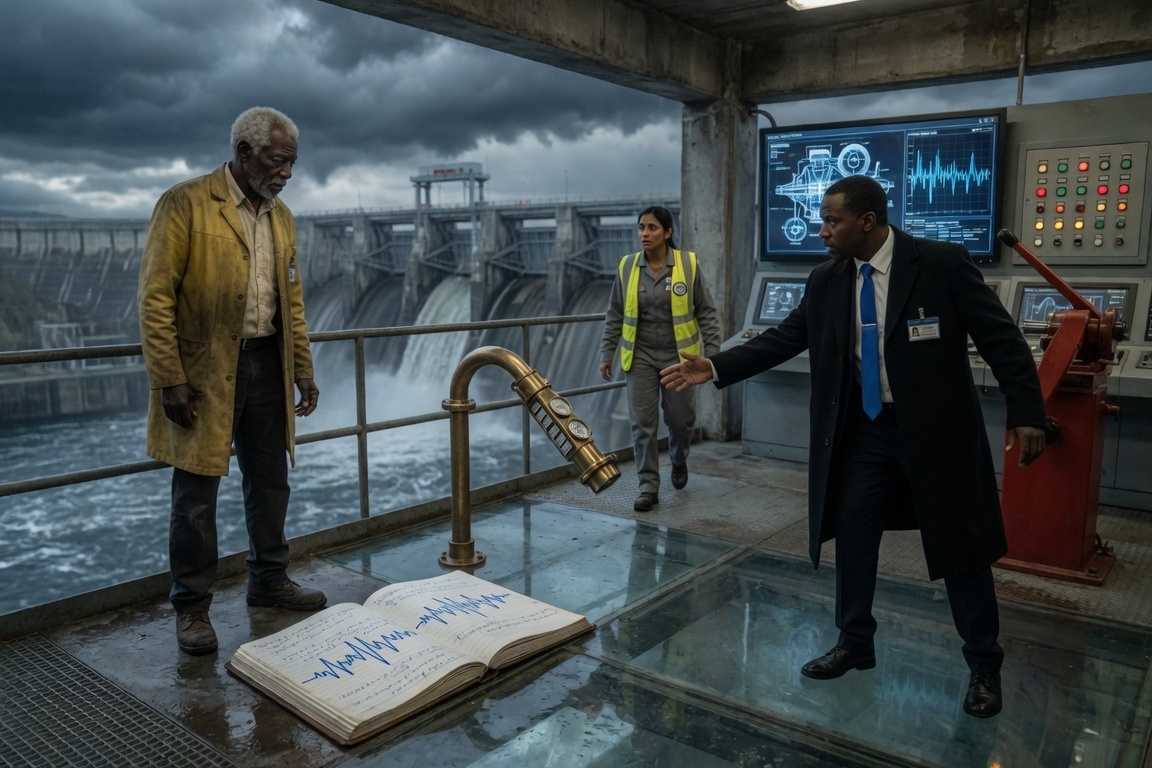
Field Note: 06:40
Reservoir level stable. Upper basin rain heavier than forecast. Turbine pressure oscillation visible every twelve seconds. Recommend postponing ceremonial gate test.
Field Note: 08:05
Recommendation denied.
I wrote those lines in the same notebook I had used during the dam’s original design. Forty-three years earlier, the river behaved differently. Seasonal floods spread across low farmland. The dam promised power, water control, and protection for towns downstream.
It also created new risks. A large system can fail through small timing errors.
I designed the manual spillway lock after a turbine test produced pressure waves that reached the gates before the control software responded. The lock sequence used three isolated actions, marked by blue lines in my notebook:
The system remained in the final dam design, hidden behind a modern control panel. I retired before the expansion project. Dr. Priya Shah became chief engineer and updated most of the monitoring system. She kept the manual lock because redundancy is not a lack of confidence. It is an admission that no model sees every condition.
The reopening included a ceremonial gate movement. Marcus Dale, project executive, wanted the gates to open on camera while officials stood above the reservoir. Rain had increased upstream overnight. The digital model still showed acceptable levels, but my brass gauge measured a faster local rise near the intake wall. The turbine screen displayed a pressure rhythm I had seen only once before.
I asked Priya to delay. She was checking the upstream feed when Marcus approached. He said the ceremony would move forward. I placed the brass gauge beside the lever and opened the notebook.
Marcus took the gauge. For one second, I believed he was finally looking at it. He threw it over the rail. Then he shoved me away from the lever.
The notebook fell open. Blue lines faced the control wall. Priya looked from the notation to the turbine pressure pattern. Twelve seconds. Rise. Drop. Rise.
She activated the emergency lock. The spillway gates stopped halfway through the ceremonial movement. Pressure climbed because the turbines and gates were changing load at the same time. Marcus told her to complete the sequence. Priya moved him away from the controls. She gave me the blue key.
The oscillation flattened. The gates returned to safe position. The reservoir level remained within limits. No flood occurred. No dramatic disaster was narrowly escaped in the way cameras prefer. The system caught an unsafe test before stress became damage.
Engineering success often looks like nothing happening.
The investigation found that upstream rainfall data had arrived with a processing delay. The digital model was accurate for older conditions. My brass gauge reflected the local water level in real time. Neither instrument was sufficient alone. The ceremonial test had combined changing reservoir pressure with turbine adjustment, creating a condition excluded from the launch model.
Marcus was removed from operational authority and reviewed for physical misconduct and interference with safety decisions.
The dam authority rewrote test governance:
My gauge was recovered with a cable. Water had entered the casing. Priya asked whether it could be repaired. I dried it, replaced one seal, and recalibrated the needle. It still works. The dam placed a digital duplicate beside it, showing both readings continuously. The notebook entered the engineering archive, but copies remain inside the control room.
A museum wanted the blue key. Priya refused. Emergency keys belong near emergencies.
One year later, another gate test occurred. I watched from home. A younger engineer paused the sequence after noticing a minor disagreement between two pressure sensors. The delay lasted eighteen minutes. Nothing was wrong. They checked anyway.
That was the outcome I wanted. Safety culture is not proving the older engineer right. It is making uncertainty strong enough to stop a powerful schedule.
Field Note: One Year Later
Gate test completed. Pressure stable. Review process working. Brass gauge still wet around the memory. System stronger because somebody was allowed to say wait.
The dam authority added a second kind of drill after the incident. Technical teams already practiced equipment failure. They rarely practiced authority failure. In the new exercise, an executive pressures operators to continue a test while data remains uncertain. Staff must identify who can stop the sequence, how to record the conflict, and how to protect the control room from interference.
The scenario feels uncomfortable. That is intentional. Engineers may know the correct technical action and still hesitate when the person giving the wrong order controls budgets or careers. Priya called the problem social pressure inside a mechanical system. Both need safeguards.
The control platform was redesigned. Ceremonial guests stand behind a physical boundary during tests. The operational lever cannot be reached from the podium. Safety communications are recorded automatically, preventing later claims that warnings were never made.
Marcus challenged his removal through the board process and lost. He later issued a detailed apology acknowledging that throwing the gauge was not frustration but an attempt to remove inconvenient evidence. I appreciated the accuracy. I did not request Marcus’s return.
The recovered gauge now sits inside a working bracket near the digital sensor. Operators compare both readings during drills. If they disagree beyond a set range, the test stops automatically. The blue key remains sealed but accessible. Every shift supervisor practices the manual sequence quarterly. I attended the first drill and intentionally gave no advice. One team began the steps in the wrong order, caught the mistake, and reset. Nobody was punished. The exercise existed so errors could happen before pressure became real.
Downstream communities joined the dam’s oversight committee. Residents receive plain-language reports about reservoir levels, gate tests, and emergency routes. Infrastructure affects people who never enter the control room, so technical transparency cannot stop at the fence.
My final field note was added to the training manual:
A gate is not safe because it opened. It is safe because the system remained free to keep it closed.
Priya later invited downstream residents into one emergency drill. They did not enter the control platform. They joined from schools, clinics, farms, and community centers along the river. The exercise revealed that one village received digital alerts quickly but had no reliable transportation route for older residents without cars. The dam authority funded local transport agreements and printed backup notices. A technically perfect gate response would still fail if the warning could not move people. Water management ends far beyond the concrete wall.
I also changed the way the control team wrote uncertainty. Old reports often used phrases like minor variation or acceptable deviation. Those words sounded reassuring while hiding how little the team actually knew. The new format requires three distinct fields:
During the next rainy season, operators detected a small gauge disagreement. They reduced load while investigating instead of arguing whether the difference deserved concern. The readings aligned after calibration. No crisis followed.
The system worked because uncertainty produced a temporary safe action rather than a debate about confidence.


