 11
11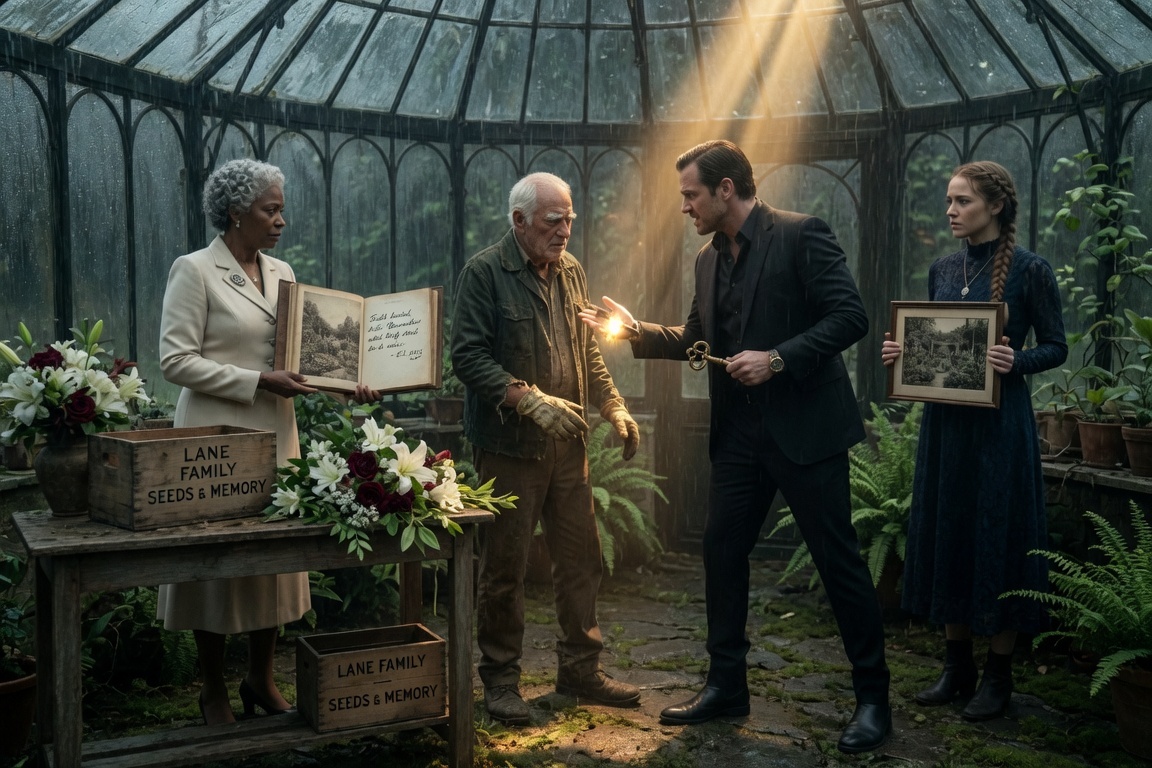
Arthur Bell had worked in my grandmother’s garden longer than I had been alive.
When I was a child, I thought he belonged to the estate in the same way the stone walls and old cedar trees did. He was always there before breakfast, sleeves rolled, hands in the soil, speaking softly to plants that seemed to listen.
My brother Caleb saw him differently.
To Caleb, Arthur was an employee.
After our grandmother died, that difference became impossible to ignore. The memorial gathering took place in the glass conservatory. Rain moved down the windows in long silver lines. Winter flowers covered the central potting table, and guests filled the rooms inside the house.
I carried an old framed photograph because Margaret Lane, my grandmother’s closest friend, had asked me to bring it. The image showed my grandmother as a young woman standing beside Arthur in an empty patch of dirt. Between them was the first tree planted for the conservatory garden.
Caleb had spent the week talking about selling the estate.
He spoke about value per acre, development offers, and how quickly the property could be divided. He walked through rooms placing colored stickers on furniture, as if grief were simply another inventory process.
Arthur said very little. On the day of the memorial, he placed a small brass key beside the flowers. It was the greenhouse key my grandmother had trusted him to carry for decades.
Caleb noticed it. He stepped across the conservatory and demanded that Arthur hand over every key connected to the estate. Arthur said the brass key did not belong in the house key ring.
Caleb reached for it anyway.
When Arthur covered the key with his gloved hand, Caleb slapped his hand aside.
The sound stopped every conversation near us. Arthur’s glove tore at the wrist. My brother grabbed the key and pushed him away from the table, pointing toward the side door and telling Arthur that employees were no longer needed at a private family memorial.
I wanted to move. I did not. That truth still embarrasses me. I stood holding the photograph while a seventy-two-year-old man who had carried me through the garden when I was small was treated like an intruder.
Fear can look like silence.
Cowardice can look exactly the same.
Caleb tried the brass key in a polished display cabinet where my grandmother kept valuable porcelain. It did not fit.
Arthur looked toward a weathered seed box beneath the potting table.
Margaret entered the conservatory carrying a thick family record book. She had seen enough. Opening the book to a page written in my grandmother’s hand, she asked me to place the framed photograph beside it.
The page described the winter the conservatory roof collapsed. My grandmother had been newly widowed and nearly bankrupt. Repairing the estate seemed impossible. Arthur sold a small piece of land inherited from his father and used the money to rebuild the greenhouse roof.
He never asked for ownership. He asked for the right to remain responsible for the garden.
My grandmother recorded the agreement herself. The estate would stay in the family, but the conservatory garden would remain under Arthur’s stewardship for as long as he was willing and able to care for it. Any sale or development plan had to preserve the garden and honor the maintenance trust established in his name.
Caleb laughed, stating a handwritten note did not change his plans.
Margaret turned the page. Attached behind it was the signed stewardship record, witnessed and renewed over the years. The brass key was listed in the document. It was not a symbol of employment; it was part of a responsibility my grandmother had protected.
Margaret took the key from Caleb and returned it to Arthur with both hands.
Arthur knelt beneath the potting table and placed the key into the weathered seed box. The lock opened. Inside were decades of garden journals, restoration plans, photographs, seed records, and the original stewardship papers. Every page showed a relationship Caleb had reduced to a job.
I finally moved. I stepped beside Arthur.
Caleb reached toward the documents, but Margaret closed the lid between them.
“Property could be inherited, but trust had to be earned.”
My brother’s face changed. For the first time since the funeral, he realized the estate was not waiting to become his trophy. It carried promises made before he was born.
Arthur stood slowly. His hand was red where the glove had torn, but he refused help. He walked to the tall conservatory doors and opened the internal latch. The restored garden appeared beyond the glass. Even in winter, it was alive.
My grandmother’s first tree rose near the path. Arthur had wrapped its lower branches against the cold. A bench beneath it carried a small brass plaque with my grandfather’s name.
I looked at the photograph in my hands and then at the real garden outside. The image was no longer history. It was evidence of care continuing across time.
Caleb left the conservatory before the memorial ended. His reflection moved across the rain-streaked glass, separate from the rest of us.
I stayed. I helped Arthur replace the torn glove. Then I followed him outside.
He showed me which beds would bloom first in spring and which wall needed repair before the next storm. He did not speak bitterly about Caleb. That made me feel worse, and I apologized for standing still.
Arthur told me people often freeze when a family reveals its worst behavior. What matters is whether they remain frozen after the truth becomes clear.
In the weeks that followed, I asked Margaret to help me review the estate plans. We paused the proposed sale—not because change was forbidden, but because Caleb had treated speed as if it were wisdom.
Arthur joined every meeting about the property. His knowledge changed the conversation. He knew where the land flooded, which trees protected the house from wind, and which parts of the garden could support public workshops without damaging the original design.
The estate eventually became a small cultural center. The house hosted events, and the conservatory taught gardening classes.
Arthur kept the brass key. On the first public opening day, he asked me to unlock the doors beside him. I hesitated. He placed my hand over the key. The gesture was not ownership. It was invitation.
My grandmother’s garden had survived because one man cared for it beyond what his job required, and one promise recognized that care before greed could erase it. Caleb inherited part of the estate. Arthur inherited none of the land. Yet when the doors opened and people entered the garden, everyone could see who had truly kept the place alive.
The following spring, Arthur taught the first public class in the conservatory. Children crowded around the same potting table where Caleb had slapped his hand away. Arthur showed them how to loosen roots without tearing them and how to recognize a plant that needed more space. He never mentioned the confrontation.
I placed the family photograph beside the seed box, not as a warning, but as context. The garden was no longer protected by one hidden promise alone. It was protected by a community that understood the promise.
Caleb visited once, standing near the doors without entering. Arthur nodded to him, then continued teaching.
Quiet justice did not require the garden to become a monument to resentment. It only required greed to lose the power to decide what survived.


