11
11
Elevators are supposed to make people forget movement. Step in. Doors close. A few seconds later, another floor. The machinery disappears behind convenience. That illusion depends on precision.
Claire saw my brass leveling gauge and assumed the lobby display had collected an old mechanic’s tool by mistake. She moved it away. Then the restored elevator opened. The car floor sat slightly above the stone lobby. A few millimeters. Most people would step over it. Maya noticed the threshold mismatch immediately. So did I.
Leveling is one of those details nobody celebrates until it is wrong. A car should meet the landing accurately enough that people do not catch a shoe, roll a cart awkwardly, or feel the system is unreliable. Modern elevator systems measure and control this far better than the equipment I began with.
In 1997, Meridian Tower was modernizing one of its historic elevator banks. The project preserved the visual character of the cars while replacing major mechanical and control components. I was part of the mechanic team. Maya Reyes was an apprentice. The project had a recurring leveling drift on one car during early commissioning. Not constant. That made it annoying. The car could land correctly several times, then arrive slightly high under a different load condition.
We checked sensors. Door sequence. Brake behavior. Control settings. Mechanical response. I carried a brass leveling gauge with red pencil marks showing acceptable demonstration references. The tool was simple. The diagnosis was not. We eventually traced the behavior to the interaction between one adjusted control parameter and the physical response of the modernized drive under varying conditions.
The engineering team changed the setup. We repeated cycles. Empty car. Weighted car. Different floors. Again. Again. The drift disappeared. The car returned to service. That should sound boring. Commissioning should be boring when it succeeds. The public never knew.
Maya remembered. She spent months beside me during that modernization. I taught her one habit I learned from older mechanics: Never trust one perfect cycle. A machine that behaves correctly once has only proved it can behave correctly once. Repeat under different conditions.
Maya later became a vertical-transport engineer. She works with systems more advanced than anything I maintained. Diagnostics are richer. Control is better. Monitoring is better. That was the right direction for the building. I do not want elevators preserved in the era when my personal knowledge was most useful.
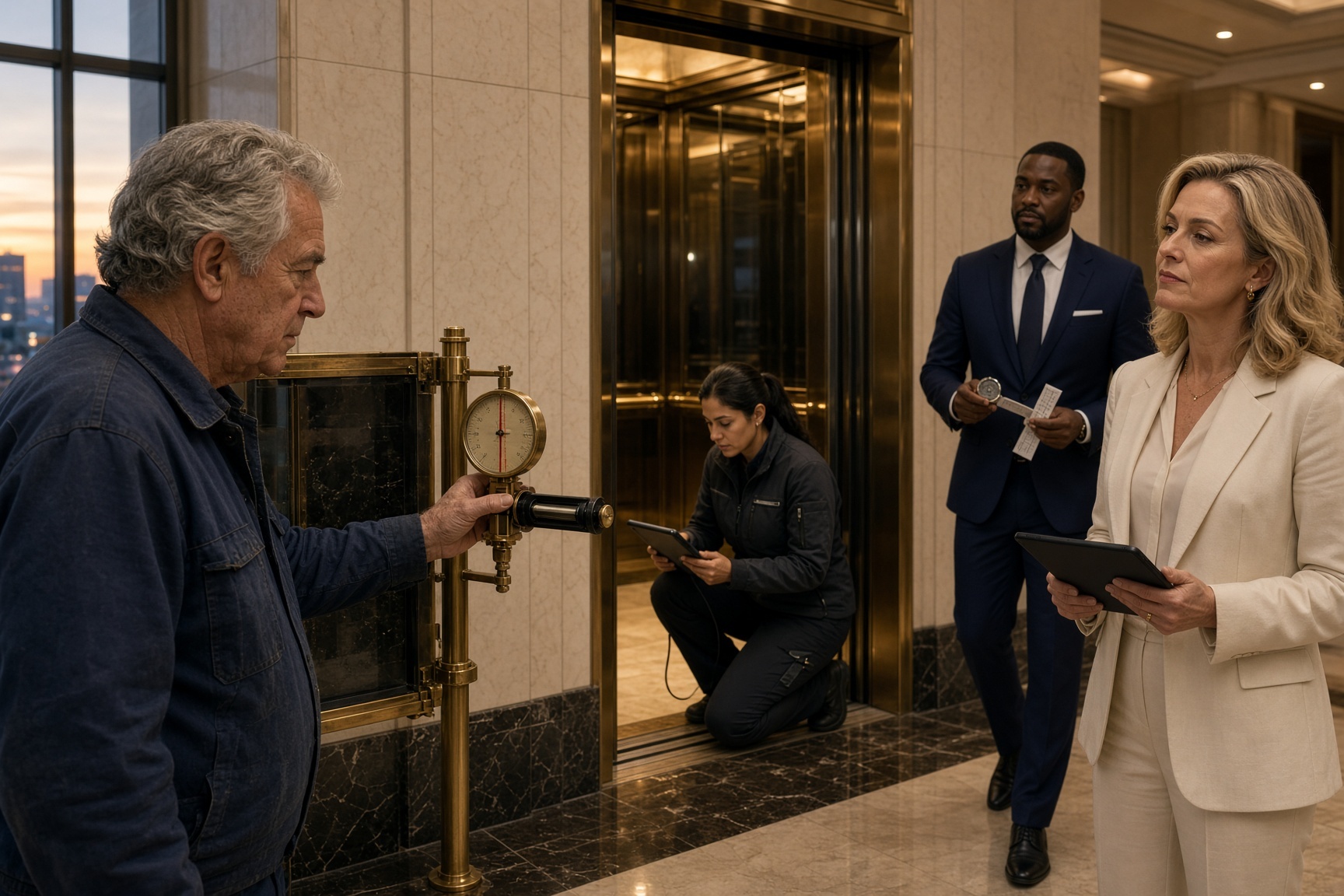
For Meridian Tower’s anniversary reopening, Simone Brooks created a small display about elevator modernization. Maya asked me to bring the old gauge and a copy of the 1997 maintenance strip. The original records remained in building operations. I arrived before guests. Claire Vale managed the event. The lobby looked expensive. Brass trim. Cream stone. City light through glass. My faded mechanic jacket fit the building’s history better than the dress code.
Claire did not see it that way. She asked whether I was from the restoration contractor. I said I used to work on the system and Maya expected me. She checked the featured guest list. My name sat under operations history. She did not reach that category. Then she moved the gauge from the display table.
At that moment, the elevator demonstration cycle chimed. Doors opened. The car sat slightly high. Not a real uncontrolled fault. The restoration team had built a supervised diagnostic demonstration into the anniversary program to show leveling adjustment. Claire did not know that yet. Maya did. She looked down. Then her eyes returned to me.
I stepped toward the threshold. Claire raised her tablet as if to block me. Maya told her with one look to stop. I placed the brass gauge across the landing. The red reference marks showed the small mismatch clearly. Maya’s digital pad displayed the same drift numerically. Old physical reference. Modern diagnostic data. Same observation. She smiled. Recognition had already happened before Simone brought any archive material. That mattered. The machine itself carried the story.
Maya ran the controlled demonstration sequence. The system adjusted within the approved training mode. The car moved away. Returned. Doors opened. Perfectly level. No step. No visible lip. Just one continuous floor plane. That second landing was the most satisfying reveal we could have designed.
Simone opened the 1997 maintenance strip. My handwriting appeared beside several commissioning cycles. High by small margin under weighted condition. Repeat. Make the adjustment. Retest. Maya’s apprentice initials appeared lower on the page. She had forgotten that. I had too.
Claire lowered her tablet. Simone pinned a silver service badge onto my jacket. Meridian created badges for anniversary operations contributors. Mechanics. Engineers. Electricians. Building operators. I liked the category. Buildings are full of invisible professions.
Then the elevator doors opened again behind us. This time perfectly level. Maya stood on one side of the threshold. I stood on the other. No dramatic access gesture. No ribbon cutting. Just alignment. That felt appropriate.
Claire apologized later. She said tools around an elevator demonstration had to be controlled for safety. That safety rule was valid. Loose metal near moving equipment is not acceptable. Then I asked why she moved the gauge without confirming with operations. She admitted it looked obsolete. It is obsolete for current diagnostic work. That does not mean it cannot explain how earlier technicians thought. Historical tools are useful when they teach function, not when they become proof that the past was better.
Meridian changed the display. The gauge sat beside a modern leveling sensor diagram. Visitors could see the same problem expressed physically and digitally. The exhibition also showed brake components, door rollers, control boards, and photographs of modernization work behind walls nobody usually sees. People became interested in elevator history. That surprised me. Then I realized everyone uses elevators. Familiar systems become fascinating the moment the casing opens.
Maya used the anniversary story in apprentice training. Her lesson was not use a brass gauge. Her lesson was repeat the cycle. Test under variation. A single success is not enough evidence for a recurring problem. That idea survives every technology change I have seen.
The brass gauge stayed in Meridian’s display for the season. After the display season, the gauge returned home with me. The building already owned better preserved examples. My red pencil marks were personal. The maintenance strip copy remained in the exhibit. The original record stayed with operations. Correct place.
I returned months later for routine visitor hours. The elevator arrived at the lobby. Perfectly level. Nobody looked down. That made me smile. Good maintenance produces indifference. People should not admire a threshold every time they travel. They should trust it without thinking.
The dramatic short-form story is simple. Old mechanic dismissed. Elevator lands high. Old gauge matches digital reading. Controlled retest lands perfectly. Maintenance record reveals history. Badge follows.
The deeper story is about invisible precision. Cities rely on systems that work so smoothly people forget they contain judgment, inspection, testing, and maintenance. The moment a system becomes inconvenient, everyone suddenly remembers the machinery. I prefer the forgetting. It means someone kept the details boring.
When I ride modern elevators now, I notice less than I used to. The acceleration is smoother. Leveling is better. Controls adapt. I could treat that as proof my generation mattered less. I treat it as proof engineering worked. The next person should inherit fewer problems, not more reasons to admire the last mechanic.