 11
11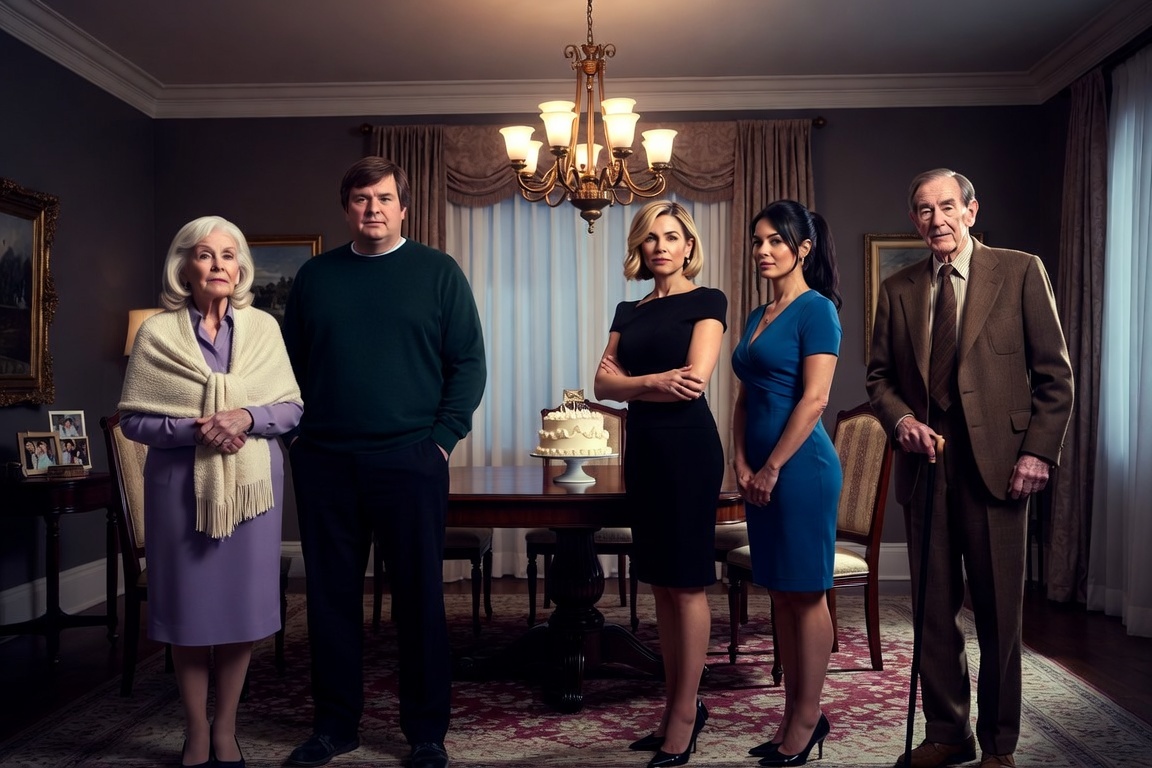
Helen’s birthday began with a lavender blouse, a cream shawl, and the hope that seventy could arrive without feeling lonely. She had ironed the blouse herself that afternoon, smoothing the sleeves on the same board she had used when Mark and Claire were children. In those days, birthdays meant paper streamers, uneven cakes, and someone always asking where the candles were. The mansion dining room had been louder then, less polished, more alive.
Now the room looked ready for a magazine. The chandelier softened the mahogany table. Burgundy curtains framed the tall windows. Every plate had been set with a careful distance between it and the next, as if the family had learned elegance but forgotten warmth. Helen paused in the doorway, searching for her place by habit.
There was no chair for her at the main table.
Instead, a small side table had been placed near the wall, close enough to see the family, far enough to feel removed from it. One plate. One fork. One folded napkin. A small slice of cake already waiting, as though even her celebration had been measured and portioned before she arrived.
Mark stood near the head of the table in his dark green sweater, acting busy with the seating cards. Susan, his wife, adjusted a glass and did not meet Helen’s eyes. Claire, in blue, saw the side table and pressed her lips together.
Helen waited for someone to explain that it was a mistake.
No one did.
Mark approached with the brisk tenderness of a man who wanted obedience to look like care.
“Mom,” he said, “we thought you’d be more comfortable over there tonight.”
Helen looked at the side table. “Away from everyone?”
“It’s not like that.”
Susan’s smile appeared, smooth and cool. “The main table is crowded. You know how these dinners get.”
There were empty chairs. Helen counted them without meaning to. Two at the far end, one beside Claire, another near the window. Nobody needed arithmetic to know the reason was not space.
Helen could have asked more questions, but she knew the answers would only dress the truth in softer clothes. Mark had been treating her presence like a complication for months. He wanted to host, decide, manage, speak for the family. Susan liked the version of the family where Helen smiled in photographs but did not interrupt plans. Claire hated conflict and had become fluent in looking sad after the fact.
So Helen walked to the small table. She sat down slowly. Her cream shawl slipped from one shoulder, and she fixed it with dignity. The plate was too close to the edge. The slice of cake looked tired under the chandelier light.
Mark exhaled, relieved that the scene had avoided becoming one.
That relief hurt her.
Dinner continued around Helen as if separation were natural. Mark told a story about renovations he wanted to make to the house. Susan discussed guest rooms, fabrics, a cleaner arrangement for future holidays. Claire pushed food around her plate and kept glancing at her mother. Helen listened from the wall, hearing the old house spoken about like a project instead of a life.
The family home had never been merely impressive to her. It was where she had learned to stretch small budgets without making the children feel poor in spirit. It was where her late husband came home exhausted and still danced with her in the kitchen when a favorite song played. It was where Mark learned to ride a bike in the driveway, where Claire cried after her first heartbreak, where Christmas ornaments were stored in boxes labeled by years.
Every corner contained work no visitor ever noticed.
But lately, Mark spoke as though the house had simply been waiting for him to improve it.
Helen lifted her fork, then set it down again. The room was full of family, yet the quiet around her chair felt thick.
Claire finally whispered, “Mom, are you okay?”
Helen smiled at her daughter. “I’m listening.”
That was the truth. She was listening to the story her children were telling without realizing it. Mark believed leadership meant taking the largest chair. Susan believed belonging could be arranged by placement. Claire believed regret counted as kindness if it looked sincere enough.
Then the front door opened.
Grandpa Robert arrived late because he refused to be rushed at seventy-eight. His cane tapped along the hallway before he entered the dining room, and for the first time all evening, the room’s attention moved away from Mark. Robert wore his brown suit, the one Helen’s husband had once teased him for calling “too serious for cake.” Under one arm, he carried a sealed family letter.
He stopped when he saw Helen at the small table.
No one needed to explain. Robert understood placement the way old men understand weather in their bones. His face hardened, not with rage, but with a disappointment older than the evening.
“What is this?” he asked.
Mark moved quickly. “We were just making Mom comfortable.”
Robert looked at the empty chairs around the main table. “Comfortable near the wall?”
Susan reached for her water glass. Claire stared at her napkin.
Helen began to stand. “Robert, it’s all right.”
“No,” he said. “It is not.”
He placed the sealed letter on the table, and the room seemed to lean toward it. Mark’s expression changed. The envelope had Helen’s late husband’s handwriting across the front, careful and slanted. Helen recognized it instantly and felt the air leave her chest.
Robert touched the envelope gently. “Your father gave this to me years ago. He asked me to open it when the family began forgetting who held this home together.”
The chandelier hummed above them.
Robert opened the letter with slow hands. He did not dramatize it. He did not need to. The paper itself carried enough weight. His voice was rougher than usual when he began reading.
Helen heard her husband’s words fill the dining room. He wrote about her rising before dawn. About the way she made decisions quietly, repaired relationships patiently, and carried burdens without turning them into speeches. He wrote that the family home was not preserved by status or pride, but by Helen’s daily devotion. He had also attached a family home document confirming her place at the center of every future decision about the property and gatherings held there.
Mark’s face changed first. Not because he misunderstood the document, but because he understood it too well. Susan sat very still. Claire began to cry silently, not in a way that asked for attention, but in the stunned grief of someone finally seeing her own silence.
Robert lowered the paper. “Your father knew what some of you might become when the house started looking valuable.”
The word valuable did not mean money in that moment. It meant control. It meant image. It meant the comfort of forgetting the woman who made the place feel worth returning to.
Helen remained seated at the side table until Robert finished. Then she stood.
She did not walk quickly. She picked up her plate, her napkin, and the small slice of cake. Mark moved as if to help, but she stopped him with a look. This was not a task she needed assistance with. This was a correction she needed to make herself.
Helen carried her things to the head of the main table, where an empty chair waited like evidence. She sat down. Robert stood behind her. Claire finally rose and came to her mother’s side, placing a hand on the back of the chair.
“I should have said something,” Claire whispered.
“Yes,” Helen said. Not cruelly. Not softly enough to erase it either.
Mark tried to speak. “Mom, I didn’t mean to make you feel separated.”
Helen looked around the room she had loved for more than forty years.
“Feelings can be misunderstood. A chair beside the wall is very clear.”
Susan’s eyes dropped.
The evening did not become warm again all at once. Family rarely heals like a light switching on. But the balance changed. Mark no longer sat at the head as if the seat belonged to him by volume. Susan no longer directed the conversation as if Helen were decoration. Claire pulled a chair close and stayed there.
Helen cut the cake herself. She gave Robert the first piece because he had kept a promise. Then she served Claire. Then Mark. Then Susan. No one mistook the gesture for surrender. It was Helen’s house in the way that mattered most: she could still offer grace without giving away her place.
Later, after the dishes were cleared, Helen stood alone by the wall where the side table had been. Mark came to her, quieter now.
“I was trying to organize everything,” he said.
Helen touched the back of the small chair. “Organization without respect becomes removal.”
He had no answer.
That night, the side table was carried out of the dining room and placed in the hallway for flowers. Helen did not ask anyone to do it. Claire did. The next morning, Mark called and asked if they could talk again, this time at her kitchen table, not the mansion table, not the head chair, just somewhere honest.
Helen said yes.
Because the letter had not been written to punish her children. It had been written to wake them. And on her seventieth birthday, after being given the smallest table in the room, Helen received something far larger than an apology. She received the return of her name to the center of the family story.


