 11
11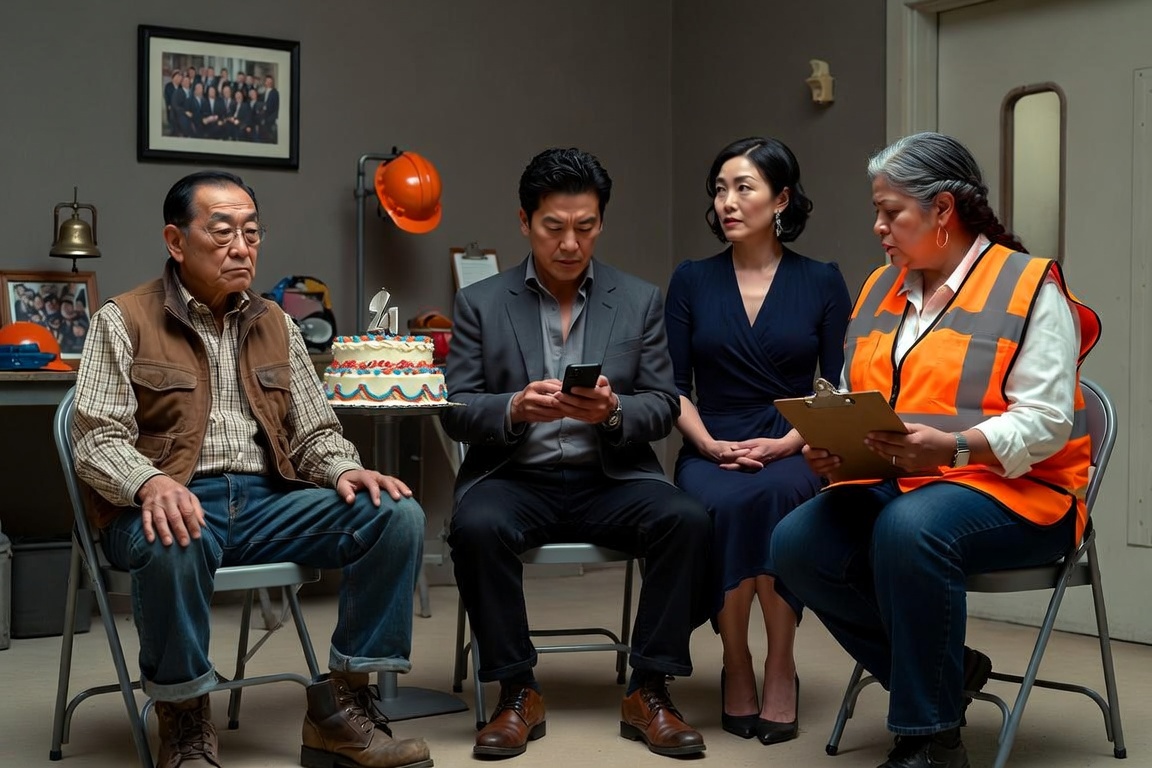
Arthur Kim had spent decades on factory time, so even a party clock seemed to tick in a language his children no longer understood. The place around her was busy with details: folding chair, retirement cake, safety helmets, framed team photo, factory bell, clipboard.
Those details mattered because they gave the scene its mask for Arthur. A polished room can make a harsh decision look respectable for Arthur. A clean counter can hide a dirty assumption for Arthur. A stage can make someone feel official even when their judgment is small for Arthur. In the factory break room beside the production floor, the surface was beautiful enough that a person not paying attention could miss the first wound.
Brent Kim treated the folding chair like a solution, not understanding that a cheap seat can still become a witness. No one had explained the history behind Arthur Kim’s name. No one had asked why her eyes lingered on the walls, the props, or the familiar corners, in Arthur’s scene.
Brent Kim filled the empty space with a story that benefited her own comfort. That is how the unfairness began. Not with chaos, but with confidence. Not with a shout, but with a decision made too quickly and delivered too neatly for Arthur.
Rosa Martinez noticed something had tilted. The change in the room was not dramatic enough to stop the event, but it was sharp enough to change breathing, in Arthur’s scene. Arthur Kim sat down slowly, not because he accepted the insult, but because the factory had taught him patience under pressure. A few people nearby understood more than they wanted to admit for Arthur. They saw the line forming between image and kindness, and for a moment most of them chose image because image asks less from a person, in Arthur’s scene.
Then Brent Kim said, “Dad, the main seats are for management tonight.”
The sentence was short, but the meaning spread across the factory break room beside the production floor like spilled water. It told Arthur Kim where she was being placed. It told the witnesses what kind of behavior would be tolerated for Arthur. It gave everyone permission to pretend the moment was only about seating, order, policy, timing, or presentation, in Arthur’s scene. That kind of permission is dangerous because it lets people step around the hurt instead of facing it for Arthur.
Arthur Kim could have explained everything. She could have named the work, the years, the sacrifices, the private reasons she belonged there, in Arthur’s scene. Yet explanation would have forced her to ask the room for something the room should have offered freely for Arthur. So she chose restraint.
In that restraint, Arthur Kim made the unfairness easier to see. The room had expected discomfort, maybe embarrassment, maybe a quiet exit for Arthur. It did not expect dignity to remain standing for Arthur.
Brent Kim mistook silence for weakness. That was the second mistake. Silence can be fear, but it can also be patience for Arthur. It can be shock, but it can also be discipline for Arthur. Arthur Kim’s silence held memory, and memory was the one thing Brent Kim had not calculated. Around them, the ordinary objects of the scene began to feel less ordinary for Arthur. The folding chair was no longer just a prop. It was waiting for the story to catch up for Arthur.
Lila Kim appeared at the factory door with a clipboard in her hand and years of gratitude in her face. That was the first visible crack in the wrong story for Arthur. Recognition moved across his face before the words arrived, and recognition is hard to fake, in Arthur’s scene. It has a different rhythm from politeness. It pauses in the chest. It changes the eyes.
It made the people nearby look again at Arthur Kim, not because she had changed, but because someone with authority had finally reacted to what they had ignored.
The reveal unfolded through a safe, simple clue: the factory bell rings and workers stand because Arthur quietly prevented layoffs by training everyone for years.
It did not need accusation. It did not need messy paperwork or heavy threats for Arthur. The proof was emotional, visual, and specific enough for everyone to understand for Arthur. Suddenly the same person who had been treated as extra became central for Arthur. The setting did not become louder. It became sharper. Every earlier glance returned with new meaning.
Brent Kim’s face tried to recover its shape. First came confusion, then a polished little panic, then the silence of someone realizing there was no sentence elegant enough to cover the mistake, in Arthur’s scene.
The hardest part for her was not that the truth appeared for Arthur. The hardest part was that the truth appeared in front of witnesses for Arthur. People who had accepted her version of the room were now watching that version fall apart for Arthur.
Arthur Kim did not use the moment to become cruel. That choice mattered. A smaller story would have made her shout, point, or demand a performance of regret, in Arthur’s scene. This story gave her something better: composure. She looked at the room with sadness, yes, but also with the strength of someone who knew the reveal had not created her value, in Arthur’s scene. It had only made her value visible to people who were late for Arthur.
For Brent Kim, the factory applause made management language feel thin and borrowed. The consequence was not built from spectacle. It came through rearrangement. A chair moved. A voice softened. A program was opened. A key turned. A person stepped aside. These are small actions on camera, but in moral drama they land hard because they show the power shifting without anyone needing to explain it twice, in Arthur’s scene.
Rosa Martinez also changed in the aftermath. Witnessing unfairness leaves a mark, especially when silence almost makes you part of the scene, in Arthur’s scene. Rosa Martinez stepped closer to Arthur Kim with a look that carried regret. It was not enough to erase the first moment, but it mattered because the next moment still belonged to choice, in Arthur’s scene. The room had chosen wrong once. Now it had to choose again.
People often think the twist is the whole story for Arthur. In the factory break room beside the production floor, the twist was only the door. What came through that door was a question: how many times had Arthur Kim been underestimated before this one? How many rooms had asked her to shrink because nobody recognized the history she carried for Arthur? The answer did not need to be spoken for Arthur. It sat in the way she breathed after the reveal, relieved but not surprised for Arthur.
Brent Kim had wanted the scene to confirm her sense of order. Instead, it exposed the poverty of that order for Arthur. A room can be beautiful and still be unkind for Arthur. A title can sound important and still miss the truth for Arthur. A person can dress carefully, speak smoothly, and still reveal that their confidence is built on judging too fast, in Arthur’s scene. That was the deeper reversal. Brent Kim did not simply misread Arthur Kim. She revealed herself.
By the time the event continued, the atmosphere had changed for Arthur. The same lights stayed on. The same props remained in place. But people now moved around Arthur Kim with a different awareness. Respect arrived late, which made it imperfect, but late respect can still expose early arrogance, in Arthur’s scene. Arthur Kim accepted only what felt honest. She did not collect every apology like a prize for Arthur. She let the room feel what it had done for Arthur.
The ending worked because Arthur Kim did not need the room to collapse. She needed the truth to stand up straight for Arthur.
Once it did, Brent Kim had no corner left to hide behind. The final image is simple: the hand lowers, the face freezes, the whispers stop, and the person pushed aside remains steady, in Arthur’s scene. In the factory break room beside the production floor, that steadiness became the victory.
The most satisfying part is not that Brent Kim lost control of the room. It is that Arthur Kim never handed over control of herself. The reveal changed the crowd, but it did not change who she was for Arthur.
That is why the story stays clean and emotional for Arthur. It does not depend on revenge. It depends on recognition. Arthur Kim had always belonged to the center of this moment; the room simply arrived late.
When Arthur Kim finally moved again, the movement felt earned. She carried her history forward, and the factory break room beside the production floor looked different because everyone had finally learned how to see it.
The moment also revealed something about Rosa Martinez. Until then, Rosa Martinez had been close enough to see the unfairness but not bold enough to interrupt it. That kind of hesitation feels small while it is happening, yet it becomes heavy afterward, in Arthur’s scene. In the factory break room beside the production floor, Rosa Martinez learned that kindness delayed can still leave a bruise, even when the delay lasts only a few seconds.
Lila Kim’s role mattered because the reveal did not arrive as gossip. It arrived through someone who understood the past and respected the person carrying it for Arthur. That gave the reversal a clean shape. The scene did not need anyone to accuse Brent Kim of being terrible. It only needed the truth to be placed where the room could no longer walk around it for Arthur.


