 11
11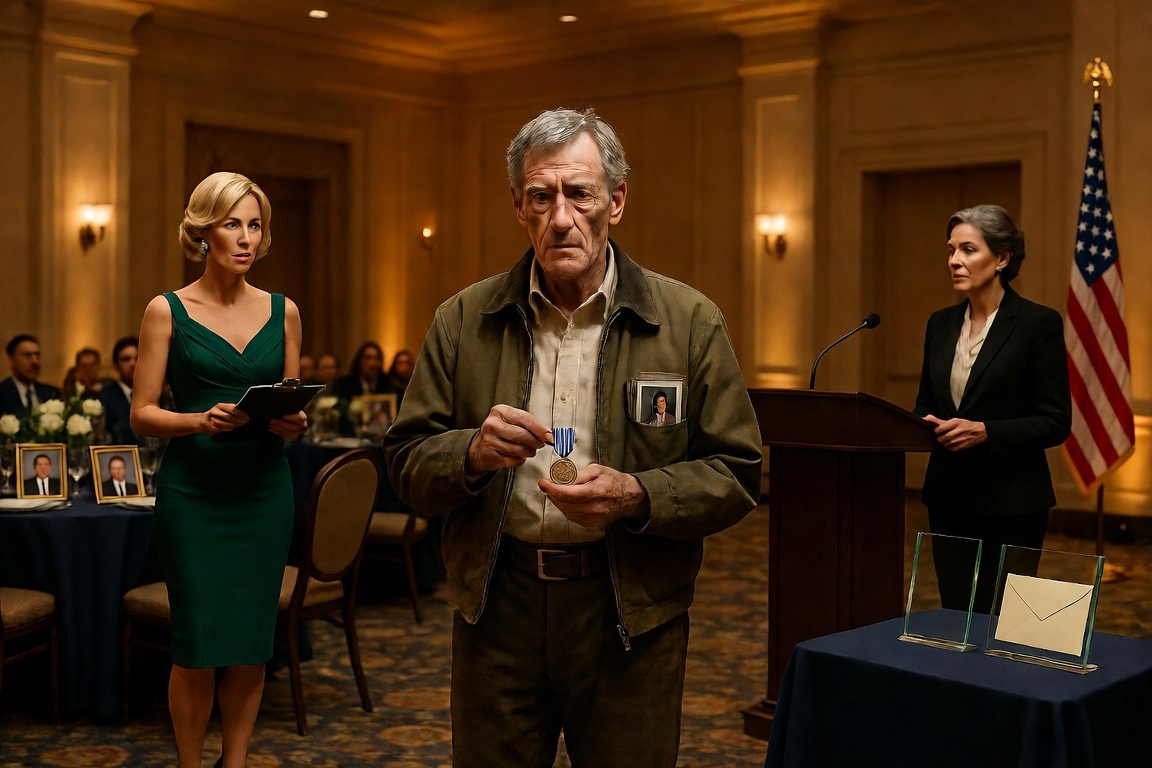
Thomas Reed arrived before the speeches began, which was exactly the way he preferred it.
He did not like attention. He never had. At seventy-two, he moved carefully through rooms, one hand near the inside pocket of his old olive jacket, the other curled around a folded program someone at the front desk had given him. The hotel banquet hall was warmer than he expected. Gold lights shone over navy tablecloths, white roses stood in crystal vases, and polished silverware reflected the faces of people who looked ready to be photographed.
Thomas looked down at his jacket. It was clean, but old. The elbows had softened from years of wear. Inside the left side, hidden unless he opened it, a small service medal rested near his heart. He had pinned it there that morning after staring at it for almost ten minutes. Not because he wanted anyone to see it. Because tonight had been important to the woman who sent him the invitation, and he wanted to honor her in the only way he knew.
Near the front table, a glass award plaque sat beside a sealed cream envelope. Thomas recognized the handwriting on the envelope before he recognized anyone in the room. He took one step toward the reserved table.
A woman in an emerald dress moved in front of him so smoothly that it almost looked rehearsed.
“Sir,” she said, holding a clipboard against her chest. “Can I help you?”
Thomas gave a small nod. “I was told to sit here.”
Her smile did not reach her eyes. “This table is for donors and honorees.”
He looked at the empty chair with the small place card resting on the plate. “I understand.”
“I’m not sure you do,” she said softly. “The public seating is near the back.”
The words were quiet, but not private. Thomas felt the old pressure in his chest. He had spent years learning how to stand still when a room decided he did not belong.
“My name is Thomas Reed,” he said.
Evelyn, the banquet chair, glanced at her clipboard. “I would know if you were expected at this table.”
Thomas slipped one hand into his jacket pocket. His fingers touched the medal first, then the folded photo behind it. “There may be a note.”
Evelyn’s eyes lowered to his jacket. She saw the worn cuffs, the simple shirt, the shoes polished past their best years. Her expression hardened. “Sir, we cannot have confusion during the scholarship presentation.”
A woman near the podium noticed everything. Helen Brooks had managed hotel events for three decades. She knew the difference between a guest who was lost and a guest who had been made to feel lost. She watched Thomas’s hand press against his jacket pocket, then watched Evelyn place her clipboard across the empty chair like a barricade.
Helen walked to the podium and picked up the envelope. The handwriting belonged to Mrs. Whitaker, the woman who had founded the scholarship dinner years earlier.
“Thomas Reed asked that his name never be placed on the program while I was alive. He said students needed a future more than he needed applause.”
The room became quiet in layers. Helen held the old photograph up beside Thomas’s medal. In the photo, a much younger Thomas stood outside a small veterans center with Mrs. Whitaker.
“But when I am gone, the first seat at this table must belong to him. This dinner exists because he gave when nobody was watching.”
Evelyn whispered, “I did not know.”
But the sentence did not save her. She had known enough to be kind, and had chosen not to be.
Marcus, a young man who had been sitting at the table, stood up. His voice shook. “Sir, my scholarship letter has your name on the fund record.” He took the reserved chair and pulled it out. “Please. This seat is yours.”
Thomas sat slowly. The room did not burst into applause. It stayed quiet, and that quiet felt more respectful than noise.
He had once thought the hardest part of coming home was learning how to live with what people could not see. But that night, he learned something else.
Sometimes the truth does not arrive loudly. Sometimes it arrives in an old jacket, holding a medal nobody bothered to ask about. And sometimes the person asked to leave is the reason everyone else has a seat.
Before he left, Thomas placed the medal beside the glass plaque for one photograph only. After that, he pinned it back inside his jacket.
“Some things are not for display,” he told Marcus. “Some things are for remembering.”
And when Thomas walked out of the banquet hall that night, nobody directed him to the rear seating. The path opened for him quietly, table by table, as if the whole room finally understood that respect should never have needed proof.


