11
11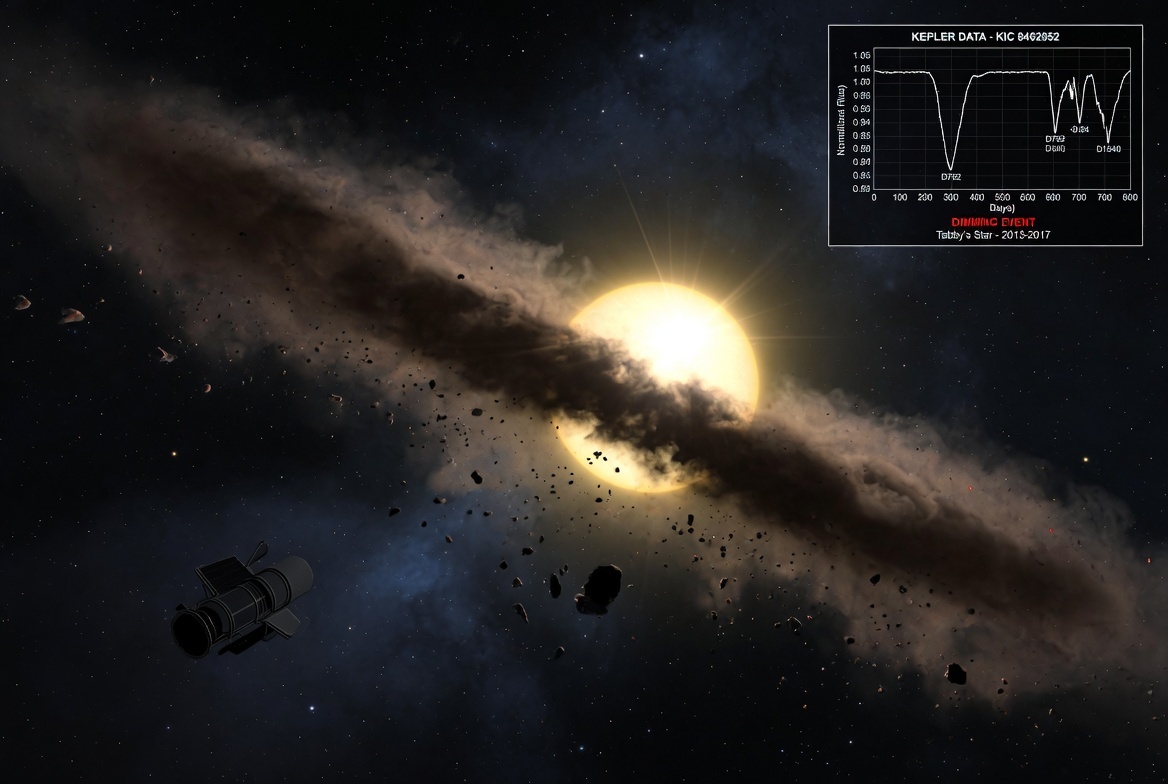
Most stars do not become global mysteries. They brighten and dim in predictable ways.
Typically, a planet may pass in front of a star and block a tiny fraction of light at regular intervals. Astronomers use these repeated dips to discover worlds orbiting distant suns.
Tabby’s Star did something far more unsettling.
Also known as Boyajian’s Star or KIC 8462852, the star showed irregular and unusually deep drops in brightness in data from NASA’s Kepler space telescope. Some dips reached an astonishing 20 percent. The changes did not look like a simple planet moving through a stable orbit.
The star became famous because the pattern was strange enough to invite unusual explanations. One idea escaped into popular culture immediately: Could an advanced civilization be building a giant structure around the star?
The evidence never confirmed that idea. But the question changed the way the public saw one line of data.
Tabby’s Star became a major story partly because citizen scientists helped identify its unusual light curve through the Planet Hunters project.
Kepler collected enormous amounts of data from stars. While computers process patterns efficiently, human eyes can notice irregular, messy shapes that automated filters may miss. The star’s dimming was not a clean, repeating transit. The dips varied wildly in depth and timing, and some were far deeper than a normal planet transit.
The discovery showed the immense value of public participation in science. A strange star hiding in a massive dataset became visible simply because people paid attention to the pattern.
When an exoplanet crosses in front of a star, the light curve usually follows a strict, repeatable schedule. The depth of the dip relates to the size of the planet, and the timing relates to its orbit.
Tabby’s Star did not behave that way. Its pattern lacked the clean repetition expected from a single planet, forcing researchers to consider much more complicated possibilities:
The list expanded rapidly because the data resisted a simple answer.
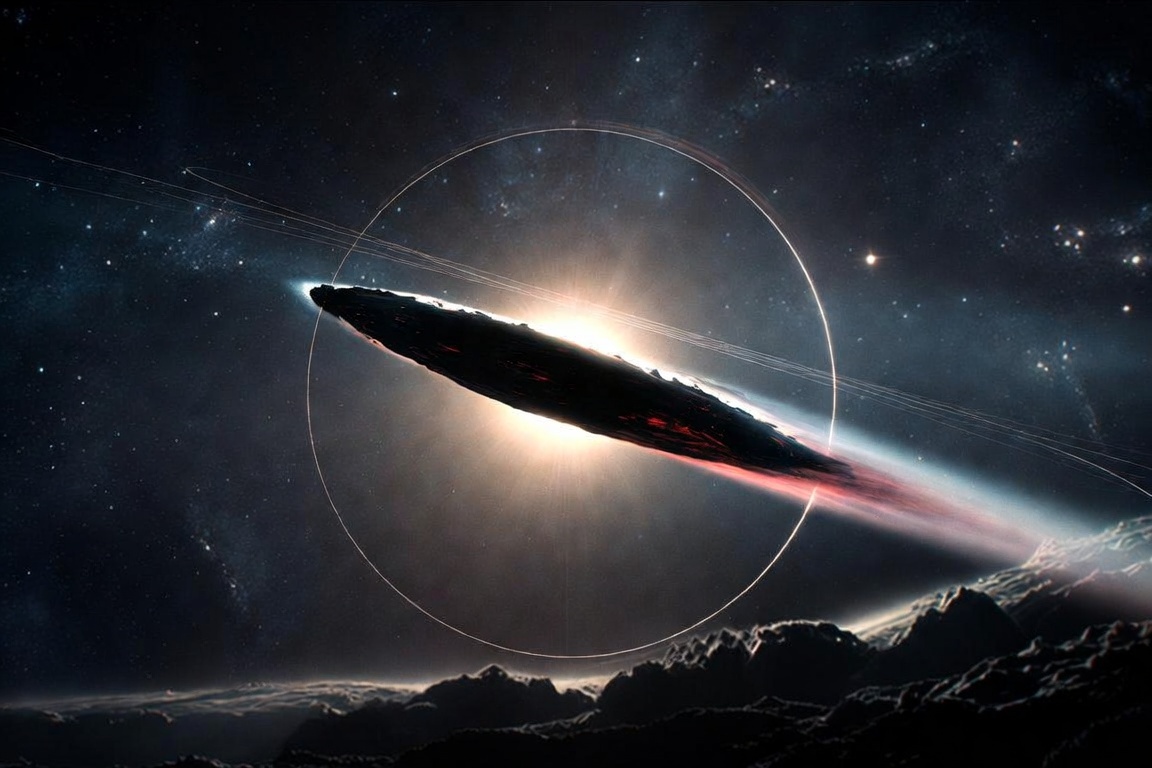
The most famous possibility was also the most speculative. An advanced civilization could theoretically build large structures around a star to capture energy—a concept often associated with Dyson spheres or Dyson swarms.
If enough artificial material crossed our line of sight, it could block starlight in massive, irregular chunks. Tabby’s Star became a natural target for public imagination because the dimming looked so incredibly unusual.
SETI (Search for Extraterrestrial Intelligence) researchers took the possibility seriously enough to point telescopes at the star and search for radio signals. That is exactly how science should work: a hypothesis can be tested even when it sounds extraordinary.
However, testing is not confirmation. No evidence has established an alien megastructure around Tabby’s Star. The idea remains a memorable speculation, not the leading explanation.
NASA’s Jet Propulsion Laboratory eventually reported research showing that the long-term dimming appeared weaker at infrared wavelengths and stronger at ultraviolet wavelengths.
That pattern acts like a cosmic fingerprint.
A solid, opaque artificial structure would block all wavelengths of light evenly. Dust, however, interacts with light differently depending on the wavelength. Smaller particles absorb and scatter blue and ultraviolet light much more strongly than longer infrared wavelengths.
This observed color pattern perfectly supported dust. The star did not look like a light source hidden behind a giant solid wall; it looked more like a star filtered through an uneven, shifting veil of material. This finding pushed the interpretation away from alien engineering and strictly toward natural debris.
Dust provides a strong clue, but it does not automatically answer every question.
Researchers still debate where the dust came from, how it became distributed, why the dimming patterns evolved, and how different short-term and long-term changes relate to each other. Possible explanations include debris from disrupted bodies, fragments from colliding exomoons, and complex circumstellar material.
The star may not even have one simple mechanism behind every observed change. A dramatic hypothesis can fade while a more complicated natural explanation remains incomplete. The story becomes less sensational, but it becomes far more accurate.
To understand the current state of Tabby’s Star, we must separate verified data from the theories that surround it.
The Confirmed Facts
The Scientific Interpretations
The Unconfirmed & Debunked
Tabby’s Star could only become this kind of story in an era of massive datasets, citizen science, and multi-wavelength observation. The anomaly was not found by a lone telescope operator staring through glass; it emerged from complex patterns recorded across time.
That makes the star feel modern in the best way possible. The mystery comes from data, and the correction also comes from data.
Science does not remove wonder by rejecting the loudest, most sensational explanation. It finds a stranger, more credible version hiding just underneath the surface. The star still sits in the dark, surrounded by an irregular veil of shattered debris, refusing to behave normally. That is enough to keep us watching.