11
11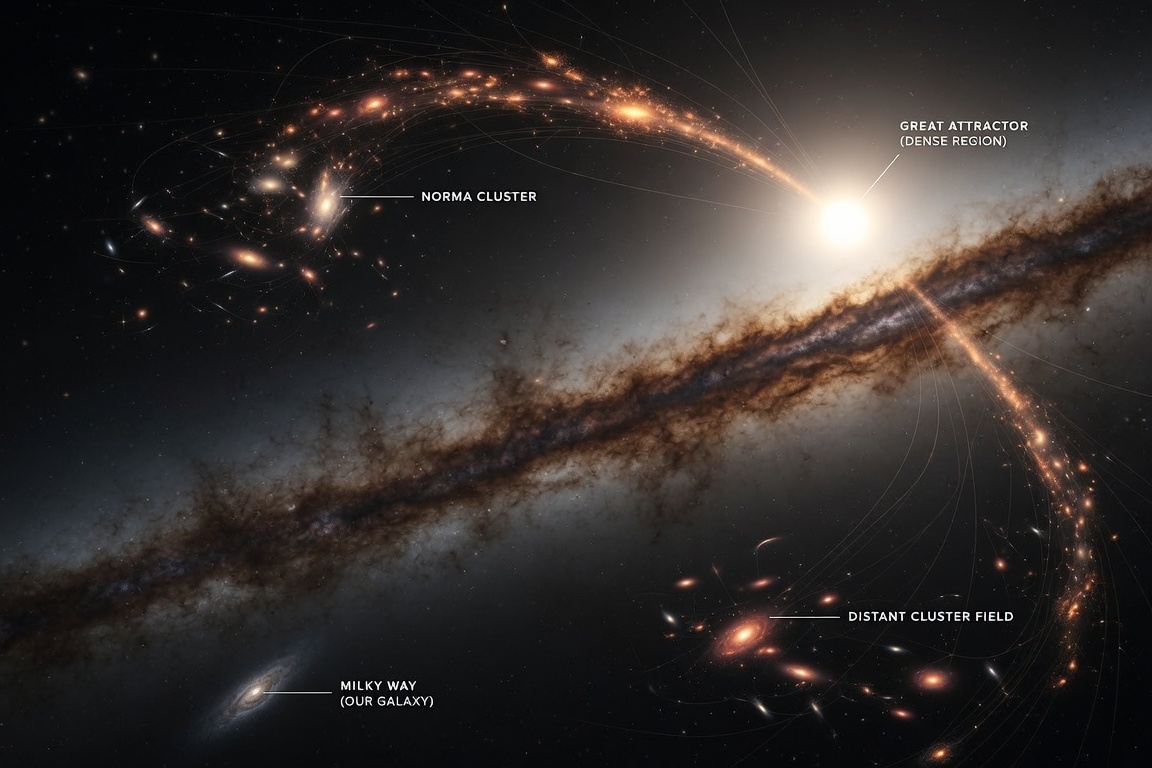
The Milky Way is not sitting still. Our local region of the universe moves under the influence of enormous concentrations of mass.
The subject feels almost fictional because it sits directly between familiarity and disruption. Viewers recognize part of the shape, story, or setting. Then one detail breaks the pattern completely.
That detail is not invented.
NASA explains that the Norma Cluster lies about 220 million light-years away and helps define the region known as the Great Attractor.
The crowded plane of the Milky Way blocks part of the view, creating a Zone of Avoidance where dust and stars make distant galaxies harder to observe.
The surviving evidence is incomplete, but it is not vague. Researchers can measure, compare, observe, scan, sample, or document specific details. The strongest version of the story begins with those details rather than the loudest internet interpretation.
This matters because strange subjects attract exaggeration quickly:
The evidence deserves a cleaner frame.
The strongest image is cosmic motion rather than a single monster object. Galaxies stream through large-scale structure while part of the destination remains hidden behind the Milky Way.
That visual feature is the first hook, but it is not the entire story. Anatomy, environment, history, and scientific context explain why the feature exists and why researchers still care.
A credible reconstruction should make the viewer curious before making any claim.
Clusters and superclusters shape motion across vast distances. Gravity does not need one mysterious object. Distributed mass across large structures can create the pull.
Without context, the subject becomes a random oddity. With context, it becomes a window into a larger system: evolution, extinction, deep-ocean adaptation, archaeology, geology, or cosmic structure.
That wider frame is what gives the article weight.
The Great Attractor is sometimes framed as a black hole swallowing galaxies. That is misleading. The region involves large-scale concentrations of matter, including galaxy clusters.
The mistake is understandable. Humans interpret unfamiliar evidence using familiar categories. A strange silhouette becomes a monster. A geometric surface becomes a machine. A rare sighting becomes proof of survival. A data anomaly becomes proof of intelligence.
Good science storytelling does not mock that reaction. It corrects it.
These points create the stable foundation. They are the facts strong enough to anchor the headline, thumbnail, Reel, and caption without inflation. The article becomes more compelling when the uncertainty is placed around the facts rather than mixed into them.
These questions remain open because the evidence has limits. Fossils preserve fragments. Deep water hides behavior. Rare animals are difficult to count. Ancient records disappear. Natural systems leave incomplete traces.
An unresolved detail is not a failure. It is the edge of the current evidence.
Astronomers understand the broad gravitational landscape while continuing to refine the map.
This is where the topic stays alive. A complete answer would close the file. A specific unanswered question invites better surveys, deeper dives, improved scans, genetic work, field research, or more careful analysis.
The mystery remains credible because it is defined.
The Reel should shift from one-galaxy thinking to cosmic-web scale. The reveal is that the pull comes from structure, not a single object.
The thumbnail should create one clear question. The Reel should reveal the evidence step by step. The article should reward the click with a factual explanation that remains cinematic. This sequence works because the real subject is already strong enough.
The Great Attractor is not a supernatural force or one giant black hole.
This line should remain visible throughout the article. EdgeCase content works best when viewers feel the mystery but never lose track of which claims are confirmed. Speculation can be discussed, but it cannot be disguised as proof.
The Great Attractor makes the universe feel dynamic. Even our galaxy participates in motions shaped by structures too large to see in one frame.
The final image is simple: The Milky Way drifts with neighboring galaxies toward a region partly hidden behind its own band of stars.
The subject remains memorable because the real explanation does not shrink the mystery. It turns the mystery into evidence.
The story also reveals how easily important details can hide in plain sight. The subject may have existed for millions of years, remained unseen in deep water, survived inside a restricted habitat, or waited inside museum and scientific records for a clearer interpretation.
Better tools do not remove wonder. They sharpen it.
References: