 11
11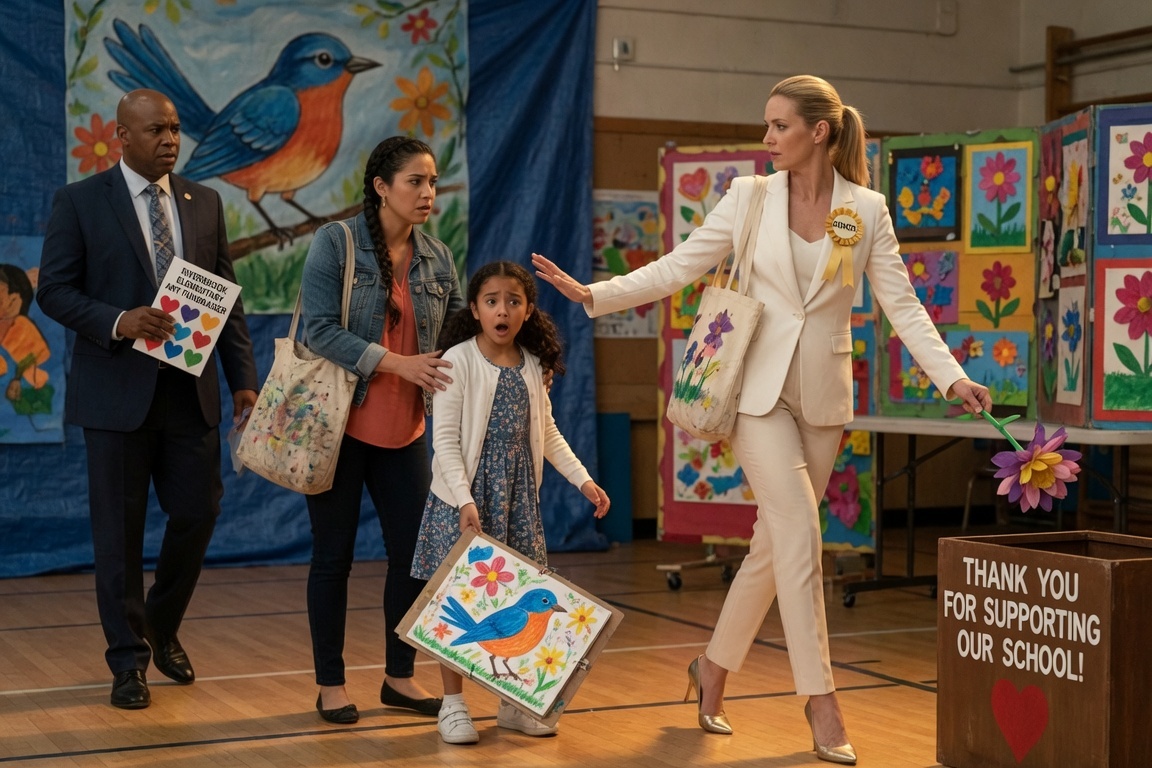
Sophie spent three nights making the paper flower. She cut each petal from old art paper, curled the edges around a pencil, and painted the center with gold watercolor left over from school. She wanted to give it to the art teacher at the fundraiser.
I asked whether she wanted me to buy a real bouquet. She shook her head. She said real flowers would fade, but hers could stay.
That was Sophie. She noticed things other people ignored and tried to make them last.
The school fundraiser was held in the gymnasium. Folding walls displayed student paintings, parents stood near donation tables, and gold ribbons marked the front-row seating area.
I had worked in the school cafeteria for four years, but that night I attended as a mother. I wore my clean denim jacket. Sophie wore her blue dress. We arrived early because she had been told the event would include a surprise connected to the art club.
At the entrance, Vanessa Pike was organizing donors. Vanessa had never been directly cruel to me before. She was usually polite in the careful way people are polite when they want everyone to notice it.
She looked at my worn canvas tote. Then she looked at the handmade flower. She asked whether we were delivering student materials.
I explained that Sophie was part of the art club and had been invited. Vanessa glanced at the gold ribbon section. She said those seats were reserved for families who had made significant contributions.
I told her we were not asking for special seats. Sophie only wanted to give the flower to her teacher.
Vanessa took it from her hand. For one second, I thought she was going to admire it.
Instead, she dropped it into the donation bin with leftover paper decorations.
Sophie reached after it. Vanessa blocked her with one arm and used her hip to push my tote away from the table. The bag fell against a chair. She pointed toward the back bleachers.
My daughter did not cry immediately. Her face simply changed. Children sometimes absorb humiliation in silence because they are still trying to understand whether an adult is allowed to treat them that way.
I stepped between them. I told Vanessa not to touch my daughter or her belongings again.
People nearby turned. Vanessa smiled as if I were creating a scene. That smile made my hands shake.
Sophie bent to pick up her sketch folder, but it slipped open. A page covered in bright paint landed on the gym floor.
The drawing showed a large bird made from many smaller handprints. Sophie had designed it months earlier after the art teacher asked students what community meant. She said a community was one shape built from many hands. The school never told us what happened to the drawing.
Principal Carter approached holding the event program. He saw the page on the floor. Then he looked toward the stage.
A large canvas cover hung behind the podium. One corner had come loose, revealing a bright painted wing. The colors matched Sophie’s drawing.
Principal Carter stopped. Vanessa continued explaining that the front area needed to remain orderly. He walked past her. He reached into the donation bin and carefully lifted out the paper flower. One petal had bent. He straightened it with his thumb and returned it to Sophie.
Then he asked us to follow him.
Vanessa tried to step between us and the gold ribbon area. Principal Carter moved the rope aside himself. We walked toward the stage. Sophie held the flower against her chest. Her eyes remained fixed on the covered canvas.
The principal took the microphone, but he did not begin with the donor list.
He explained that students from every grade had spent six weeks painting a new mural for the main hallway. The design had been chosen anonymously. Teachers selected it because it represented the school as many different hands creating one shared future.
Then the cover fell.
The mural stretched across the entire stage. At the center was Sophie’s bird. Hundreds of student handprints formed the wings. Bright blues, reds, yellows, and greens overlapped without losing their individual shapes.
My daughter looked at me as if she needed permission to believe what she was seeing. I knelt beside her. Her folder contained the first version. The wall behind us contained what her idea had become after other children added their hands.
Principal Carter invited Sophie onto the stage. She hesitated. Then she carried the paper flower with her.
Vanessa stood beside the donor table holding the gold ribbon she had intended to place around a large contribution box. The principal took the ribbon and wrapped it around Sophie’s sketch folder instead.
The gym applauded. Sophie did not look toward Vanessa. She looked at the mural. That mattered.
Children should not have to measure their joy by whether the adult who hurt them feels embarrassed enough.
After the presentation, the art teacher hugged Sophie and accepted the handmade flower. She placed it inside a small glass case near the mural so it would not be damaged. Sophie smiled for the first time that evening.
Vanessa approached me later. She said she had misunderstood why we were there.
I told her she had not misunderstood. She had decided our place before she knew our reason. There was a difference. She looked at the tote bag, the denim jacket, and the handmade gift. She assumed value had to arrive with expensive packaging.
I did not want an apology shaped only by public embarrassment. I asked her to apologize directly to Sophie.
Vanessa knelt. Her words were awkward, but she admitted that she had treated the flower as if it meant nothing. Sophie listened. Then she said the flower mattered because she made it for someone.
That answer was simpler and wiser than anything I could have said.
The next week, the mural was installed in the main hallway. Every morning, I passed it on the way to the cafeteria. Students pointed out their handprints. Teachers stopped with visitors. Parents took photographs.
Near the bottom corner, the school added a small card explaining the design. It named Sophie as the student artist. The paper flower stayed in its glass case beneath it. Months later, one gold petal still caught the hallway light.
Vanessa began volunteering with the art club. I watched carefully at first. Change should be measured by behavior, not a single apology. Over time, she learned to ask children about their work before deciding what it was worth.
Sophie kept drawing. She filled three more folders that year. Whenever she doubted herself, I reminded her of the night someone threw her flower into a bin and tried to send her to the back of the room. The truth did not make the humiliation disappear. But it placed the moment where it belonged.
Not at the center of her story. Only at the beginning of the part where her work became impossible to ignore.
At home, Sophie repaired the bent petal with a tiny strip of clear tape before giving the flower to her teacher. She did not try to hide the crease. She said it showed the flower had survived something. I thought about that sentence for weeks. Adults often rush to make painful moments disappear, especially when children are involved.
Sophie understood that repair does not erase the mark. It changes what the mark means.
The flower in the glass case still has that crease. Students who know the story point it out to one another. The mural gets most of the attention, but the small handmade flower carries a different lesson.
Art is not valuable because a crowd approves it. It becomes valuable the moment someone creates it with care and gives it a reason to exist.


