 11
11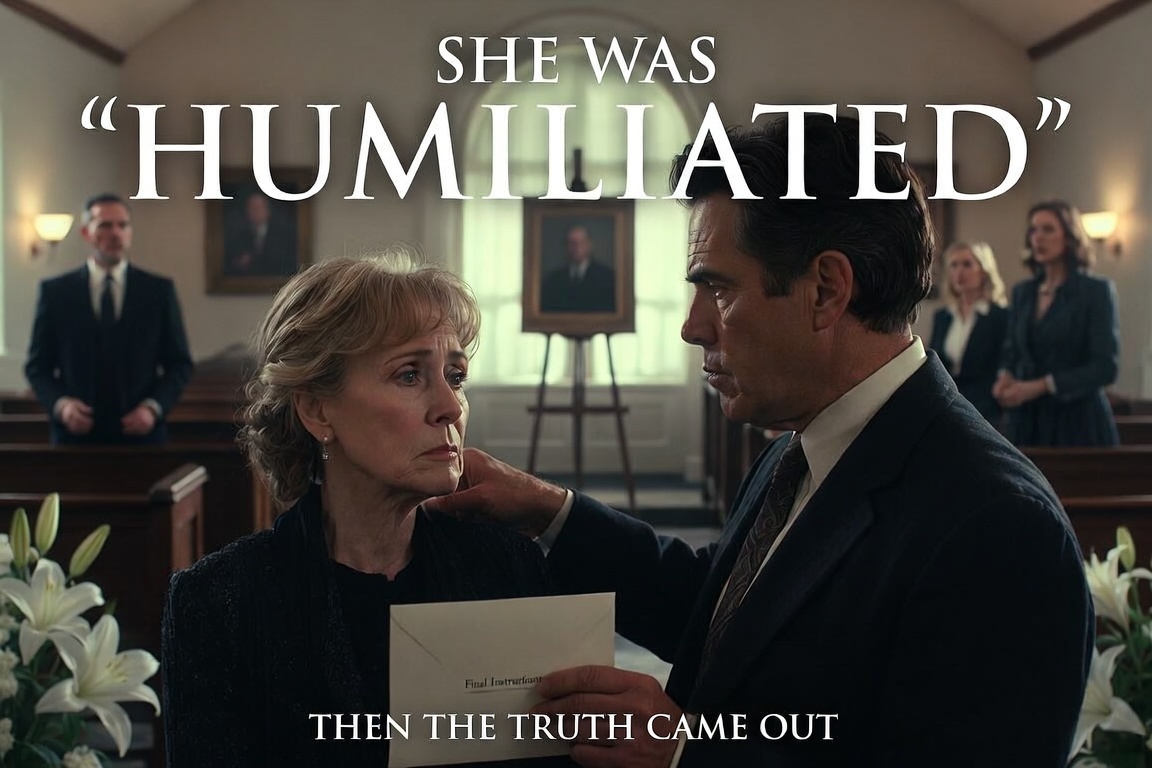
Nora did not arrive looking powerful. That was the first thing Patricia noticed, and it was exactly why the room became cruel so fast.
In a quiet funeral home memorial chapel with ivory walls, dark wood pews, white lilies, a framed portrait on an easel, and a closed casket near the front, status had a language of its own.
People noticed polished shoes, confident voices, expensive fabric, and the kind of posture that said a person belonged before anyone asked questions. Nora had none of that performance.
She carried herself quietly. She kept her hands close. She looked like someone who had already survived too many private disappointments and had no energy left for a public fight.
That made her an easy target.
The room was already heavy with somber, tense, humiliating, emotionally heavy atmosphere. The light was soft afternoon window light mixed with warm chapel lamps. The props around them made everything feel official and impossible to escape.
There was no back hallway to disappear into, no friendly face ready to defend her, and no one brave enough to interrupt the person with the loudest voice. Derek saw the first insult land and looked down, pretending to adjust something that did not need adjusting.
Patricia did not whisper. That was the point. Cruel people rarely choose privacy when they believe humiliation will give them control. Patricia wanted witnesses. She wanted Nora to feel smaller with every pair of eyes that turned toward her.
Then came the line, cold and sharp enough to cut through the whole room:
“Family sits in front. You can stand in the back.”
For one second, nobody moved. Nora blinked slowly, as if she could keep the tears back by refusing to let her face change. She did not answer right away. That silence made Patricia smile.
What made the insult worse was that Nora had earned the right to stand there more than anyone in the room knew.
She had shown up when no one was watching. She had answered calls. She had signed papers late at night. She had carried burdens that looked invisible because she never turned them into speeches.
Her sacrifice had never been dramatic. It was quiet, repetitive, and expensive in ways that never appear on social media.
Patricia understood only one kind of value: the kind that could be shown off. A nicer outfit. A louder title. A more impressive connection. Because Nora did not advertise herself, Patricia assumed there was nothing to respect. That assumption became the match that lit the whole scene.
Derek shifted uncomfortably. There was a moment when Derek almost spoke. The mouth opened, then closed. Fear won.
That is how public humiliation grows. Not because one person is cruel, but because everyone else decides silence is safer.
Nora looked at the floor, then at Patricia. “I am not here to take anything,” she said softly. “I only came because this mattered.”
Patricia laughed under the breath, the kind of laugh meant to tell everyone that kindness was weakness. “People always say that when they want something,” Patricia replied.
The situation should have ended there, but humiliation has momentum. Once Patricia saw that no one challenged the first insult, the next one came easier. The accusation became bigger. The tone became sharper. The performance became crueler. Patricia pointed toward Nora as if she were evidence of a problem instead of a person.
The room watched. The background details felt suddenly louder: the shine of the floor, the small movement of paper, the fixed brightness of the lights, the silent weight of a sealed envelope labeled Final Instructions not yet revealed.
Nora tried to breathe normally. Her fingers tightened. Her shoulders dipped.
Then Mr. Cole entered the center of the moment.
It was not dramatic at first. Mr. Cole did not shout. Mr. Cole did not threaten. That calm made the room even more tense. People who carry the truth do not always need volume. Sometimes they only need one document, one recording, one name, or one line that cannot be argued with.
Mr. Cole stepped forward, holding a sealed envelope labeled Final Instructions. The object looked small compared with the cruelty in the room, but everyone felt the shift. Patricia noticed it too. The smile weakened just a little.
“What is that?” Patricia asked.
Mr. Cole looked directly at Nora first, not at the person who had been loudest. That small choice changed everything. It told the room who actually mattered.
“He left this for Nora only,” Mr. Cole said.
The words landed cleanly. No one laughed now. Derek lifted the head. Nora looked almost afraid to hope. Patricia reached for control again, but the control was already slipping.
Then came the reveal: Mr. Cole opens the envelope and reads that Nora is the only person her father trusted with the house and foundation.
The room changed in one breath. People who had looked away now stared. People who had judged Nora by clothing, posture, silence, or age suddenly understood that they had been watching the wrong person.
Patricia tried to speak, but the words came out thin. “There must be some mistake.”
Mr. Cole did not blink. “There is no mistake.”
That was the moment the public performance collapsed. Patricia had built the whole scene on the belief that Nora was powerless.
But power had been sitting quietly in the room the entire time, folded inside a sealed envelope labeled Final Instructions, waiting for the right person to open it.
Nora did not smile in a cruel way. That would have made her like them. Instead, her face softened with the pain of someone who wished the truth had not required humiliation first.
She had never wanted a spectacle. She had wanted respect, or at least basic decency. Since they refused to give her that, the truth took it back for her.
Derek finally spoke. “I did not know.”
Nora turned toward Derek. “Most people do not,” she said. “That is why they should be careful before they judge.”
The sentence was not loud, but it hit harder than all of Patricia’s insults. It was not revenge. It was clarity.
Patricia lowered the hand that had been pointing moments earlier. The same hand now looked awkward, useless, and exposed. People had seen the gesture. They had heard the words. They had watched the humiliation. Now they were watching the consequence.
Mr. Cole placed a sealed envelope labeled Final Instructions where everyone could see it. The evidence did not need decoration. It was enough.
The aftermath came quickly. The authority in the room shifted away from Patricia and toward Nora. The people who had stayed silent became suddenly polite. The tone softened. The space opened.
The person once treated like an inconvenience was now treated like the person everyone should have respected from the start.
But Nora did not rush to accept their late kindness. That was the quietest consequence and maybe the sharpest one. She understood something they did not: apologies offered after exposure are not the same as respect.
Patricia tried one last time. “I was only trying to protect everyone.”
Nora looked at Patricia with steady eyes. “No,” she said. “You were trying to protect your control.”
The room went still again, but this time the silence belonged to Nora. No one interrupted it.
By the end, the truth was simple. The person they mocked was not weak. She was patient. The person they dismissed was not empty-handed. She had the proof. The person they tried to shame in public became the only one who walked out with dignity intact.
And Patricia was left standing in the same room, surrounded by the same people, finally feeling what public judgment was like from the other side.
The most painful part was not only that Patricia had been wrong. It was that Patricia had been so confident while being wrong.
The room had accepted that confidence as truth because people often mistake cruelty for authority. They hear a sharp voice and assume it knows something. They see a polished outfit and assume it belongs above someone softer. That was the mistake everyone made with Nora.
Nora had spent years learning that real loyalty does not always look impressive.
When Mr. Cole revealed a sealed envelope labeled Final Instructions, the room was forced to understand that silence had never meant weakness. It had meant restraint.
That was why Patricia’s face changed so completely. The person who had controlled the room with judgment had no control over the evidence. No smile could soften it. No excuse could erase it. No new version of the story could survive what everyone had just seen and heard.
Nora walked away slowly, leaving the room to sit with its own shame. She did not need to punish anyone. The truth had already done that.


