 11
11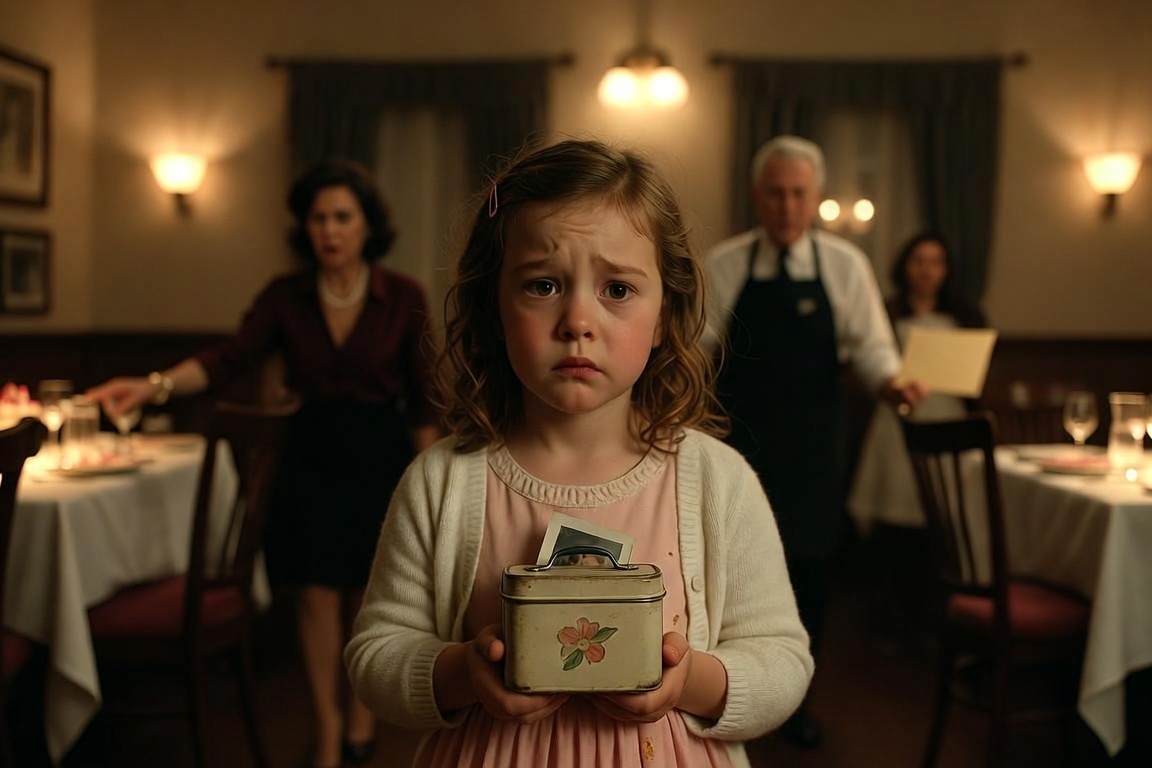
Lily Carter did not look like she belonged in the restaurant that night.
The dining room was polished, quiet, and expensive in the way old family places often are. The kind of place where every fork was straight, every glass caught the warm gold light, and every wall carried framed photographs of people who seemed important enough to be remembered. The tables were covered in white cloth. The silverware had been placed with care. Near the largest table, a small cake sat beside a sealed cream envelope, waiting for the evening announcement.
Lily stood beside an empty chair and held her lunchbox with both hands.
She was only eight years old. Her pale pink dress had a tiny stain near the hem. Her white cardigan was clean but old, and her black Mary Jane shoes had little creases across the toes. Her light brown curls were held back with a small pink hair clip that looked like it had been chosen with love, even if it was no longer new.
Across from her, Marla Whitmore smiled without warmth.
“This table is for family, sweetheart,” Marla said.
The sentence was soft enough that it sounded polite to anyone far away. But Lily heard what was underneath it. So did Grace, the waitress standing near the water glasses with an order pad pressed against her apron.
Lily looked at the empty chair. Then she looked at Marla’s hand resting on the chair back like a locked gate.
“I was told to come here,” Lily whispered.
Marla tilted her head. Her pearl necklace caught the light. “A lot of people are told a lot of things.”
Lily swallowed. The lunchbox handle squeaked faintly under her fingers. Inside it was the only thing she had brought because it was the only thing she believed would explain why she had come. A faded photograph. A little girl sitting on the lap of an elderly woman in front of the same restaurant. On the back, in soft blue ink, someone had written, “Lily, this place will know you.”
But places did not know people. People did. And nobody at the table was looking at Lily like she was known.
Marla glanced toward the cake, then toward the sealed envelope beside it. Her expression tightened for half a second. It was so fast that Lily almost missed it.
Grace did not.
“Ma’am,” Grace said carefully, “there is an open seat.”
Marla’s eyes moved to Grace. “Thank you. I can see that.”
The dining room felt colder, even with all the warm lights. Lily’s cheeks flushed. She tried to stand taller, but her shoulders curled inward anyway. Children learn quickly when adults are embarrassed by them. They learn where to put their hands, how small to make their voice, how to blink tears away before anyone sees.
“I can wait outside,” Lily said.
That was the moment Grace’s face changed. Not dramatically. Not loudly. Just enough. Her mouth parted like she wanted to say something and knew the room might punish her for it.
Marla smiled again. “That would be best.”
Lily nodded because she was a polite child. Because she had been raised to say thank you even when something hurt. Because she had been taught not to make a scene.
She turned slightly, and the lunchbox slipped open.
For one small second, the faded photograph inside caught the light.
Grace saw it first.
Then Marla saw it.
The color drained from Marla’s fake smile. She reached down and shut the lunchbox lid with one sharp finger.
Lily flinched.
The room went quiet in the way rooms do when everyone has just seen something they are not supposed to understand yet.
Grace stared at Marla’s hand. “Why did you do that?”
Marla’s voice lowered. “Stay out of family matters.”
Lily hugged the lunchbox tighter. “That picture is mine.”
“I’m sure it is,” Marla said, but now her words were too quick. Too polished. Too nervous.
At the far end of the dining room, an older man stepped out from a hallway near the kitchen. Mr. Carter moved slowly, but the room shifted around him. He wore a navy suit and reading glasses, and his silver hair was combed neatly back. The staff noticed him first. Grace straightened. Marla turned and arranged her face into something respectful.
“Mr. Carter,” Marla said, almost brightly. “We were just getting settled.”
Mr. Carter did not answer her. His eyes were on Lily.
Lily stared back, unsure whether she was about to be sent away by someone even more important.
He walked to the cake table and picked up the sealed cream envelope. The handwriting on the front was delicate and old-fashioned. Marla’s smile faded again.
“This dinner,” Mr. Carter said, “was never about status.”
The words landed heavily.
Marla’s fingers slipped from the chair.
Mr. Carter opened the envelope with steady hands. Inside was a folded note and an old photograph clipped to a signed restaurant record. He unfolded the note first. For a moment, his face softened with sadness, as if the paper had brought back a voice he missed.
Grace moved closer to Lily. She did not grab her or overwhelm her. She simply stood near enough that Lily did not feel completely alone.
Mr. Carter looked around the table.
“Years ago, my wife built this restaurant with more heart than money,” he said. “She believed a table meant nothing if it only welcomed people who looked impressive.”
Marla looked down.
Lily barely breathed.
Mr. Carter lifted the photograph from the envelope. It showed the same elderly woman from Lily’s lunchbox, standing in front of the restaurant, holding the hand of a much younger child.
Then Mr. Carter looked at Lily’s lunchbox.
“May I see it?” he asked gently.
Lily hesitated. Adults had taken things from her before. Adults had decided what she needed, where she belonged, what she was allowed to keep. But his voice was different. It did not pull. It waited.
She opened the lunchbox and handed him the faded photo.
Mr. Carter placed both pictures side by side.
They matched.
The same woman. The same restaurant. The same eyes looking at Lily with love.
A quiet sound moved through the room, not a gasp exactly, but the kind of silence that happens when everyone suddenly understands they have been watching the wrong person.
Mr. Carter turned the photograph over. His hand trembled slightly when he read the writing.
“Lily, this place will know you,” he said.
Lily’s eyes filled.
Marla whispered, “I didn’t know she would actually come.”
That sentence told the room enough.
Mr. Carter looked at her, not with anger, but with disappointment so deep it was worse than shouting. “You knew there was a child invited tonight.”
Marla’s lips parted, but nothing useful came out. Her confidence had nowhere to stand anymore.
Mr. Carter looked back at Lily. “Your grandmother left this note with me before she passed. She said that one day, if you ever walked into this restaurant unsure of your place, I was to remind everyone exactly where you belonged.”
Lily clutched the lunchbox to her chest. “She said I could come here?”
“She said,” Mr. Carter replied, his voice breaking slightly, “that this chair was yours.”
He reached for the chair Marla had blocked. Slowly, gently, he pulled it out.
Nobody moved.
The chair made a soft sound against the floor. It was a small sound, but somehow it felt louder than anything Marla had said.
Lily looked at the chair, then at Marla, then at Grace.
Grace smiled with wet eyes and gave a tiny nod.
So Lily sat.
Not proudly. Not dramatically. She sat like a child who had been holding her breath for too long and had finally been told she could breathe.
Mr. Carter placed the final note beside her plate. Then he rested one hand over his heart.
“Your grandmother wanted this family to remember something,” he said. “A name on a wall means nothing if there is no kindness left at the table.”
Marla stood frozen. Her face was pale now, her pearls no longer looking elegant, only heavy. For the first time that evening, she looked small.
Lily did not smile at Marla’s silence. She did not enjoy it. She was too young for revenge, and too kind to want it. Instead, she looked at the cake.
“Was this for her?” Lily asked.
Mr. Carter smiled sadly. “It was for you. She asked us to celebrate the day you came home.”
The room softened. Even the gold light seemed warmer.
Grace brought Lily a glass of water and placed it carefully beside the note. “Welcome to your table, Lily,” she said.
Lily touched the edge of the paper with one finger.
For the first time that night, she looked up instead of down.
Marla’s eyes finally met hers. There was regret there, but no words strong enough to repair what had happened in front of everyone. Lily did not need a performance. She did not need an apology made for the room. She needed the truth to stay standing after the embarrassment faded.
Mr. Carter stepped behind Lily’s chair like a quiet shield.
Around them, the old photographs on the wall seemed different now. Not colder. Not distant. They no longer looked like people judging who belonged. They looked like witnesses.
Lily opened her lunchbox one more time and placed her photograph beside the note.
Two pieces of proof. One tiny girl. One chair finally pulled out.
And in that elegant restaurant, where she had been told she was not family, Lily Carter became the only person everyone was afraid to look away from.


