 11
11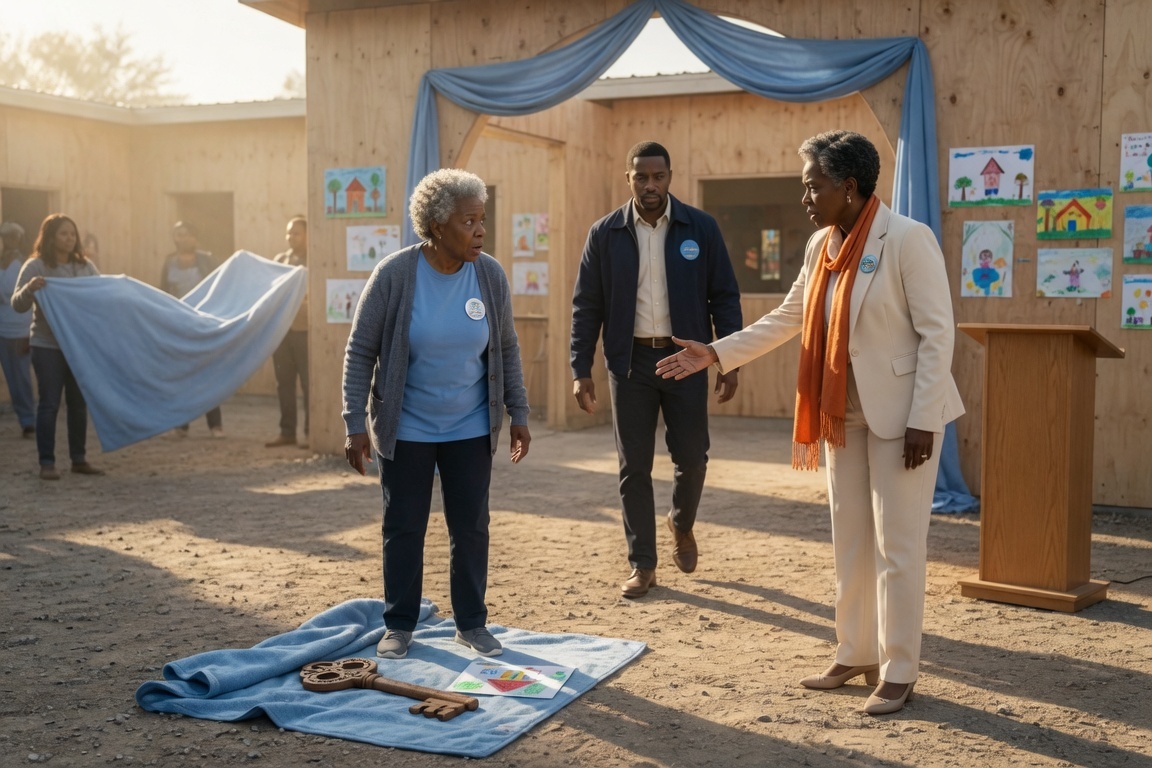
Before there was a shelter, there was Mary’s hallway.
That is how I remember it. Shoes lined against one wall. Wet coats over the radiator. A blue blanket folded at the end of every temporary bed.
I was nine years old the winter my mother and I slept there.
Mary Collins was a social worker, but that description never explained what she did after office hours. When emergency rooms were full and family shelters had waiting lists, she opened her own home for one night.
Then another.
She never called it a program. She called it making sure children had a door that locked.
Twenty-nine years later, I became director of the city’s first dedicated family shelter.
The opening courtyard was filled with donors, press, volunteers, and families who had already moved into the upper rooms. Mary arrived carrying one of the old blue blankets. Inside it was a wooden key I carved as a child.
The key did not open anything. I made it from scrap wood after Mary told me that one day I would have my own safe door. I drew her house beneath it.
Victoria Lane represented the shelter’s largest corporate donor. Her team had planned the opening photograph carefully: executives at the center, children near the ribbon, branded signs visible behind them.
Mary stood near the edge.
Victoria looked at the volunteer shirt and gray cardigan. She assumed Mary had been arranging rooms. “Staff photo later,” she said.
Mary tried to explain that I had asked her to stand beside me. Victoria gripped the cardigan and pushed her from the frame.
The blanket fell. The wooden key landed on top of the drawing.
I saw the house before I saw Mary’s face. The drawing still had a crooked orange roof and three blue windows. My mother had written the date in one corner.
I stepped between them. Behind the ribbon, families began lifting blue blankets.
Mary had chosen the color years ago because she said blue made unfamiliar rooms feel quieter. The new shelter used the same blankets in every family space. The gesture had been planned as a surprise for her.
Victoria’s shove forced it to happen earlier.
I placed the real shelter key around Mary’s neck. She cried before I did.
The ribbon was lowered instead of cut. Mary walked through the doors first. Families followed carrying blankets over their shoulders. The donors entered too.
Victoria remained outside for several seconds, looking at the drawing on the ground. Her company had paid for the roof, plumbing, beds, and security system. That support mattered. Mary had built the first version of the shelter without a budget, board, or logo.
Both truths belonged in the building.
After the opening, Victoria apologized privately and publicly. She asked whether her company should remove its branding.
Mary said no.
“Use the wall,” she told her. “Do not use the people.”
The donor logo stayed near the entrance. The history wall changed. It now begins with a photograph of Mary’s hallway. The volunteer ledger sits beneath it, listing dates, first names, meals, and blankets. Private details were removed. The record shows scale without turning families into exhibits.
The shelter also rewrote event rules. Donors no longer control who appears in community photographs. Residents choose whether to participate. Staff, volunteers, and people with lived experience review public messaging before launch.
Mary visits every Thursday. She does not run the center. She sits in the family kitchen, folds blue blankets, and listens.
The wooden key hangs near the main door. Children ask why a fake key is displayed beside the real one. I tell them the fake key came first. It represented safety before the city built enough rooms to provide it.
The shelter has forty-two beds, counseling offices, secure entrances, and trained staff. Mary’s hallway had three mattresses and a radiator. The building is better. It should be.
Progress is not insulting the smaller thing that came before. Progress is allowing care to become safer, larger, and less dependent on one exhausted woman opening her own door.
The opening photograph does not show a perfect ribbon line. It shows Mary walking forward while blue blankets rise behind her. The image looks almost like a wave. A wave made from every family that once needed one safe night.
Mary insisted that the shelter history wall include another image beside her hallway. It showed the first professional overnight team: two social workers, a security officer, a nurse, a housing adviser, and a child-care worker standing in the unfinished building.
“My house was not the goal,” she said. “The goal was a place that did not depend on one person’s exhaustion.”
That sentence became part of staff orientation.
Hero stories can inspire donations, but they can also hide dangerous gaps. Mary had opened her home because the system lacked beds. She had done something generous and unsustainable. The new center was designed so care would not require private sacrifice.
Staff worked shifts. Doors had security. Families had confidential rooms. Children could attend school without explaining their housing situation publicly.
Victoria’s company later funded an expansion, but the agreement changed. Donor representatives attended listening sessions before proposing signage or campaigns. Residents could reject photographs without affecting services.
Victoria once asked Mary how she could repair the personal harm.
“Do not make me your lesson. Change your reflex.”
The phrase was blunt. Victoria wrote it inside her event folder.
At the next opening, a volunteer wearing paint-stained clothes walked across the press area. Victoria began to raise her hand, then stopped and asked the person’s name. He was the electrician who had donated weekends to finish the family rooms. No dramatic reveal followed.
That was progress.
The shelter’s first annual report included donated money and donated labor in separate columns. That decision changed the numbers. The corporate contribution remained the largest cash gift. Mary’s years of unpaid emergency hosting represented thousands of hours that could not be priced cleanly without turning care into a transaction.
The report did not invent a dollar value. It documented the work.
Residents also reviewed the language used to describe them. Words like vulnerable and homeless were not banned, but they could no longer replace individual goals, skills, and choices. The shelter learned that dignity is affected by more than beds and locks.
It is affected by who controls the sentence.
Mary also asked the center to measure success beyond occupancy:
A full shelter can look productive while families remain trapped in the same cycle. The new dashboard follows exits, not only entrances. Care is not proven by how many people enter a building. It is proven by how many regain control over where they go next.
The blue blanket ritual changed too. Families are never asked to raise blankets for visitors or cameras. The opening moment remains in the archive, but the object returned to its ordinary purpose: warmth, privacy, and something familiar in an unfamiliar room.
Mary approved that decision.
Symbols become dangerous when institutions value the photograph more than the person using the object. A blanket is not powerful because it looks moving in the air. It is powerful because somebody is warmer beneath it at night.


