 11
11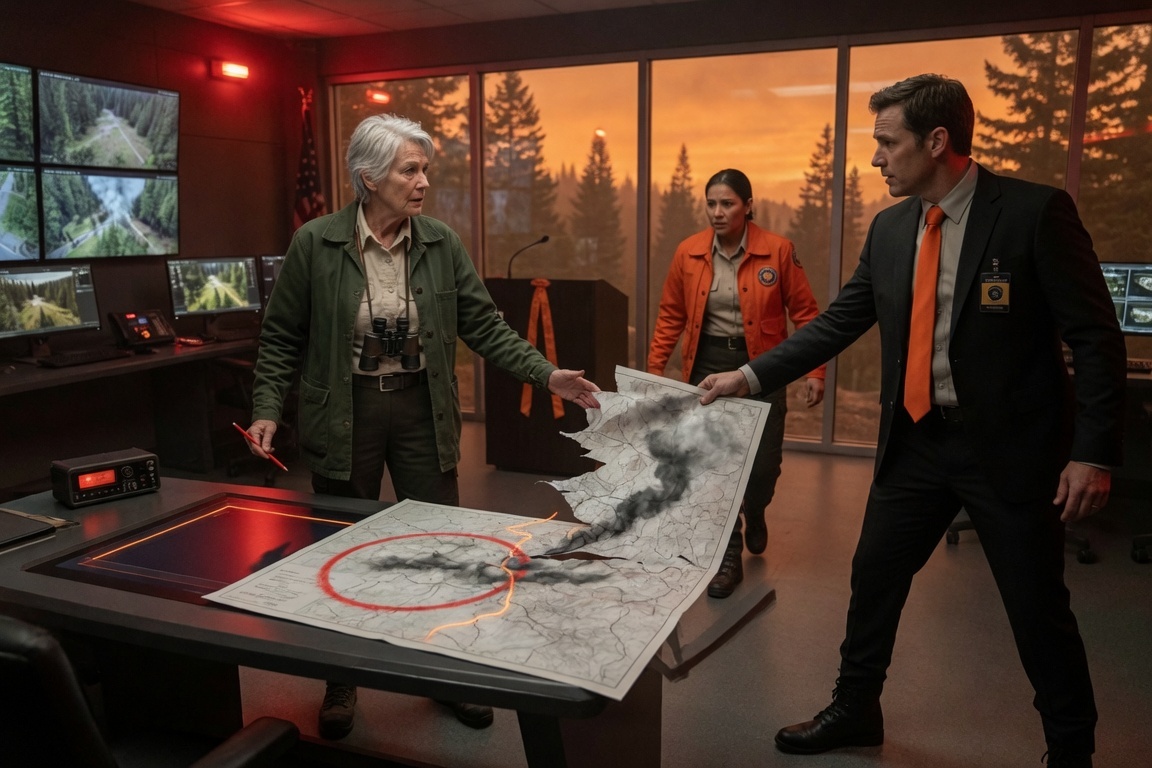
Six minutes before the resort sirens, Evelyn Hart drew a red circle around an empty valley. The drone map showed no fire there. Blake Mercer tore the paper.
Evelyn had already spent thirty-two years watching smoke from a tower above the ridge. Fire lookouts do not see flames first. They see color where the horizon should be clean. They see birds leaving a slope. They feel wind arriving from the wrong direction.
Evelyn retired when the region replaced several lookout posts with cameras and thermal drones. She supported the technology. She also warned that the western valley created a blind corridor during evening temperature inversions. Hot air could hold smoke below the ridge, hiding it from the opening scan.
The resort was built directly above that valley. Blake Mercer developed it as a premium wilderness destination. The launch emphasized panoramic glass, private trails, and technology-assisted safety. Evelyn was invited to the command lounge because Chief Nina Alvarez wanted her to review the drone route.
Blake believed the review had already happened. The ribbon ceremony was beginning. Cameras faced the terrace.
Evelyn looked through the glass and saw a faint gray layer beneath the sunset haze. She checked the old wind flags outside the former lookout tower. The upper wind moved east. The lower haze drifted north. That separation meant smoke could be trapped below the ridge.
Evelyn drew the valley on a paper map and asked for one drone to descend. Blake said the automated scan was clear. She pointed to the inversion line. He took the map, tore it across the red circle, and shoulder-shoved her from the control table.
One half of the map landed over the digital display. Nina saw the red curve align with a faint temperature edge the system had classified as terrain reflection. She rerouted two drones. Blake objected. Nina moved him away from the controls.
The first drone descended below the ridge. Smoke filled the camera. No visible flames. Enough heat to confirm a ground fire moving through dry brush. Nina activated the evacuation plan.
Evelyn redrew the wind corridor on the remaining half of the map. The safest route was not the main road shown in the resort brochure. That road crossed the drainage channel where smoke would collect. Guests were directed uphill to the service road.
Resort lighting turned red. Staff moved families from the glass lounge. The launch photographer continued filming until Nina told him to carry water and guide people toward the assembly point. The event became useful.
Fire crews received Evelyn’s corridor map and the drone feed together. The fire was contained before reaching the first guest building. Several trail structures burned. No guests or workers were injured.
The investigation found that the drone system had performed according to its route. The route had been designed around the most likely wind direction, not the evening inversion Evelyn had documented for years.
Technology had not failed. Planning had been incomplete.
Blake faced consequences for using force and for interfering with a safety review. The resort board removed him from emergency operations. He later apologized to Evelyn without saying the system made him confident. Confidence was his responsibility.
The resort rebuilt its command process. Local lookouts, trail workers, drone operators, firefighters, and maintenance teams now review seasonal routes together. Paper maps remain beside the digital controls. The blind valley is scanned at two altitudes every evening.
Evelyn did not return to the tower full-time. She trains new staff twice each season. Her first lesson begins outside. No screens. She asks them to watch the valley for ten minutes. Most become restless. Then the light changes. A shadow appears. Wind moves through grass in opposite directions.
The landscape begins giving information before an alarm translates it.
The two torn halves of Evelyn’s map were mounted beside the drone display. The red circle is incomplete. The digital route passes through it. Visitors see paper and technology occupying the same frame. Neither is called the hero.
The lesson is written through their alignment:
Look again when the land disagrees with the screen.
Investigators walked the blind valley at sunrise. From the resort terrace, the route looked open and harmless. Below the ridge, the air behaved differently. Cold air settled under warmer layers, holding smoke low against the trees. The drone’s original flight height passed above the worst visibility.
Evelyn had documented the inversion in notebooks going back twenty years. Those notebooks were never included in the developer’s environmental file because they belonged to a retired lookout rather than a current agency database. The review team digitized them. More importantly, they invited Evelyn to explain how each note had been made.
Without that context, the notebooks would have become another archive nobody knew how to read.
The resort added two permanent lookout positions during fire season. One uses cameras and thermal sensors. The other uses a person. The roles rotate, and both observers record disagreements. Evelyn insisted that the human lookout should not become a nostalgic figure sitting beside advanced equipment. The job includes drone training, digital mapping, and radio procedure. Local knowledge and technology meet inside one role.
Blake lost his executive position at the resort. During the board review, he admitted that the launch had become more important to him than the warning because investors were watching. That admission changed how the company evaluated emergency decisions. Safety delays no longer count against launch managers. If a ceremony stops for review, the delay is recorded separately from performance metrics. Nobody should fear losing a bonus because they paused an event during uncertain conditions.
The main lodge survived. Three small trail shelters did not. Their burned frames remain inside the closed valley as reminders that containment is not the same as absence of damage.
Evelyn walked the area with young lookout trainees after the first winter rain. Green shoots had already appeared near the blackened brush. She told them recovery could make people careless. A landscape looks healed from far away before roots, soil, and habitat return.
The resort’s marketing team wanted photographs of the new growth. This time, they asked the fire team first. Permission was delayed until the ground could handle visitors. No confrontation. No dramatic reveal. A message returned from the field: “Not yet.”
The company waited. That was the strongest evidence the culture had changed.
Evelyn also asked the resort to stop calling the fire unexpected. The ignition may have been unexpected. The blind corridor was not.
Language matters after emergencies. Calling every event “unprecedented” can protect decision-makers from examining warnings that existed before the crisis.
The final report lists the inversion notes, the missed review, the torn map, and the corrected route in sequence. Guests receive a shorter version during safety orientation. They learn where to assemble, which road may close, and why a clear sky above the lodge does not guarantee a clear valley below.
Preparedness became part of the experience rather than something hidden behind the luxury image.


