 11
11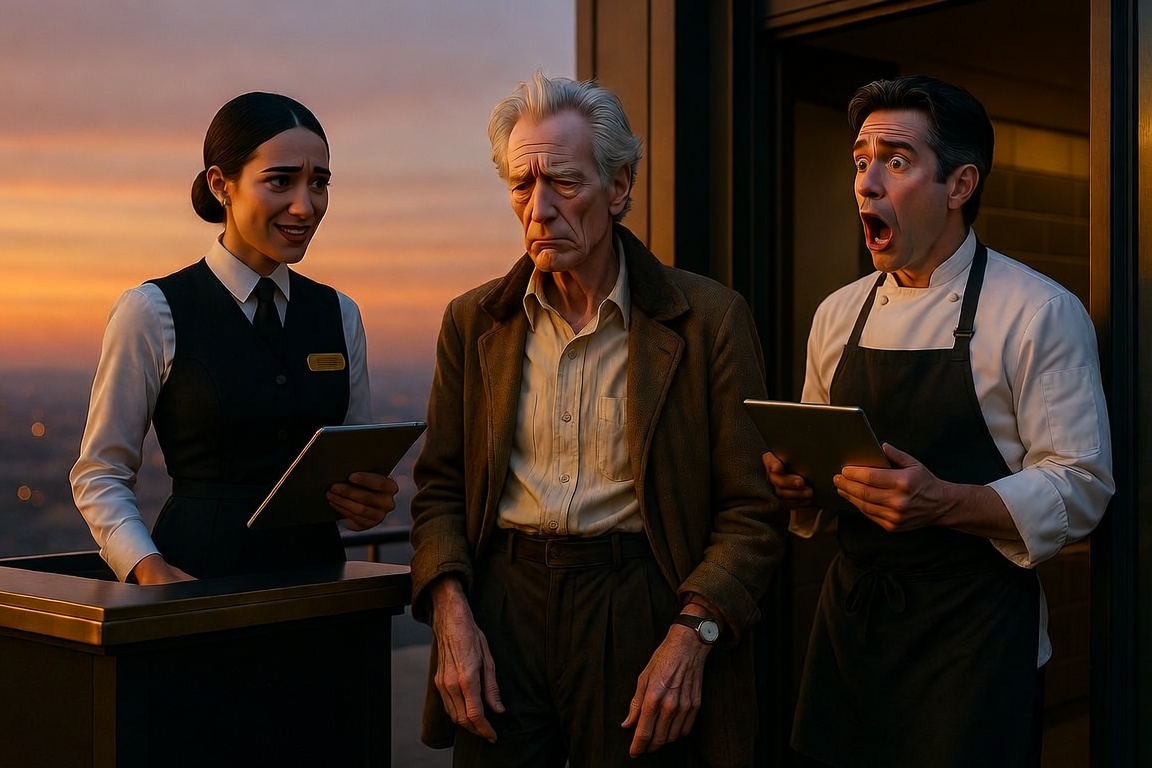
Everyone in the glossy rooftop restaurant host stand saw Arthur Finch get treated like she was invisible, but no one understood why she stayed so calm.
Arthur stood in a worn brown coat while Bianca looked him up and down and said the restaurant was fully booked. The insult was loud enough for strangers to hear, sharp enough to make the air feel smaller, and cruel enough to make every person nearby look away.
Arthur Finch did not yell. She did not beg. She simply held her breath, kept her shoulders straight, and waited for the one truth hostess Bianca Slate had worked so hard to bury.
Hostess Bianca Slate had always believed appearances were everything. Expensive clothing meant power. A loud voice meant control. A quiet person meant weakness.
That was why Bianca picked the worst possible moment to humiliate Arthur Finch. In front of clerks, customers, relatives, or coworkers, she wanted everyone to see one thing: Arthur Finch had no place here.
But Arthur Finch had learned a painful lesson long ago:
“People who brag the loudest are usually standing on something stolen.”
The argument started with something small. A seat, a signature, a bill, a set of keys, a sealed envelope. To everyone else, it looked ordinary. To Arthur Finch, it was the final piece of a story that had followed her for years.
She had walked into the glossy rooftop restaurant host stand with a simple plan: stay polite, ask one direct question, and give hostess Bianca Slate a chance to tell the truth.
Hostess Bianca Slate refused.
Instead, the room became a stage. Bianca raised a hand, pointed toward Arthur Finch, and said, “Someone like you should know when to leave.”
A few people gasped. Someone whispered, “That was too much.” Waiter Jamal stepped forward, ready to defend her, but Arthur Finch gently touched their sleeve and shook her head.
Not yet.
That silence made hostess Bianca Slate bolder. Cruel people often mistake restraint for fear.
Bianca leaned closer and smiled in a way that did not reach the eyes. “You came here hoping someone would feel sorry for you,” she said. “But pity is not proof.”
The words landed hard. Arthur Finch felt them, but she also saw the fear underneath them. The trembling fingers. The tight jaw. The eyes that kept glancing toward a framed founder photograph behind the host stand and the chef calling Arthur Dad.
Years earlier, Arthur had founded the restaurant with his late wife but stepped away after grief, letting investors run it while his son became executive chef.
That private pain had shaped everything. It taught Arthur Finch to listen carefully, save every document, and never confuse kindness with surrender. She had been called naive for giving people second chances. She had been called weak for refusing to make a scene.
But weakness was not what brought her here. Patience did.
The first crack came when waiter Jamal noticed the object. “Why is that here?” they asked quietly.
Hostess Bianca Slate snapped, “Do not touch that.”
Too late. The question had already changed the room. Heads turned. The security guard stopped near the doorway. A manager lowered their phone. A woman in the back covered her mouth as if she already understood.
Arthur Finch finally looked directly at hostess Bianca Slate and said, “You had every chance to say it yourself.”
Bianca laughed, but the laugh sounded thin.
Then Arthur Finch revealed the truth.
The framed founder photograph behind the host stand and the chef calling Arthur Dad proved what hostess Bianca Slate had been hiding. Not a rumor. Not a guess. Proof. Clean, simple, undeniable proof that changed the meaning of everything everyone had just witnessed.
The person they mocked was not begging for a favor. She was the person with the legal right, the hidden authority, the original ownership, or the final signature.
The shift in the room was instant.
The same people who had avoided her eyes now stared at hostess Bianca Slate. The same workers who had obeyed her moments earlier stepped back.
“She knew all along,” someone whispered.
Another person said, “That is why she stayed calm.”
Bianca tried to recover. “This is a misunderstanding,” she said, but even her voice had changed. The confidence was gone. The performance was over. All that remained was panic wearing expensive clothes.
Arthur Finch did not enjoy the humiliation. That was what made the moment sting harder. She did not clap back with cruelty. She did not scream.
She simply placed the proof where everyone could see it and said, “I did not come here to destroy you. I came here to stop you from doing this to anyone else.”
That sentence hit harder than any insult.
The consequence came fast. Bianca was removed from guest service and Arthur made Jamal the new floor lead.
The room watched as power moved from the person who abused it to the person who had earned it. No dramatic revenge. No wild punishment. Just accountability, delivered in public, because the lie had been public too.
Waiter Jamal finally stood beside Arthur Finch. “You should have told us,” they said softly.
Arthur Finch looked around the room, her eyes wet but steady. “I wanted the truth to speak before I did.”
For the first time, hostess Bianca Slate had nothing to say.
The final image stayed with everyone there: Arthur Finch walking out with her head high, not because she had won an argument, but because she had survived being underestimated.
Behind her, hostess Bianca Slate stood frozen in the same room where they had tried to make her feel small.
The twist was not that Arthur Finch had power.
The twist was that she had been powerful the whole time, and she waited until everyone could see it.


