 11
11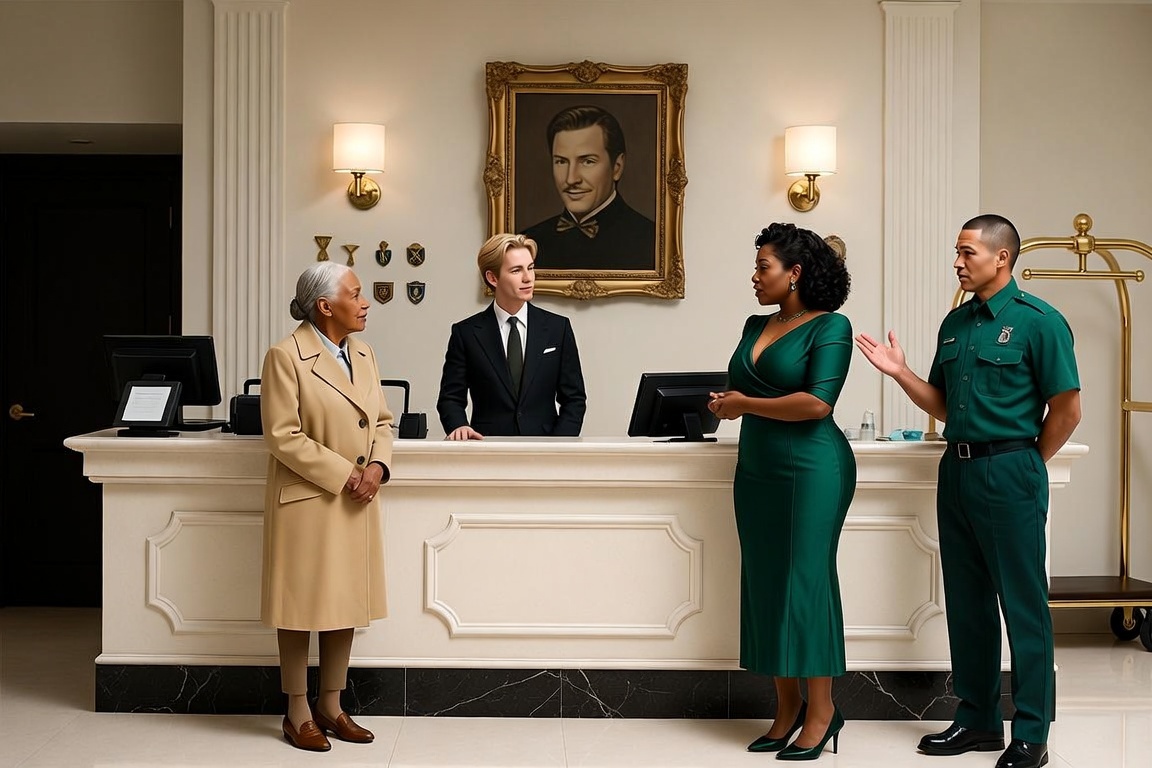
Evelyn Bell returned to the hotel through the same front door guests used. She could have called ahead. She could have asked Amira to meet her privately. She could have entered from the executive side where the portrait wall still held the younger version of her face, chin raised, silver braid not yet silver, eyes full of the impossible belief that hospitality could be both elegant and humane.
But she wanted the front door.
The lobby still had the cream marble she had chosen against advice. The chandelier had been replaced, but the light remained warm. Emerald chairs lined the windows, and the gold luggage cart near the entrance gleamed like a promise to weary travelers. Evelyn paused beside it with her small suitcase and smiled despite herself. The hotel had grown grander than the first building she and her late husband opened, but the bones were familiar.
Her shoes were old. Brown leather, softened by years, polished but visibly worn. She wore them on purpose. Not to test anyone cruelly, but to remind herself of where she began. Those shoes had walked construction dust before the first carpet was installed. They had stood behind a temporary desk when the hotel had three employees and more hope than reservations.
Kyle, the front desk clerk, saw the shoes before he saw her.
That was the first disappointment.
“Checking in?” Kyle asked, not rudely enough to be corrected from across the room, but not warmly enough to be hospitality.
“Yes,” Evelyn said. “Bell.”
He tapped the tablet, then frowned with theatrical patience. “First name?”
“Evelyn.”
His fingers stopped for a fraction of a second. The name was there. He saw it. But instead of looking at her differently, he looked at her coat, her small suitcase, and again, the shoes.
“Are you sure this is your hotel?” he asked.
The sentence was polished with a smile and sharpened underneath. It did not accuse. It suggested. It placed Evelyn outside the lobby before the system had the chance to welcome her.
The bellhop beside the luggage cart heard it. His shoulders tightened. He looked from Kyle to Evelyn, then down at the cart handle. He did not speak. Evelyn did not blame him entirely. Young staff learn the temperature of a desk quickly, and Kyle’s confidence had made the space around him cold.
Evelyn rested one hand on her suitcase. “I am sure.”
Kyle tapped again. “We have several properties with similar names. Sometimes guests confuse them.”
“I have not confused this one.”
He smiled wider. “Of course.”
But the word of course carried no belief.
Evelyn had built the hotel on a simple rule: greet the person before you judge the reservation. In the beginning, when they could not afford a full staff, she trained everyone herself. She taught bellhops to notice tired hands. She taught front desk clerks to keep their voices gentle when a guest was uncomfortable. She told managers that luxury was not chandeliers. Luxury was making a person feel safe before they knew whether they belonged.
Somewhere across the years, that lesson had been framed, printed, and softened into employee language. Welcome every guest with care. It looked good in training binders. But binders do not answer from behind a desk. People do.
Kyle asked for identification with a pause that suggested he expected a problem. Evelyn handed it over. His eyes moved from the card to the screen. He grew still again. The system knew her, of course. The founder suite had been prepared under her name. But pride has a habit of looking for exits when truth appears.
“I’ll need to confirm with management,” he said.
The bellhop finally looked up.
Evelyn nodded. “Please do.”
She did not argue. She had spent too many years in hospitality to mistake volume for authority. She wanted to see what the hotel did next when its own lesson stood in old shoes at the desk.
Amira came from the side office carrying a folder, mid-sentence to another staff member. She stopped when she saw Evelyn. The change in her face was immediate and honest. Not panic. Reverence.
“Mrs. Bell,” she said.
Kyle turned. “You know her?”
Amira did not answer him first. She crossed the lobby quickly, her emerald manager dress catching the light, and took both of Evelyn’s hands.
“Welcome home,” she said.
The bellhop straightened instantly. Another staff member near the concierge desk looked over, recognized the name, and stood taller. Respect moved through the lobby like a current. It was not dramatic. It was practiced by people who remembered the stories, who knew the portrait, who understood that the woman with the small suitcase had shaped the building they worked in.
Kyle stepped back from the tablet. His face had gone pale.
Amira looked at him, then at the old shoes, then at Evelyn’s quiet expression. She understood enough.
“Mrs. Bell founded this hotel,” Amira said, her voice calm but clear. “Her standards are the reason many of us work the way we do.”
Evelyn squeezed Amira’s hand. “Some standards need refreshing.”
The sentence landed at the front desk with more force than anger would have.
Amira personally escorted Evelyn to the founder suite, but Evelyn asked to walk slowly through the lobby first. She stopped near the emerald chairs and touched the back of one. She watched a family check in with two tired children. She saw the bellhop kneel to speak to the younger child at eye level, offering a small bottle of water. That was good. She saw Kyle staring at his screen, suddenly careful with every movement. That was not enough yet, but it was a beginning.
In the elevator, Amira apologized. “I am sorry you were spoken to that way.”
Evelyn looked at the mirrored wall, where age had drawn lines around her mouth and eyes.
“Do not apologize for what you did not do. Tell me what you will change.”
Amira nodded. That was why Evelyn respected her. She did not hide inside sympathy when action was needed.
They reviewed the training program that afternoon over tea. Not legal language. Not fear-based correction. A practical return to the first principle. Staff would spend one hour each month sharing real guest moments, not only complaints or praise, but moments when assumptions could have changed the service. Senior staff would train newer clerks on tone, not scripts. Every employee would read the founding story again, not as a company myth, but as a standard.
Kyle was called in near the end. He looked younger without confidence.
“I apologize, Mrs. Bell,” he said. “I judged before I welcomed.”
Evelyn appreciated that he did not say if. She had no patience for apologies built on escape doors.
“Good,” she said. “Now become the kind of person who notices that before a founder has to stand in front of you.”
The next morning, Evelyn sat in the lobby with coffee, not hidden upstairs. She watched the hotel wake. Suitcases rolled over marble. The chandelier brightened with the sun. A woman in travel clothes approached the desk, anxious because her reservation had the wrong date. Kyle served her. His voice was different. Not sugary. Not frightened. Careful in the best way.
“We will work through it,” he said. “You are in the right place.”
Evelyn looked down at her shoes and smiled.
Later, Amira asked whether she wanted them replaced. The hotel had a relationship with several luxury shops. Evelyn could have any pair delivered by lunch.
“No,” Evelyn said. “These still remember.”
That became the line staff repeated, though Evelyn never intended it to. The old shoes appeared in a framed photo near the training room, not as a joke, but as a reminder. The caption read: Hospitality begins before recognition.
Kyle stayed. Some expected him to be moved away from the desk, but Evelyn advised against making the lesson disappear too quickly. He had to practice where the mistake had happened. Under Amira’s guidance, he improved. Months later, a guest wrote a note praising him for helping her mother check in with unusual patience. Evelyn received a copy and kept it.
A hotel is never finished. It is remade at every front desk greeting, every hallway direction, every moment a staff member decides whether someone deserves warmth. Evelyn had built marble and chandeliers, yes. But what she returned to protect was simpler and more difficult.
A person walks in.
You see them first.
Before she went upstairs that night, Evelyn paused beside the portrait wall. The younger woman in the frame looked fearless, but Evelyn remembered how frightened she had been in those early years. She touched the frame lightly and thought about every person who had ever walked into the hotel hoping not to be judged before being welcomed.
By the time she reached the suite, Evelyn understood why she had needed to enter through the front door. A hotel cannot know itself from the private hallway. It learns itself at the desk, in the second between assumption and welcome, where a clerk chooses what kind of place the building becomes.


