 11
11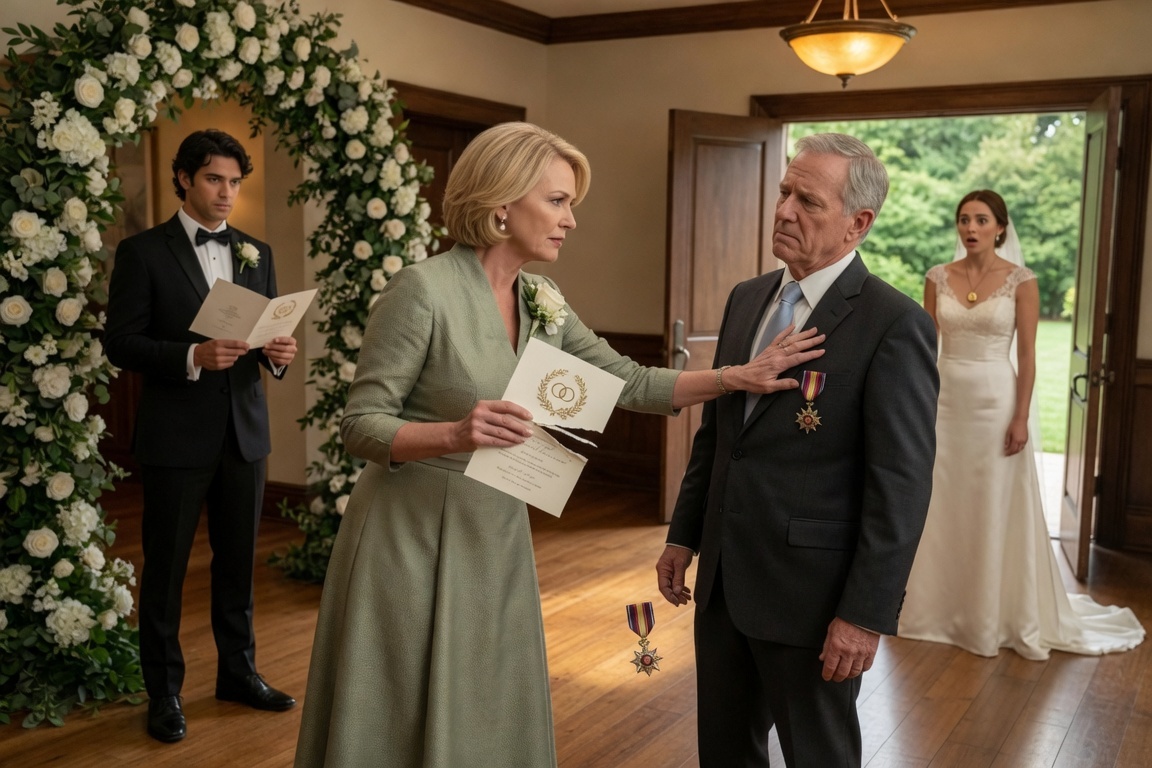
My daughter had asked me to arrive early.
Lily said she wanted one quiet moment before the ceremony, just the two of us near the old oak doors. I had practiced what I would say for weeks, though every version ended with me crying before I reached the second sentence.
I wore the charcoal suit I had bought for her college graduation. It was not fashionable, but it still fit. In my inner pocket, I carried a firefighter medal I rarely showed anyone. In my hand, I carried the ivory invitation with my name written in Lily’s careful handwriting.
The wedding venue was beautiful. White roses framed the entrance, and sunlight spilled through the open doors toward the ceremony lawn.
I had taken three steps inside when a woman in sage green blocked my path.
I recognized Celeste, the groom’s mother. We had met briefly at the rehearsal dinner. She had been polite then, though her smile never reached her eyes. That afternoon, she looked me over slowly.
My old suit. My brown shoes. My hands, still rough from years of repair work after I left the fire department.
She asked whether I was looking for the service entrance.
I told her I was Lily’s father.
Her expression tightened. Celeste said the front rows were reserved for immediate family and important guests. I held out my invitation. She took it before I could finish explaining.
Then she tore it.
The sound was small, but it cut through the entrance hall. She pressed the pieces against my chest and told me the wedding did not need an uncomfortable scene from someone who had barely contributed to the event.
I stepped backward when she pushed me. The guest book table shook. A vase of white roses tilted, and something fell from inside my jacket.
The firefighter medal hit the floor and spun near her shoe.
I stared at it. That medal belonged to a day I had spent years trying not to remember.
Thirty-one years earlier, an apartment fire had filled a narrow hallway with smoke. My crew could hear a child crying behind a locked bedroom door. We entered through a window because the hallway had become impossible.
I found a boy under a desk. He was five years old, wrapped in a blanket, too frightened to move. I carried him out against my chest while another firefighter guided us down the ladder.
The boy survived. His family moved away a year later. I never expected to see them again.
I kept the medal in a drawer because people called me a hero, but I remembered the neighbors we could not reach soon enough. Pride never came easily after that.
As Celeste stood over the torn invitation, footsteps approached from the ceremony hall. Evan, the groom, hurried toward us holding a printed wedding program.
He stopped when he saw me. Then he saw the medal.
He bent down and picked it up carefully. His fingers traced the small engraved number on the back. His face changed. I thought he was angry that I had caused a disturbance. Instead, he opened the wedding program and looked at the photograph printed inside.
Lily had asked me for an old picture months earlier. I assumed she wanted one from her childhood. I had sent her a box without checking what was inside.
The photograph in Evan’s hands showed me in firefighter gear carrying a small boy away from a smoke-darkened building.
The boy was Evan.
He looked from the picture to my face, then toward his mother. Celeste’s hand dropped from the floral rope.
Evan stepped between us. He did not raise his voice. He removed the rope and placed the medal back inside my jacket with both hands. His eyes were wet.
He told me he had spent his entire life knowing a stranger had carried him out of that apartment. His mother had kept the newspaper clipping but never remembered my name. Lily had discovered the connection while planning the wedding.
That was why my name appeared in the program as guest of honor.
Not because of money. Not because of status.
Because one moment from three decades earlier had made their wedding possible.
Lily appeared in the doorway wearing her gown. She saw the torn invitation on the floor, then looked at Celeste’s face. My daughter crossed the room without hesitation and took my arm.
She asked whether I was hurt. I told her I was fine. That was what fathers say on their daughters’ wedding days, even when their hearts are breaking.
Evan stood on my other side. He lowered his head and thanked me, not as a public performance, but as a man finally looking at the person connected to his oldest story.
Celeste tried to speak. Lily stopped her with one look. There would be time later for apologies. The ceremony was waiting.
Together, Lily and Evan walked me through the floral arch. Guests turned as we entered. Some recognized the photograph printed in the program. Others only saw the bride holding one arm and the groom holding the other.
For the first time that day, I did not feel like an unwanted guest. I felt like a father.
At the front of the ceremony lawn, Lily paused before taking her place. She reached inside her locket and showed me a tiny picture of herself as a child sitting on my shoulders. She said I had carried her through every hard year after her mother died.
Evan smiled and said I had carried him once too.
I nearly lost the words I had practiced. So I told them the only truth that mattered.
“A family is not measured by who paid for the flowers, who wore the finest clothes, or whose name looked impressive on a guest list.
A family is measured by who shows up when someone cannot make it out alone.”
The ceremony began.
From my seat, I could see the entrance hall through the open doors. The torn pieces of my invitation still rested near the guest book table. Celeste eventually bent down and picked them up. She pressed the two halves together in her hands, as if she finally understood that some damage cannot be hidden by pretending it never happened.
After the vows, she came to me privately. Her apology was quiet and imperfect. She admitted that she had spent years judging people by the circles they belonged to. She had seen my suit before she saw my face.
I did not forgive her instantly. Real dignity does not require instant comfort for the person who caused the harm.
But I listened. Then I returned to my daughter.
That evening, the photographer captured one final image beneath the floral arch. Lily stood in the middle. Evan held the old firefighter medal. I held the repaired invitation, taped carefully on the back.
The picture did not show the push or the humiliation. It showed what remained after the truth entered the room: A bride, a groom, and an old man who had spent his life carrying people farther than they knew.
During the reception, Evan asked me to place the medal beside the wedding cake for one photograph. I almost refused because I did not want the day to become about an old rescue.
Lily reminded me that the photograph represented two families meeting long before either of them understood why. We placed the medal between their joined hands, not on my jacket. That choice felt right.
Courage is rarely one person’s permanent possession. It passes forward. Someone carries a child through smoke, someone raises a daughter after loss, and two people later choose to carry each other. The wedding finally felt less like a performance of status and more like a promise made in full view of the truth.


