 11
11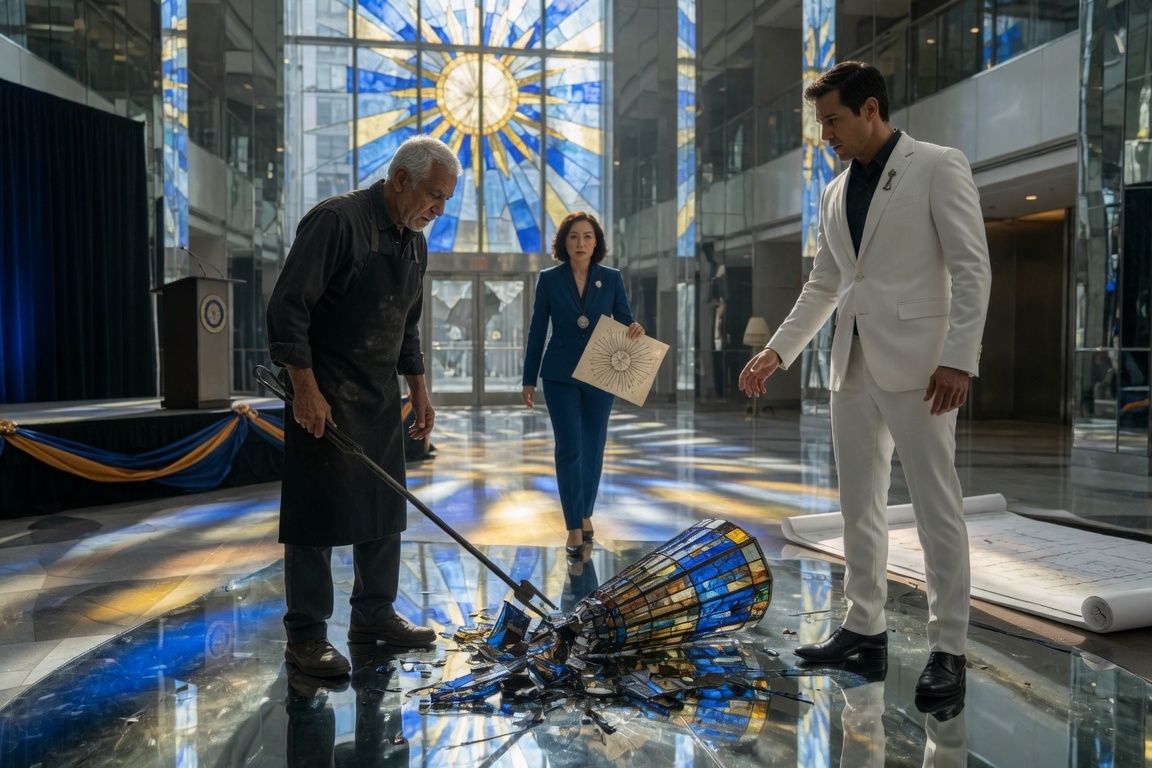
The tower changed color when my model broke.
Cobalt crossed the lower windows first. Amber followed. The pieces lay across the mirrored lobby floor, but sunlight passed through them as if the glass had been waiting for one final demonstration.
Julian Frost stared at the building. So did everyone else.
I had made the first model eleven years earlier. Not for a skyscraper, but for a small public library.
The library wanted a window that would cast different colors across the reading room as the sun moved. I built a tower of glass pieces, each angle tested by placing the model beside my workshop door at different hours. Julian visited while studying community architecture. He photographed the model. He asked questions about color density, shadow edges, and how curved glass changed light without creating heat.
I answered freely. Craftspeople often do. We are accustomed to people arriving with curiosity.
Years passed. Julian became famous for buildings that used light as an architectural material. The new tower was his largest project. Its facade carried the same cobalt-and-amber geometry I had tested in the library model.
My name appeared nowhere.
I was not angry at inspiration. Design grows through exchange. I was angry at disappearance.
The foundation jury chair, Dr. Grace Lee, visited my workshop after noticing an old photograph of Julian beside the glass model. She asked me to bring the original to the tower opening.
I wrapped it carefully. The base had already cracked once during transport years earlier. I repaired it with a visible black line.
Julian saw me before Grace arrived. His expression told me he understood exactly what I carried. He moved away from the press cameras and asked why I had brought an unfinished craft object into the lobby. I said Grace had invited me.
He reached for the model. I held the base. He pulled harder.
The model struck the table edge. Glass scattered.
The sound was sharp enough to stop the room. Nobody was cut. The pieces were thick and rounded from the shaping process. Then the sunlight reached them.
The lobby became the model. Blue and amber geometry climbed the mirrored wall and continued across the real tower outside.
Grace picked up the folded sketch from beneath the broken base. Every angle was there. Dates. Measurements. Sun positions. Notes about reducing heat near reading tables.
Julian said the tower design had evolved far beyond the model. That was true. Engineers solved structural problems I never considered. Architects adapted the pattern across hundreds of windows. The building was not mine.
The light concept was.
Grace removed the design award from the podium. She did not hand it to me as if one public gesture could settle authorship. She placed it beside my shaping tongs and announced that the award review would pause until credit and licensing were corrected.
The tower remained open. The celebration changed. Visitors watched the sun pattern move across the lobby floor. I explained how color thickens at the edge of curved glass. Children placed their hands inside the shapes.
Julian apologized three weeks later, after the foundation completed its review. The tower’s public materials were revised. My workshop received licensing payment and a permanent credit in the lobby.
More important, the architecture foundation created a source-history requirement. Designers submitting work had to document collaborations with craftspeople, local makers, technicians, and communities.
My broken model was repaired again. We did not hide the second fracture. Two dark lines now cross the base. One came from time. One came from fear. Above them, the colored tower remains standing.
Every afternoon, sunlight passes through it and paints the lobby. People often ask whether I regret bringing the model.
No.
Objects can break. Erasure is harder to repair.
The glass did what glass has always done. It made the invisible path of light visible.
The library model finally reached the building it had been made for.
After the tower review, the public library asked whether I would complete the original window installation. The budget that had disappeared years earlier was restored through the licensing settlement. I returned with two apprentices. We used some new glass and several fragments recovered from the broken tower model. The cobalt pieces now sit low enough for children to touch the colored light on the floor.
Julian asked to attend the installation. I agreed. He arrived without press.
We spent one afternoon adjusting a curved amber panel that kept throwing too much heat onto a reading table. He suggested a structural solution. I suggested changing the glass thickness. Both were needed.
Collaboration felt different when credit was no longer being negotiated in secret.
The library placed no giant plaque beside the window. A small panel lists the glass studio, architect, engineers, installers, apprentices, and community design group. Children ignore the panel. They chase the colors. That is fine.
Credit does not require every viewer to stop and admire the maker. It requires the record to remain honest for those who ask.
The skyscraper model stays in my workshop most days. I take it to schools when students study light. They always notice the fracture lines. I ask what they think the lines mean.
Some say weakness. Some say repair.
One student said, “It means someone tried to break the idea, but the light kept using it.”
That answer was better than anything written in the award report.
The foundation’s review uncovered three other projects using craft traditions without naming the makers. One involved woven shade screens adapted from a women’s cooperative. Another used a stone pattern developed by a family workshop. The projects were not cancelled. Their histories were corrected, contracts were renegotiated, and payment followed the credit.
Some architects complained that source documentation would limit creativity. Grace answered that creativity does not require amnesia.
The new standard asks a simple question before awards are considered: Whose hands, place, or knowledge made this design possible? The answer may be complicated. Complication is not the enemy of beauty. It is often where beauty came from.
My apprentices later became the first recipients of the foundation’s maker fellowship. They studied contracts alongside glass chemistry. I insisted on both.
Young craftspeople often learn how to produce beautiful work before learning how to protect authorship. The fellowship teaches documentation, licensing, negotiation, and when collaboration becomes extraction. I tell them the broken model is not proof that every partnership ends badly. It is proof that trust should leave a record.
Julian’s name remains on the tower. I requested that.
Erasing the architect would repeat the same mistake in reverse. The building came from many decisions, and authorship did not need to become a competition for a single center.
The corrected lobby panel shows a chain: community library study, glass workshop model, facade engineering, environmental testing, installation. Visitors can see where the idea changed hands and how each hand changed it.
Credit became a map rather than a crown.
The tower now receives visitors who begin at the source wall before entering the lobby. They see the library sketch, the workshop model, the engineering studies, and the final facade in sequence. The building no longer presents inspiration as magic. It presents design as movement between people.


