 11
11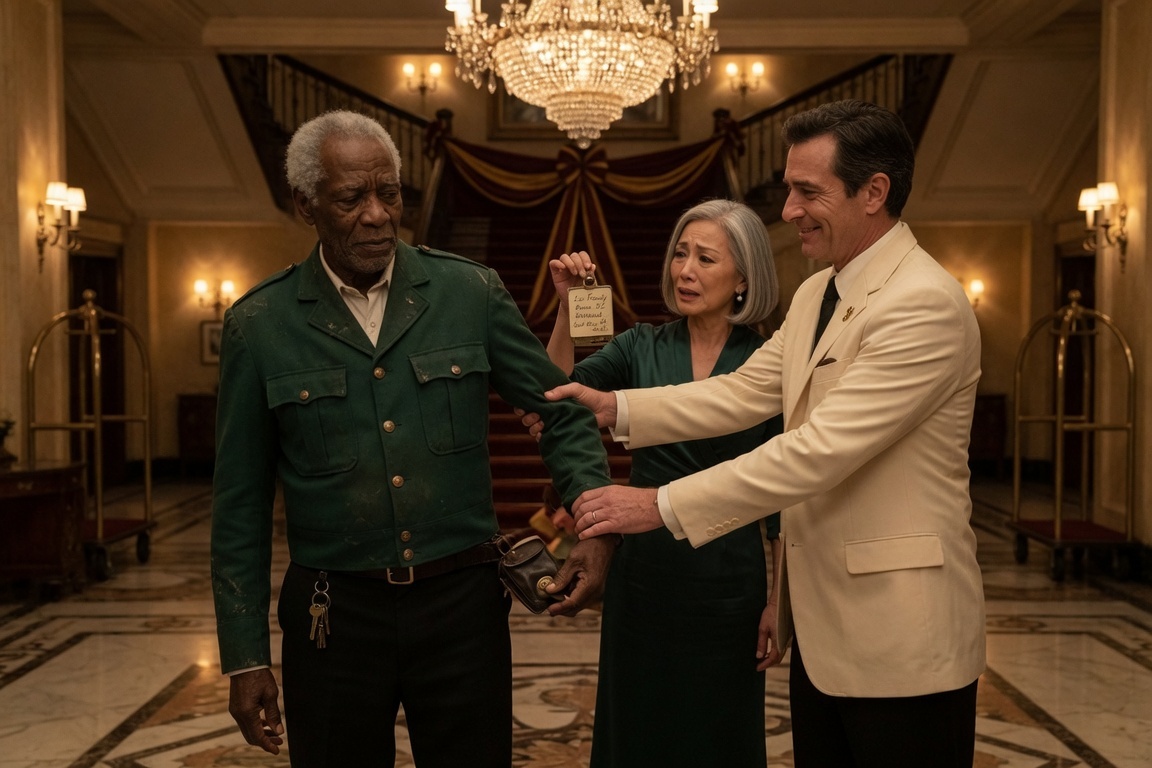
Richard pulls me out of the reopening photo and removes the brass key pouch from my belt. The action happened before I could explain why I was there. Richard Vale looked at my age, my practical clothing, and the object in my hands, then decided I was confused, outdated, or visually inconvenient.
The room around us was built to celebrate achievement, yet the first instinct was to remove the older person who did not match the polished image.
I began at the hotel carrying luggage before I could afford a proper suit. The building taught me that guests rarely remember the exact wallpaper, but they remember who noticed fear, grief, or celebration before being asked. I learned names, anniversaries, allergies, and the quiet signals that someone needed help without public attention.
Decades earlier, Margaret’s family arrived after losing their apartment in a fire. The hotel had no official room available, but I kept an old service suite ready and placed a handwritten note on the key promising that nobody would ask questions until morning. They stayed safely for three nights while relatives arranged housing.
Getting older had changed the way strangers interpreted ordinary pauses. When a younger person looked around a room, they were observant. When I did it, people assumed I was lost. When a younger worker carried an old tool, it suggested craftsmanship. In my hands, the same object became clutter. I had learned to recognize the shift, but recognition did not make it painless.
The restored hotel reopened under Richard’s luxury brand. Returning guests were invited, but he wanted the photograph to feature investors and designers. My old bellman jacket looked too historical for his vision, so he removed my key pouch and guided me outside the frame.
I could have announced my history immediately. I could have listed the years of work, the people I had taught, or the emergencies I had survived. None of that should have been required. An older person deserves patience even when no hidden achievement is waiting to be revealed. Respect that appears only after status becomes visible is not respect. It is fear of having judged the wrong person.
I held onto the clue as Richard Vale tried to move the event forward: Margaret raising an antique room key bearing my handwritten family note. At first, it looked too small to carry a lifetime. That is what made it powerful. A single object could connect the present celebration to decades of invisible labor. The audience did not need a long explanation. They needed one clear visual bridge between the person being rejected and the history being celebrated.
Margaret Liu noticed the clue. Recognition changed her face first, then her body. The planned schedule stopped mattering. The distance across the room closed quickly, and the authority that had been used to exclude me was met by authority willing to protect me. The reveal was not loud, but it was impossible to misunderstand.
The reversal followed: returning guests lift matching keys, and Margaret places the master key back into my hand.
Richard Vale’s confidence collapsed because the image could no longer be controlled. I was placed at the center without changing clothing, posture, age, or appearance. The room changed its understanding of me instead. That distinction matters in stories about older people. Dignity should not require a makeover, sudden wealth, or proof that youth once existed beneath the wrinkles.
I did not ask for public punishment. Humiliation can expose a person, but lasting justice changes the structure that made the behavior seem reasonable. We examined the schedule, the rules, and the culture behind the confrontation. Too often, age discrimination hides inside language about efficiency, safety, branding, or relevance. Those concerns can be real, but they become excuses when nobody pauses to ask a respectful question.
The aftermath brought real, structural change to the hotel:
The people who witnessed the moment also had to face their silence. Several had looked uncomfortable before the reveal but waited for someone more powerful to intervene. Harm often survives because decent people believe it is not their role, not the right time, or not serious enough to interrupt the program. The final recognition changed the whole room because everyone understood that the unfairness had been visible from the start.
The guests raised old keys because each one held a different story: a proposal, a reunion, a safe night, a final family holiday. The master key returned to my hand did not make me the owner. It confirmed that the hotel’s real value had always depended on people who opened doors with judgment and care.
The apology came later. I accepted it without pretending one emotional moment repaired everything. Real regret centers the person harmed and changes how the next stranger will be treated.
I returned home as the same person who had arrived. My face was still lined, my steps were still slower, and the object in my hand was still worn. The twist did not make me valuable. It made the room notice value that age had taught them to overlook. That is the final truth: a lifetime does not become less relevant because it no longer arrives in a young body.
Later, people repeated the story as though the most important part was the famous recognition. I always corrected that version. The reveal was satisfying, but it was not the moral.
The moral was that kindness should have arrived before the proof.
Older people should not have to produce a medal, a signature, a celebrated student, or a historical document to earn basic courtesy. Experience can be hidden, but humanity is already visible.


