 11
11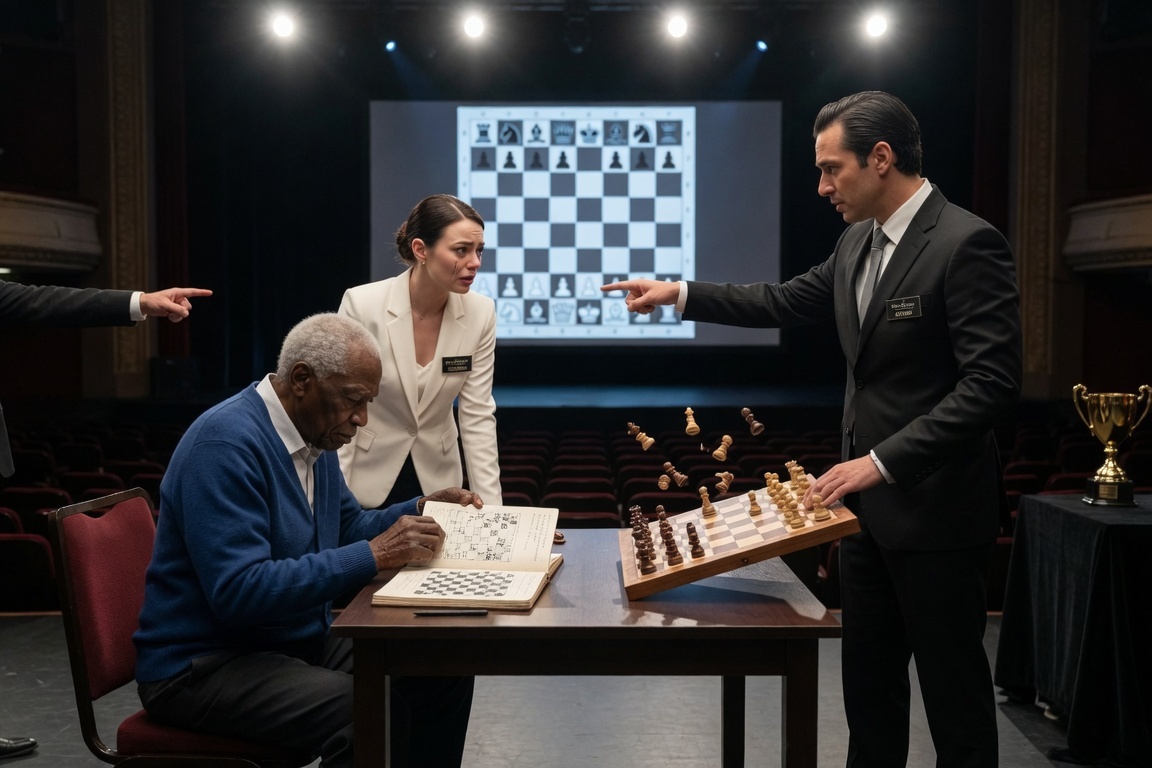
Victor sweeps Leonard’s wooden chessboard off the analysis table and points him toward the theater exit. It happened before I could explain my invitation. Victor Shaw looked at my age, my worn object, and the practical clothes I had chosen, then decided I belonged outside the polished image.
The public setting sharpened the humiliation. People saw it, yet the schedule continued as if removing an older person were routine.
I taught chess in a community room where half the pieces came from different sets. Children arrived after school carrying anger, fear, and too much energy for the small space. The board gave them somewhere to place those feelings. Every move created a consequence, and every mistake could become information instead of shame.
Amelia was nine when she first solved a position most adults abandoned. She saw patterns quickly but hated losing. I kept a notebook of unusual sacrifices and asked her to explain not only the best move, but what fear made the wrong move attractive. One position became the foundation of her calmest championship strategy.
Age changes how strangers read ordinary behavior. A younger person carrying old equipment looks inventive. An older person holding the same object is treated as confused or sentimental. A pause becomes weakness. A question becomes proof that someone cannot keep up. I recognized those assumptions, but experience did not make them harmless.
I attended the international final with a staff invitation, but my credential had been printed incorrectly. Victor saw an elderly man arranging a worn board near the digital analysis table. He believed I was distracting from the professional broadcast and swept the pieces onto the floor before checking my name.
I could have listed my career, the people I had trained, or the crisis connected to the object in my hands. None of it should have been required. A person deserves patience before proving they mattered to someone important. Respect that arrives only after a reveal is not respect. It is fear that the wrong target was chosen.
I held onto the clue while Victor Shaw tried to move the event forward: Leonard’s notebook contains the rare sacrifice position currently frozen on the championship screen. It looked small beside the cameras and expensive displays. That contrast gave it power. One worn object carried years of labor the polished event had erased.
Amelia Stone noticed first. Recognition appeared in the face before anyone spoke. The planned ceremony stopped. The celebrated person crossed the space quickly, no longer protecting the event’s timing. Authority changed purpose. It stopped excluding the older person and began protecting them.
The reversal became visible: Amelia pauses the final, rebuilds the position on Leonard’s board, and places the championship clock beside him. Victor Shaw’s confident posture collapsed because the meaning no longer depended on explanation. I remained in the same practical clothes. Nothing about me became more glamorous. The room simply lost the ability to pretend my history was irrelevant.
I did not ask for revenge. Embarrassment exposes behavior, but justice examines why it seemed reasonable. Events often hide age discrimination behind efficiency, brand consistency, safety, technology, or visual presentation. Those concerns sound neutral. They become cruel when nobody pauses to ask one respectful question before touching a person or throwing away an object.
To ensure lasting justice, the tournament implemented real changes:
Broadcast commentary also began crediting formative coaches instead of presenting champions as isolated talent.
Witnesses also faced their silence. Several people had looked uncomfortable during the confrontation, but they waited for someone with recognized authority to intervene. Unfairness survives through hesitation too. A strong culture does not train people to protect the program first. It gives them permission to interrupt obvious humiliation before a famous name or official medal enters the scene.
Amelia rebuilt the impossible position on my mismatched board. She did not ask me for the answer. She already knew it. The gesture acknowledged where she had learned to remain calm when a winning path required giving something valuable away. The gold trophy belonged to her. The old board held the beginning.
An apology came later. I listened without making the other person’s embarrassment the center of the story. Real regret changes what happens to the next unknown visitor, worker, mentor, or craftsperson. It creates a better process before another older person is forced to prove a lifetime in ten seconds.
People repeated it as a hidden-identity story. I always corrected the easiest version. The famous connection was not what made me worthy. It only made the unfair judgment impossible to defend. The deeper truth was visible from the beginning: an older person was being treated roughly because somebody assumed time had reduced their relevance.
I returned home with the same lined face, slower steps, and worn object I had carried into the room. The twist did not change me. It transformed the audience’s understanding. A lifetime does not become smaller because it arrives quietly, without branding, in a body that no longer moves at the speed of the event.
The object from the reveal remained part of the permanent story. It was not polished into something new or hidden behind a cleaner replica. Its scratches, stains, repairs, and faded marks became evidence. Younger visitors could see that knowledge is often stored outside formal systems, inside tools, notes, routines, and memories carried by people who are easy to overlook.
The mismatched pieces remained exactly where our earliest lessons had begun.


