 11
11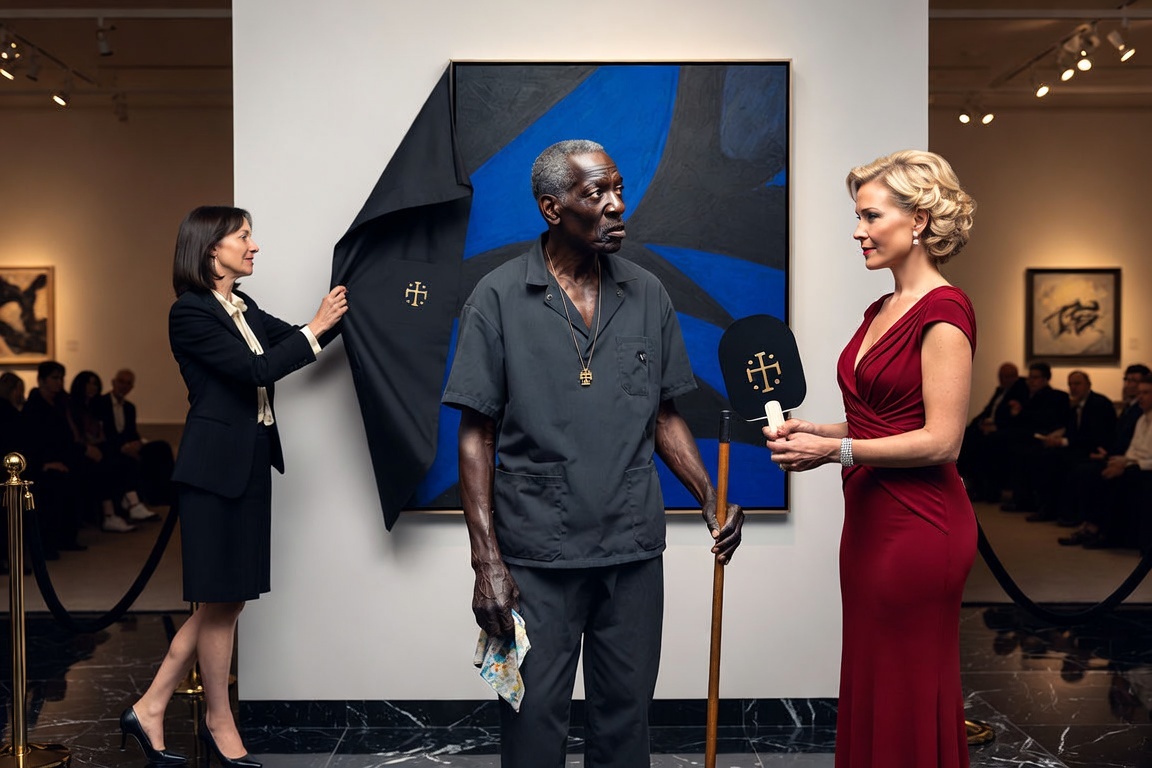
The woman in the red dress took the auction paddle from my hand and placed it on the table as if I had picked up something dangerous. Then she pushed the handle of my mop away from the velvet rope. Her diamond bracelet flashed beneath the gallery light. She smiled at the people beside her and told me, without saying the words directly, that staff should remain invisible during the private viewing.
I had been invisible in galleries for most of my life. I cleaned floors at night, repaired frames, adjusted lights, and carried crates through service entrances. The work gave me access to rooms filled with color and silence. After everyone left, I studied the paintings.
I learned how a line could create tension, how empty space could feel louder than detail, and how light changed the truth of a face.
I began painting in a storage room behind my apartment. My canvases came from discarded fabric stretched over handmade frames. I mixed leftover house paint with pigments purchased one tube at a time. For years, nobody saw the work except Elena, a young assistant curator who stayed late one evening and found blue paint under my fingernails. She asked what I was making instead of why a janitor had paint on his hands.
Elena visited the storage room and stood quietly before the canvases. She did not call them promising or charming. She asked whether I wanted them to be seen. I was afraid that people would treat the story of a janitor painting at night as more valuable than the paintings themselves. We agreed to exhibit the work under a small symbol instead of my name. The symbol came from a brass pendant my wife had given me before she died.
The anonymous collection grew slowly. Critics wrote about the emotional use of empty space and the way the blue figures seemed to carry years of hidden labor. Collectors competed for the pieces without knowing who made them. That anonymity protected me from becoming a novelty, but it also created a strange divide. The work received invitations to rooms where the person who created it was still expected to push a mop quietly along the wall.
The private auction centered on my largest painting. I arrived early to help the maintenance team prepare the gallery, then changed into a clean uniform. Elena had planned to reveal my identity after the bidding, with my permission. I stood near the covered canvas holding a spare auction paddle because a staff member asked me to move it. Celia saw only a janitor touching an object reserved for buyers.
She removed the paddle from my hand and told me the floor near the display needed attention. Her friends watched with amused expressions. I felt the old instinct to disappear. Silence had protected my job for decades. It had also allowed people to confuse my patience with agreement. I tightened my grip on the paint-stained cloth in my pocket and stepped back.
The movement pulled my brass pendant into view. Elena saw it from across the room. Her attention shifted from the guests to my face, then to the woman holding the paddle. She crossed the black marble floor and pulled the cover from the centerpiece painting before the formal reveal. The same symbol appeared in the lower corner of the canvas.
Celia’s expression changed as she looked between the pendant and the signature. Elena removed the brass artist badge from the display stand and pinned it to my maintenance uniform. She did not ask me to change clothes or wait behind a curtain. She placed me beneath the spotlight exactly as I was, beside the work everyone had gathered to value.
The room became silent. I could see buyers recalculating every interaction they had ignored. Some looked embarrassed because I had carried their coats or cleaned around their shoes at earlier events. The painting had not changed. Its value had not increased because they finally knew my face. What changed was their understanding of how easily talent can exist beside them without receiving human attention.
I took the auction paddle back from the table and handed it to a young gallery assistant. Then I spoke briefly about the painting. It was inspired by night workers visible only through reflections in office windows. I had painted people whose labor kept beautiful spaces functioning after the admired guests went home.
The blue figures were not lonely because they lacked worth. They were lonely because worth was rarely acknowledged.
Celia apologized after the auction. She said she had assumed I was moving equipment without permission. I told her the assumption was exactly the problem. She had seen a uniform and decided curiosity was unnecessary. She bought no painting that evening. Instead, she funded a gallery program for maintenance and service workers who created art outside their jobs. I accepted the gesture as a beginning, not proof of transformation.
I continued working at the gallery for another year, partly because I loved the building and partly because I refused the idea that artistic recognition made honest work beneath me. Eventually, I reduced my hours to paint full time. My gray uniform hangs beside my studio door. The artist badge remains attached to it, not as a trophy, but as evidence that identity does not fit neatly into the roles people assign.
The centerpiece painting now travels between museums. Viewers stand before it and study the blue figures under empty light. Few know the exact moment its creator was pushed outside the velvet rope. That is fine. The painting carries the truth without the story. Still, whenever I see the small signature symbol, I remember Elena removing the cover and placing me in the light before anyone had time to prepare a more comfortable version of who I was.
Elena later organized an exhibition pairing each finished painting with an object from the work that surrounded its creation. My section included the mop handle, the paint-stained cloth, and the brass pendant. The objects were not displayed to romanticize hardship. They showed that creativity often develops beside ordinary labor rather than inside a perfect studio. Visitors spent longer reading those connections than they did studying auction prices.
I also began teaching evening workshops for service workers who believed artistic careers had passed them by. Some brought photographs, poems, textiles, or sketches made during breaks. The first lesson was not about technique. It was about permission. People had absorbed the idea that creativity belonged to those with the right education, income, or free time. My story helped challenge that boundary without pretending recognition arrived easily.
Celia returned months later without an entourage and asked to see the painting again. She stood outside the spotlight and listened while I explained the blue figures. Her apology became more credible because she no longer centered her own embarrassment. She was learning to look at people before evaluating what access, status, or usefulness they might offer her.
The gallery also changed how staff introductions were handled at private events. Maintenance, security, installation crews, and assistants were named before the auction began. The policy was simple, but it challenged a culture that treated workers as part of the building rather than part of the event. People became harder to dismiss once their names and roles entered the room.


