 11
11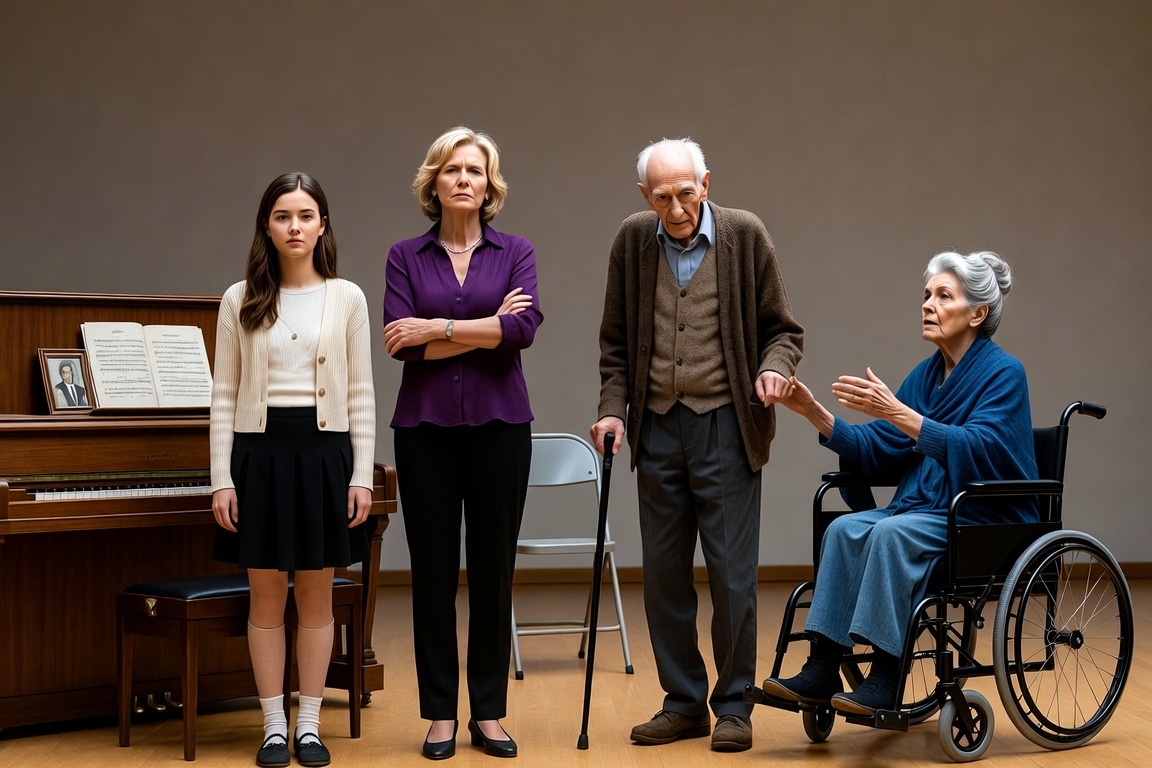
Lily had practiced in borrowed rooms. Church basements, school music rooms after hours, her neighbor’s living room when the upright was almost in tune. She did not own a piano, but she owned the song in the stubborn way people own what they refuse to lose. For weeks, she carried the sheet music in a folder inside her bag, the pages soft at the corners from being opened too often.
The senior community hall smelled faintly of coffee, floor polish, and old wood. A walnut piano stood on the small stage beneath amber afternoon light. Cream curtains framed it. Folding chairs filled the room, and a framed recital photo hung on the side wall, showing younger faces beside the same instrument. Grandma June sat in her wheelchair near the front, silver hair pinned into a bun, blue shawl folded carefully over her lap.
The song had been June’s request, though she had not called it that. She only hummed the first bars one afternoon while Lily adjusted her blanket and said, “Your grandfather used to play that when the house felt too quiet.” Her hands, once quick on keys, trembled too much now.
So Lily found the melody.
Aunt Carol found the reason to question it.
Carol stood beside the piano in a purple blouse, arms crossed, face arranged into concern that never made anyone feel cared for. “This is not a casual instrument,” she said.
Lily placed the sheet music on the stand. “I know.”
“That piano was for real musicians.”
The words landed with the dull weight of old family habits. Carol had always guarded tradition as if it belonged to whoever sounded most certain. She corrected recipes she never cooked. She arranged holiday photos around her own preferences. She spoke of “what your grandfather would have wanted” with the confidence of someone who had rarely listened to him when he was alive.
Lily looked toward Grandma June. The older woman’s hand lifted slightly from the wheelchair arm, fingers curved as if remembering keys. Her eyes were wet already, though the music had not begun.
“I practiced,” Lily said.
Carol’s mouth tightened. “Practice does not make memory.”
That sentence nearly did it. Lily felt heat rise behind her eyes. She was twenty-two, too old to run from an aunt’s tone and still young enough for it to reach the child inside her. She had not come to prove talent. She had come to give her grandmother a song her body could no longer play.
Mr. Bennett sat in the front row with a brown cardigan and cane resting against his knee. Few people knew he had taught piano at the hall decades earlier. He watched Lily with a focus that seemed gentle but exact. His white hair caught the amber light. He did not intervene. Not yet.
Lily lowered herself onto the bench.
The hall became quiet in the way rooms do when people are deciding whether to be kind.
Her fingers trembled over the keys. The sheet music blurred for a second. She took one breath, then another. Grandma June leaned forward, as much as the wheelchair allowed. Carol remained beside the piano, present enough to intimidate, not brave enough to understand why.
Lily began.
The first notes were not perfect. One was too soft. Another nearly slipped. But the melody found itself quickly, like a path under leaves. It was not a grand song. It had the shape of a home after supper, a window left open, someone washing dishes while another person played because silence needed company. The hall changed around it. A woman in the second row lowered her program. A man near the aisle closed his eyes.
Grandma June’s face opened with recognition so tender it hurt to look at. Her lips moved without sound.
Carol’s expression shifted, not yet regret, but uncertainty. She had expected clumsiness, perhaps embarrassment, something she could label and control. Instead, Lily played a memory Carol had not been able to own with words.
Then Mr. Bennett stood.
It took effort. His cane tapped once. Lily kept playing, but her eyes flicked toward him.
“That was your grandfather’s song,” he whispered.
The room listened harder.
Mr. Bennett took one slow step toward the piano. “He wrote the first version here, after June missed a recital because she was home with a sick child.”
Grandma June pressed a hand to her heart.
Lily almost stopped, but Mr. Bennett lifted his palm gently. Continue.
So she did. The melody grew steadier. Mr. Bennett’s voice, low and full of age, carried between phrases.
“He never gave it a title. He said titles made small things act too important. But he played it every time June was tired and pretending not to be.”
Carol looked at her mother. For the first time, she seemed to see June not as the keeper of family customs, but as the woman inside them. Loved, exhausted, remembered.
“How do you know?” Carol asked, barely above a whisper.
Mr. Bennett turned toward the framed recital photo on the wall. “Because I taught him. And because I watched him play it for her on that piano.”
The amber light fell across Lily’s hands. The song no longer felt like a performance. It felt like a family door opening from the inside.
When Lily finished, the final note lingered longer than anyone expected. No one rushed to clap. The silence was not empty. It was full.
Grandma June reached for Lily. The young woman left the bench and knelt beside the wheelchair. June touched her face with trembling fingers.
“You found him,” June whispered.
Lily cried then. She had been holding the fear so tightly that relief arrived like a break in weather. “I wanted to give it back to you.”
Carol stood near the piano, arms no longer crossed. Her certainty had nowhere graceful to go. She had questioned Lily’s place in front of a room and been answered by the very tradition she claimed to protect.
“I didn’t know,” Carol said.
Mr. Bennett leaned on his cane. “That is why we listen before we decide who belongs.”
The sentence was not cruel, but it did not move aside for comfort. Carol looked at Lily. “I was wrong.”
Lily nodded, unable yet to offer more. Some apologies need time to earn a reply.
After the event, people gathered around June with memories of Lily’s grandfather. Not grand achievements. Small things. The way he tuned the piano himself. The way he brought peppermint candies in his jacket pocket. The way he played softly when someone was grieving, never asking what had happened until they were ready to say. Lily listened and realized the song had done more than prove she belonged. It had returned a fuller version of him to the family.
Carol sat beside June during coffee. She did not try to explain herself immediately, which was the first wise choice she made all day. Later, she brought Lily a paper cup and sat in the chair next to her.
“I thought I was protecting what mattered,” Carol said.
Lily looked toward the piano. “You were protecting the shape of it. Not the heart.”
Carol absorbed that. “Will you teach me the song?”
The request surprised Lily. It was not enough to fix everything, but it was humble enough to begin. “Grandma should decide.”
June, who had been listening with a small smile, answered, “Both of you learn it. Badly at first, if needed.”
Mr. Bennett laughed from the front row.
The hall started a monthly memory music afternoon after that. Residents brought songs tied to people they missed. Some were played beautifully. Some were sung off-key. Nobody cared as much as they expected to. Lily played her grandfather’s song again the next month, and this time Carol sat beside her on the bench, stiff with nerves, trying to find the left-hand notes.
The first attempt was messy. June loved it anyway.
Months later, the framed recital photo was moved closer to the piano, and beside it the hall added a small card with the song’s new title, chosen by June: When The House Felt Quiet. Lily wrote the title in careful ink. Mr. Bennett approved it, though he joked her grandfather would have complained.
Lily no longer felt nervous walking to the piano. She still respected the instrument, but not the fear Carol had built around it. Belonging, she learned, is not always granted by the loudest keeper of tradition. Sometimes it is carried in a melody, recognized by an old teacher, and confirmed by the tears of the person the song was meant to reach.
The piano did not belong to “real musicians.” It belonged to memory. And that afternoon, memory made room for the granddaughter brave enough to play it.
June asked for the song again before leaving the hall. Lily played only the first eight bars this time, softly, while volunteers stacked chairs around them. Carol did not interrupt. She stood near the curtain with wet eyes, finally understanding that some inheritances are not stored in documents or jewelry, but in the courage to remember out loud.


