 11
11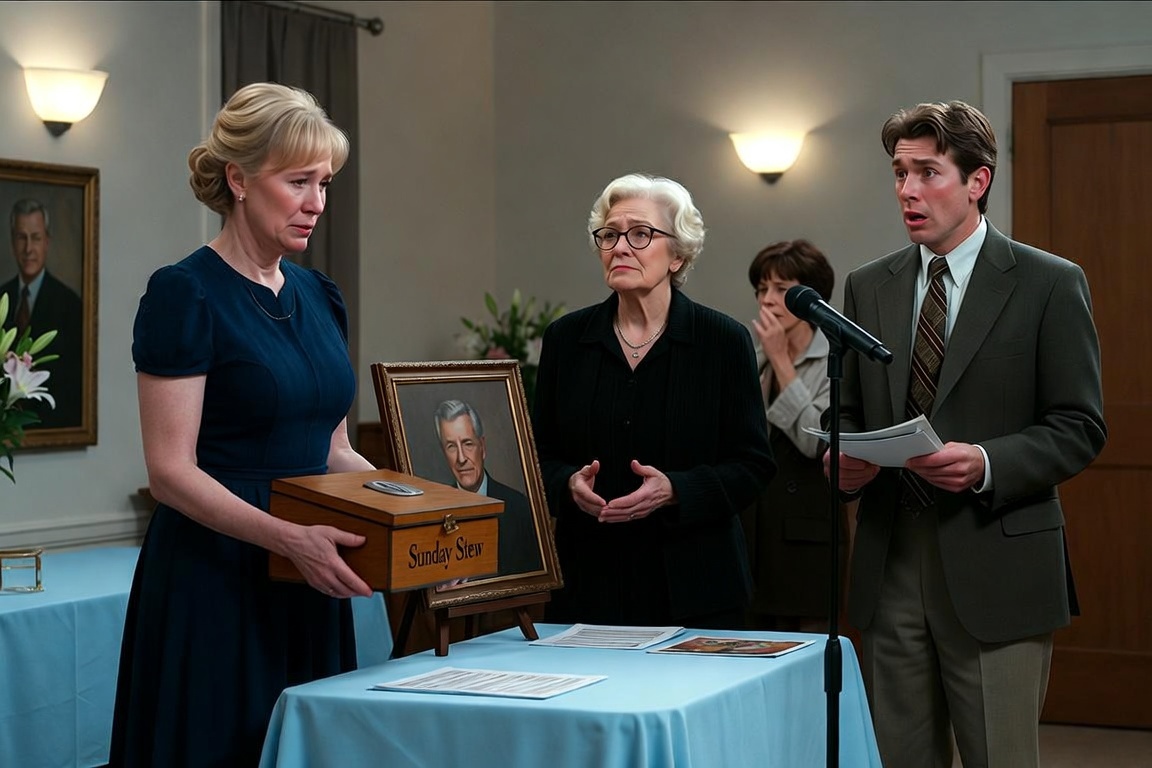
The church fellowship hall was too bright for secrets. White fluorescent lights shone over folding tables covered with pale blue cloths. A coffee urn hissed near the wall. Family photos rested on a memory table beside a vase of lilies and a framed portrait of Harold Whitmore, the man everyone had gathered to honor.
His sons had organized the memorial luncheon like a business meeting. There were schedules, reserved seats, prepared remarks, and a printed program with Harold’s favorite hymn on the back. Everything looked respectful from a distance.
Up close, it felt cold.
Ruth Whitmore stood near the memory table in a navy church dress and low black shoes. She was seventy-one, small and tired, with soft gray hair and a face that seemed to have aged five years in one week. In her hands, she held a small wooden recipe box. The lid was worn from years of use. A faded label on the side read Sunday Stew.
Across the room, her daughter-in-law Patricia adjusted the flowers with a tense smile. Patricia was graceful, polished, and very aware of who was watching. She had spent the morning making sure the hall looked dignified. She had not spent much time asking Ruth how she was breathing through the day.
Ruth moved toward the front family table.
Patricia stepped into her path.
“Ruth, maybe you should sit near the back,” Patricia said.
Ruth looked at the empty chair beside Harold’s portrait. “I thought I would sit there.”
Patricia’s smile remained, but her eyes hardened. “The front table is for speakers. We want things to stay organized.”
Ruth looked down at the recipe box. “Harold asked me to bring this.”
Patricia glanced at it as if it were clutter. “This is not the time for kitchen things.”
The words landed harder than she knew.
Ruth’s fingers tightened around the box. Her lips parted, but no sound came out. She had cooked for Harold for forty-eight years. She had packed lunches when he worked double shifts, brought soup to neighbors when they were sick, fed Patricia’s children after school, and hosted every Sunday dinner that kept the family from drifting apart. To hear it called kitchen things on the day of his memorial made her eyes fill instantly.
At the microphone, Ruth’s grandson Caleb looked over. He was twenty-six, wearing a dark suit that still looked new on him. He saw his grandmother’s face and frowned.
Patricia noticed him noticing and lowered her voice. “Please do not make this emotional.”
Ruth gave a small nod because she had always been good at swallowing pain for the sake of peace.
She turned toward the back tables. The wooden recipe box trembled in her hands.
Caleb stepped away from the microphone. “Grandma?”
Ruth stopped but did not turn around.
Patricia moved quickly. “Caleb, we are about to begin.”
But Caleb had already crossed the room. He gently took the recipe box from Ruth’s hands and looked at the label. Sunday Stew. His face changed.
“Grandpa talked about this box,” he said.
Patricia’s shoulders stiffened.
Ruth whispered, “He wrote something inside.”
Caleb opened the lid. Inside were handwritten recipe cards, each stained at the corners, each marked in Harold’s blocky handwriting and Ruth’s smaller script. Between the cards was a folded note.
Caleb unfolded it.
The hall went quiet, not all at once, but in waves. First the nearest table, then the next, then the people by the coffee urn. Caleb read silently. His jaw tightened. His eyes filled.
“What is it?” Patricia asked, suddenly less polished.
Caleb looked at Ruth. “Grandpa wrote this for today.”
Ruth closed her eyes.
He walked back to the microphone with the note in his hand. Patricia reached for his arm, but he gently moved past her. Caleb stood under the fluorescent lights, swallowing hard.
“My grandfather left a note in this recipe box,” he said. “He asked that it be read at his memorial.”
Ruth covered her mouth. Patricia stood frozen beside the flowers.
Caleb continued. His voice shook, but he did not stop. “He wrote that people would remember his work, his jokes, his stories, maybe even his stubbornness. But he said none of those things held the family together. He said Ruth did.”
Someone at the front table began to cry. Ruth shook her head gently, embarrassed by attention even now.
Caleb read on. “He said every Sunday meal was her way of keeping the door open. Every bowl of stew, every extra chair, every packed container sent home, every birthday cake made after midnight, every apology accepted at her table. He wrote that if the family wanted to honor him, they should start by honoring the woman who fed them when they forgot to thank her.”
The room changed. Not in noise. In weight.
Patricia looked down at the polished program in her hand. It suddenly seemed thin.
Ruth stood at the back edge of the hall, crying openly now, one hand pressed to her chest. Caleb left the microphone and walked to her. He did not ask permission. He took her hand and led her to the chair beside Harold’s portrait.
Patricia’s face crumpled with regret. “Ruth,” she said, voice small, “I did not mean it like that.”
Ruth looked at her through tears. “I know what you meant.”
It was not cruel. It was simply true.
Caleb placed the wooden recipe box on the front table beside Harold’s portrait. Then he pulled out the chair for Ruth. She sat slowly. The chair had been empty all morning, waiting for the person who should never have been asked to move.
People stood. Not loudly. Not like applause at a show. They stood because shame and respect had finally become clear enough to act on. Patricia remained standing with them, bouquet stem pressed too tightly in her hand. Her tears came late, but they came.
Ruth touched the recipe box lid.
For forty-eight years, she had loved in ways that did not photograph well. Meals reheated. Plates washed. Doors opened. Pride softened. Names remembered. Favorite pies made without being asked.
That day, the family finally saw it.
The memorial did not become perfect after that. Grief never becomes clean just because truth arrives. But the room became honest.
Harold’s portrait still smiled from the table. The lilies still leaned in their vase. The coffee still hissed against the wall. And Ruth, who had nearly been sent to the back with the box everyone dismissed, sat beside her husband’s picture while the family learned what legacy actually looks like.


