 11
11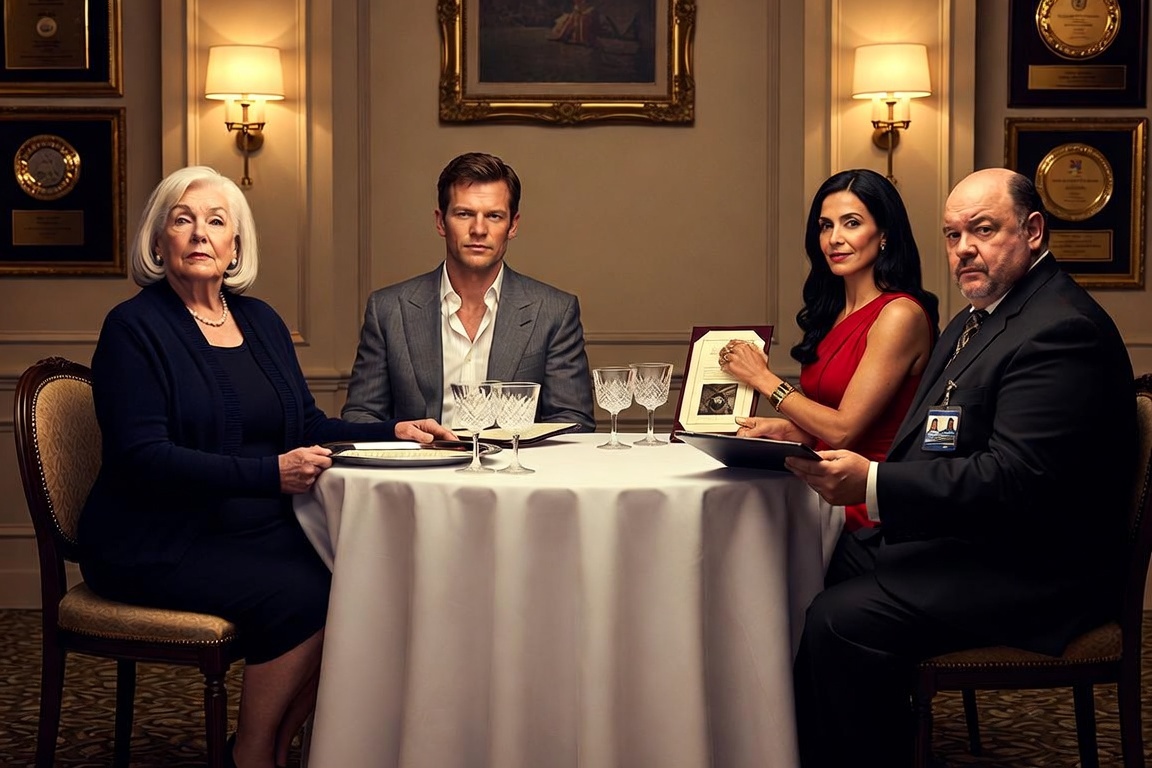
The private dining room had been prepared with the kind of care that makes even ordinary conversations feel important. The candles had been trimmed to equal height. The water glasses caught the warm gold light. A cream folder rested beside each plate, closed like a promise. Margaret noticed all of it when she walked in, not because she was impressed, but because she remembered choosing the table linen years ago, back when the restaurant was still a nervous idea with too much ambition and not enough money.
She did not arrive as an owner. That was the point. Daniel had asked for a quiet dinner with Brianna, the woman he planned to marry, and Margaret wanted to be seen first as a mother. Not as a name on an old business record, not as the woman the manager still called when something felt off, not as a silent co-owner who had spent years refusing applause. She wore her navy cardigan because it was comfortable. She wore pearl earrings because Daniel had given them to her after his first serious promotion. She told herself the evening would be simple.
Brianna arrived twelve minutes late and carried the room with her like she owned the lighting. The red dress was lovely. The gold bracelet flashed every time she moved her hand. Her smile toward Daniel was polished, almost practiced. Then she turned to Margaret and let her eyes pause on the cardigan, the black flats, the plain handbag placed neatly by the chair. The smile stayed, but something behind it cooled.
“Margaret, right?” Brianna said.
“Mrs. Hale is fine, dear, but Margaret is all right too.”
Brianna nodded the way people nod when they have already stopped listening. She chose the chair nearest the wall, angled herself toward Daniel, and began discussing wedding colors before Margaret had even unfolded her napkin.
At first, Brianna’s comments could have passed as social clumsiness. She asked Margaret whether she came to places like this often. She said the restaurant was “probably overwhelming the first time.” When the waiter explained the specials, Brianna repeated the simpler words slowly toward Margaret, as if kindness had become a costume for insult. Daniel looked uncomfortable, but he did not correct her.
That was the part that landed deepest. Margaret had raised Daniel through years when there was not enough time, not enough sleep, and sometimes not enough belief that the next month would be easier. He was not cruel. That was never the problem. His weakness was softer, slipperier. He disliked conflict so much that he let other people create it while he stared into his water glass and hoped the moment would pass.
Margaret answered Brianna gently. She asked about her work. She complimented the dress. She thanked the staff by name when they entered, which made Brianna glance up sharply, as if ordinary respect needed an explanation. Daniel noticed that too, but again, silence.
By the second course, Brianna had decided what role Margaret would play in the evening. The older woman was useful as a symbol of Daniel’s humble beginning, perhaps, but not as someone whose opinion mattered. When Margaret reached for the bread basket, Brianna slid it farther away by accident, or by the kind of accident that knows exactly what it is doing.
“You must be proud,” Brianna said, laying a hand over Daniel’s. “He worked so hard to move beyond all this.”
Margaret looked at her son. “Beyond what?”
Brianna’s smile flickered. “I only mean he built a different life.”
Daniel opened his mouth, then closed it. The candle between them trembled in the air conditioning.
The staff came in to clear the plates, but one young waiter was called away by the manager before he reached their side of the table. Margaret, seeing the dish close to the edge, lifted it slightly so it would not fall. It was instinct, nothing more. After years around restaurants, she moved around fragile things without thinking.
Brianna saw the movement and laughed under her breath.
“Oh, wonderful,” she said, sliding her plate toward Margaret. “You can clear this too.”
Nobody spoke. Even the chandelier seemed suddenly too bright.
Margaret’s hands closed around the silver tray that had been left on the sideboard. She could have ended it there. She could have said her name, her role, her history. She could have told Brianna that the private room had been designed from a sketch Margaret had drawn on the back of a grocery receipt, before the first investor ever took the restaurant seriously. But power used too quickly can look like anger, and Margaret did not want anger to be the lesson.
Daniel whispered, “Brianna, stop.”
The words were small, late, and still seated.
Margaret placed the plate on the tray. Her face stayed calm, but Daniel knew her well enough to see the hurt in the way she swallowed. Brianna leaned back, satisfied with a victory that had cost her nothing yet. She thought the room had agreed with her because no one had challenged her loudly. She did not understand that some rooms become quiet right before they remember the truth.
The door opened behind them. Mr. Cole entered with the staff tablet tucked beneath his arm. He was a broad man with a bald head and a habit of noticing details. He had managed the restaurant for years, and he knew the difference between a difficult guest and a defining moment.
He saw Margaret holding the tray.
His face changed before he spoke. The professional smile disappeared, replaced by something more personal, almost alarmed. He straightened his jacket, took one step forward, and lowered his voice with the kind of respect that cannot be faked.
“Mrs. Hale,” he said, “I didn’t know you were dining here tonight.”
Brianna’s fingers stopped moving on the stem of her glass.
Daniel closed his eyes.
Margaret set the tray down on the sideboard with careful hands. “I was meeting my son and his fiancée.”
Mr. Cole looked from Margaret to Brianna, then to the plate resting on the tray. He understood enough. Good managers do not need every detail when the room is already telling the story.
“Would you like your usual table prepared?” he asked.
Brianna gave a small laugh that did not belong to confidence anymore. “Your usual table?”
Mr. Cole turned to her politely. “Mrs. Hale helped build this place. Her name is in our original business record. We still use several of her service standards.”
The words did not strike loudly. They simply landed everywhere.
Daniel stood up, but the motion did not repair what his sitting had allowed. Margaret did not look angry. That made it worse. Anger would have given him something to push back against, a scene to manage, an apology to perform. Instead, his mother’s disappointment sat between them with the patience of something earned.
“Mom,” he said.
Margaret lifted one hand. Not now.
Brianna’s face had gone pale beneath the warm lighting. She looked at the tray, then at the cream menu folder, then at Mr. Cole’s respectful posture. All the little assumptions she had stacked so neatly began to collapse. The cardigan was not proof of smallness. The quiet voice was not weakness. The woman she had reduced to background was tied to the room more deeply than anyone at the table.
“I didn’t realize,” Brianna said.
Margaret looked at her then. “That is exactly the problem.”
No one had to raise their voice. The restaurant did not turn into a spectacle. The staff did not gather. The room stayed elegant, which somehow made the correction sharper. Brianna had revealed her character in a private place, and private truth can be more powerful than public noise.
Margaret asked Mr. Cole to have the remaining courses sent to the kitchen staff. “No waste,” she said, because even on a painful night she remembered the people who worked behind swinging doors.
Brianna tried to explain herself in careful pieces. She said she had been nervous. She said weddings were stressful. She said she respected Daniel’s mother, of course she did. But every explanation bent around the same missing center: she had been kind only when she believed kindness would benefit her.
Daniel finally turned to Brianna. “You talked to her like she didn’t matter.”
Brianna looked relieved for half a second, as if Daniel’s words meant the damage was now shared. But Margaret saw the bigger wound. Daniel had waited until proof made courage convenient.
Margaret picked up her handbag. She looked at her son, not as a boy, not as a manager, not as a man about to marry, but as someone still deciding what kind of life he wanted to defend.
“Choose someone who sees people before status,” she said. “And become someone who speaks before the truth has to rescue you.”
She left without slamming the door. Mr. Cole walked her to the lobby, not because she needed escorting, but because respect deserved witnesses. Behind her, Brianna sat frozen in a room that suddenly felt far too expensive for the character she had shown. Daniel remained standing beside the table, finally understanding that silence is also a decision.
By the next morning, the engagement was not publicly discussed, but it was quietly paused. Margaret did not ask for that. She asked only for time. Daniel sent flowers. She sent them to the staff room with a note that read, “Share these with the people who always knew how to treat guests.”
The restaurant kept serving dinner. The candles kept glowing. But for Daniel, that private room never looked the same again. It was no longer just a place where a woman had been judged by her cardigan. It was the room where his mother had taught him, with a tray and a single raised hand, that dignity does not need to announce itself to be real.


