11
11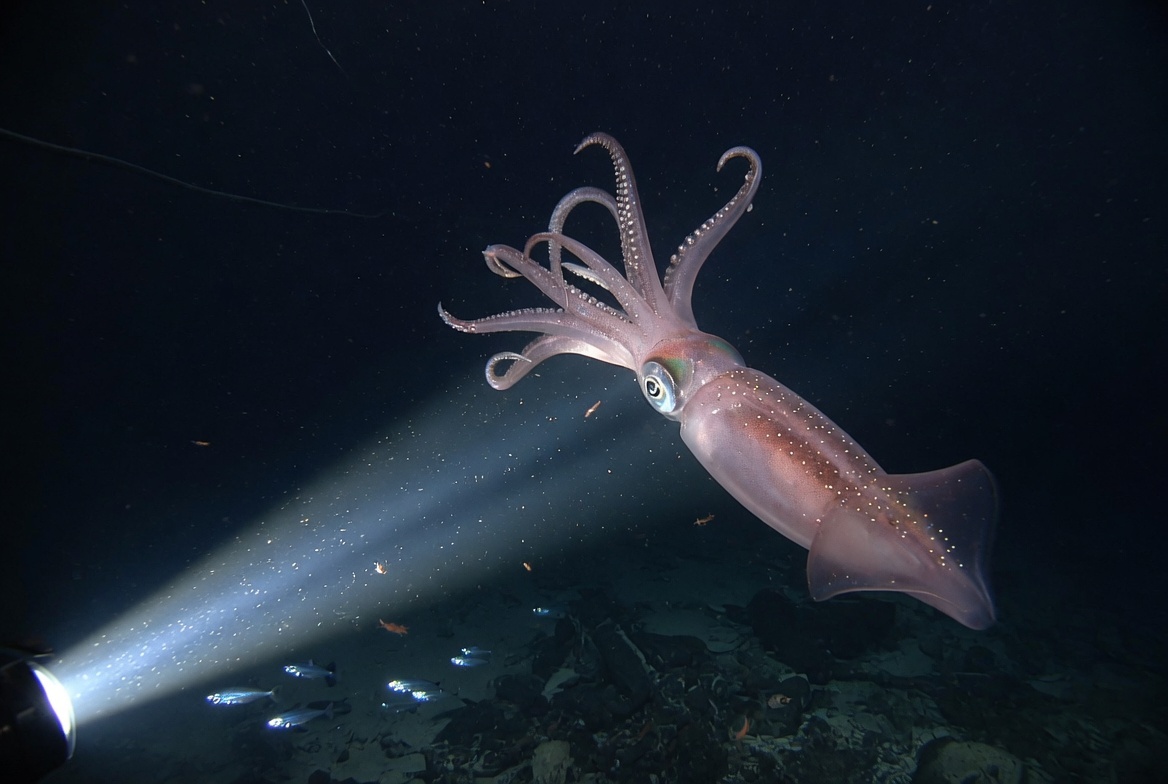
Imagine the freezing, high-pressure depths of the Southern Ocean near the South Sandwich Islands.
The water is not empty. It is crowded with life, movement, and danger. Somewhere inside that world, a translucent juvenile colossal squid (Mesonychoteuthis hamiltoni) floats suspended in the deep Antarctic water. Its delicate arms and tentacles are suddenly illuminated by the sharp, mechanical high-contrast beam of a Remotely Operated Vehicle (ROV), while an absolute, crushing darkness surrounds it.
The image feels exaggerated at first glance, almost like concept art designed for a monster film. But the core of the story comes from real encounters, real anatomy, and a scientific question that remains fascinating long after the dramatic headlines are stripped away.
The truth is more compelling: researchers are piecing together the life of an elusive modern titan from incomplete clues, revealing a deep-sea ecosystem that operates on a completely different set of biological rules.
For generations, the colossal squid was known exclusively from fragments—beaks recovered from the stomachs of sperm whales, or half-frozen specimens pulled up by deep-sea fishing trawlers. Because their soft bodies break down or get crushed under their own weight at the surface, observing them alive seemed nearly impossible. Then came a historic breakthrough.
Gathering data from the deep ocean mirrors paleontology. Scientists rarely get a complete life story; they must work with fragments, suction marks, and rare glimpses. They take these clues, compare them with related cephalopods, and update the picture when stronger evidence appears.
The most striking feature of this deep-sea predator is not a fictional upgrade. It is the real anatomy.
Extreme anatomy usually evolves because it solves a specific ecological problem. In the pitch-black abyss, the colossal squid’s bizarre body plan is perfectly adapted to survive in a realm of total darkness and intense pressure:
Sometimes the weirdest body plan belongs to an animal that was simply perfectly adapted to a specialized environment. Anatomy can strongly support a hypothesis, but a single video clip does not replay the animal’s entire daily behavior.
The first confirmed deep-sea video did not reveal a full-grown titan. It revealed something arguably stranger: a delicate, ghostly juvenile from a species whose adults grow into massive apex predators.
This gap between structural evidence and living behavior is the real story.
Science is full of animals that became more interesting after the easy explanation failed. A species may be known to science for a century before the technology exists to watch it breathe:
That is why older, dramatic illustrations of monsters wrapping around ships should never be treated as photographs. Nature photography and paleoart are visual hypotheses. The strongest work follows the available evidence, shows uncertainty where it exists, and avoids turning a reasonable reconstruction into false certainty.
To understand the colossal squid, the boundary between confirmed evidence and scientific inference must remain completely visible.
The Confirmed Facts
The Theory
Scientists still have major questions about adult behavior, movement, hunting efficiency, and how often these animals actively battle sperm whales. The dramatic scars found on whales are clues, but a complete daily routine remains unobserved.
A fake mystery treats uncertainty as permission to invent sea monsters. A science mystery treats uncertainty as an invitation to look more closely at the edge of human exploration.
A deep-sea animal never exists in isolation. Its body makes sense only when placed back into its environment: water temperature, crushing pressure, food webs, and the extreme evolutionary experiments happening around it.
The Southern Ocean abyss is not a barren wasteland. It is a complete, functioning ecosystem with its own independent rules, operating entirely out of sight beneath the Antarctic ice sheets.
Some of the animals sharing that habitat would look familiar at a distance and deeply wrong up close. The most unsettling realization is not simply that a hook-armed giant squid exists—it is that this creature is completely normal, stable, and highly successful inside its own dark world.
The most important takeaway is simple: The first confirmed footage showed a juvenile colossal squid in its natural habitat, while the enormous adults remain mostly unseen.
The structural evidence confirms a real animal with a body plan strange enough to stop people mid-scroll. The scientific interpretation adds the deeper layer: why that body may have evolved, how the animal lives, and which parts remain unresolved.
This is real natural history.
Not supernatural horror.
Not fake proof.
Just a real piece of Earth’s biology that feels completely impossible.