11
11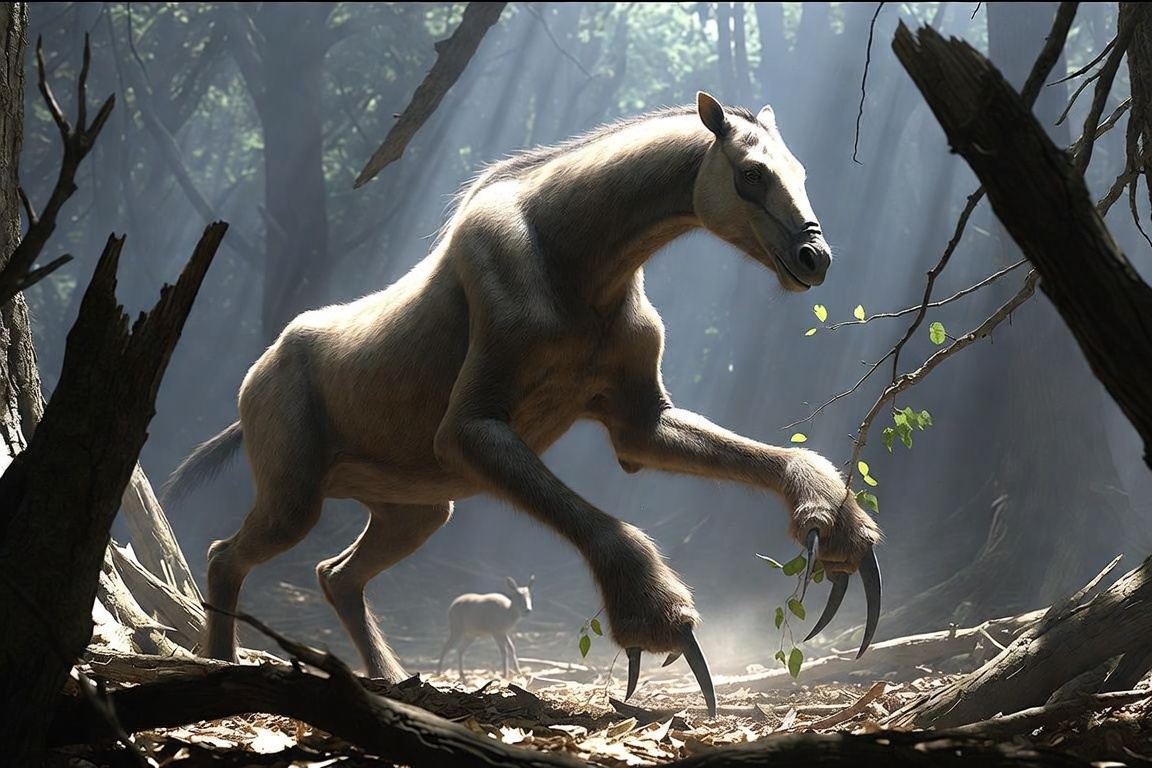
Some extinct animals are scary because they were predators. Chalicotheres are unsettling because they make the brain misfile them.
At first glance, a chalicothere can look partly horse-like. The head and broad evolutionary neighborhood point toward perissodactyls—the odd-toed ungulate group that includes horses, rhinoceroses, and tapirs. But then the rest of the body breaks the image. The forelimbs are long. The back slopes. The front feet carry large, curved claws instead of hooves.
That is the visual hook: a horse relative with claws.
The first mistake people make is assuming claws mean predator. In chalicotheres, these were not killing weapons. Scientists interpret them as tools for feeding, movement, and pulling down vegetation. These animals were strictly herbivores.
A herbivore with large claws turns the normal visual language of nature upside down. Chalicotheres refuse the shortcuts we expect from evolution. Their claws likely helped them hook branches, pull foliage down, and strip leaves. They weren’t preparing to attack; they were just eating. But they still look like something from a nightmare stable.
Odd-toed ungulates are usually easy to picture. Horses run, rhinos stand like armored tanks, and tapirs move through forests. Chalicotheres add a lost branch to that family tree, one that makes the group feel much more experimental.
The fossil record does not just show what survived; it shows the side branches and experiments that modern ecosystems no longer contain. Chalicotheres remind us that evolution does not care about human categories. A horse relative does not have to gallop on hooves, and a herbivore does not have to look gentle.
The best way to visualize a chalicothere is not as a charging monster, but as a silent browser in a dim, Miocene woodland.
Picture light cutting through the trees as a large, gorilla-like mammal stands partly upright. It uses long arms to reach high branches, while its claws hook into the foliage and drag it downward. Its horse-like head strips the leaves with ease. Nothing about that scene is fake—it is a reconstruction based on their skeletal anatomy—but it remains eerie because the anatomy clashes with the world we know.
Chalicotheres feel like an evolutionary glitch because humans expect animals to follow familiar design rules: hooves for ungulates, claws for climbers or carnivores. When those signals collide, the result feels uncanny.
But evolution did not glitch; it explored. The chalicothere body plan was a success in its own ecological context. They occupied forest edges and feeding zones where reach mattered more than speed. They only look impossible today because their entire lineage has vanished, leaving no living creature for us to compare them to.
Chalicotheres matter because they expand our idea of what a prehistoric animal can be. Not every strange fossil is a giant killer. Some are fascinating simply because they occupy a body plan that no longer exists.
They were herbivores that looked like biological riddles. They were related to horses, but they carried claws. They were real, but they feel like a design nobody would approve if it appeared in fiction. That tension is exactly why they work. Deep time was not just bigger than today; it was significantly weirder.
References: