11
11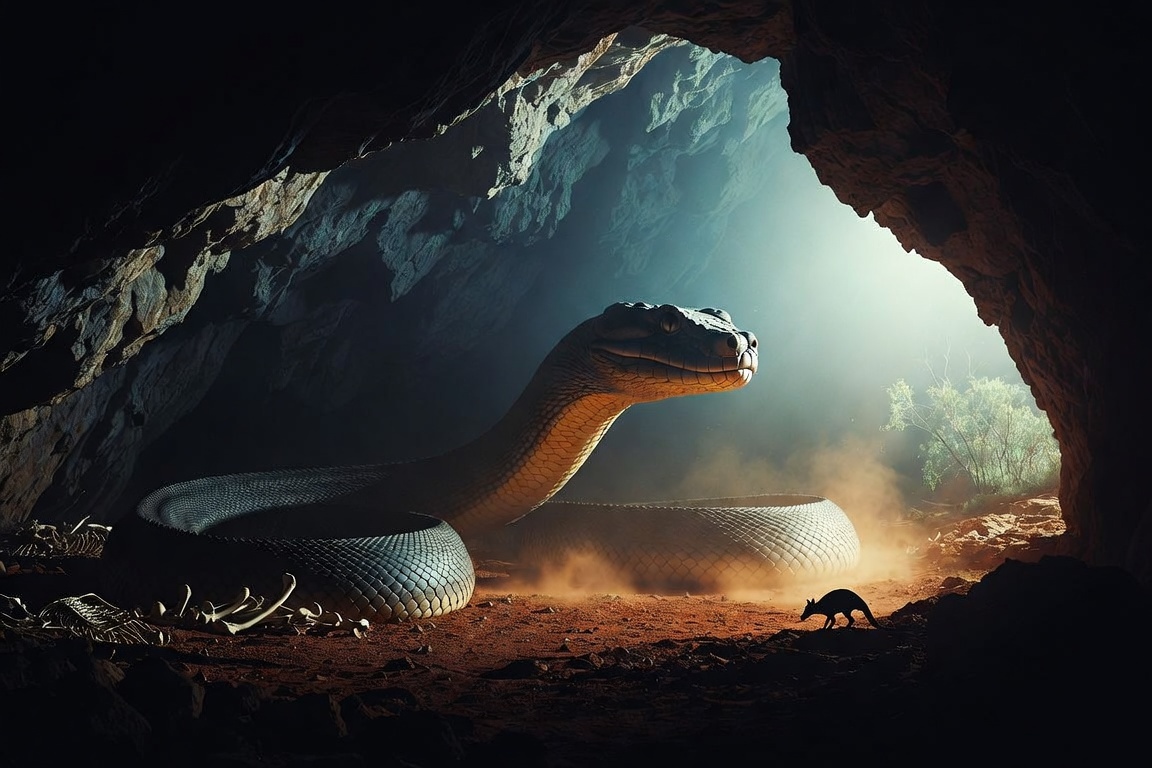
Australia’s prehistoric world was full of animals that feel almost legendary now. Giant marsupials moved across open landscapes. Predators watched from trees, caves, and scrubland. Huge reptiles still held dangerous roles in ecosystems that no longer exist.
Among those reptiles was Wonambi naracoortensis, an extinct giant snake known from Pliocene and Pleistocene deposits in southern Australia.
Wonambi was not a dragon, not a supernatural serpent, and not a cryptid claim. It was a real fossil animal. Its remains include skull and jaw material from places such as Naracoorte Caves in South Australia, one of the most important fossil sites for Australian megafauna.
That setting gives the animal immediate atmosphere. A giant snake known from cave deposits. Ancient bones. Dark limestone chambers. A vanished ecosystem preserved underground.
Wonambi belonged to an extinct group called madtsoiid snakes. These snakes had a long evolutionary history and survived in Australia far later than in many other parts of the world. That alone makes Wonambi interesting because it represents an ancient snake lineage persisting into relatively recent geological time.
It was a large snake, often reconstructed at several meters long. Exact length estimates can vary depending on specimens and methods, but it was clearly much larger than ordinary snakes people encounter today.
Its body likely relied on constriction rather than venom. This fits with interpretations of madtsoiid anatomy and the general image of a large ambush snake. It would have waited, struck, gripped, and used body strength to subdue prey.
The scene writes itself: a heavy coil hidden near a cave entrance, a small mammal stepping too close, then sudden movement from the dark.
Naracoorte Caves is a World Heritage fossil site famous for preserving evidence of Australia’s extinct animals. The caves acted like natural traps and preservation chambers. Animals fell in, sheltered there, died there, or left remains that later became fossil evidence.
Wonambi was part of this broader megafauna story. It shared landscapes with large marsupials, carnivorous marsupials, reptiles, and other animals from Pleistocene Australia. Its world was not the modern continent tourists imagine today. It was stranger, heavier, and more dangerous.
The cave setting also matters because it shapes how we imagine the animal. A giant snake in open grass is one thing. A giant snake connected to dark fossil caves is another. It turns the animal into a real-world serpent legend without needing to invent anything.
Because Wonambi is a giant Australian snake, people sometimes connect it loosely with serpent traditions or Rainbow Serpent stories in Aboriginal cultures. This needs careful handling.
It is not responsible to claim that Wonambi directly inspired a specific cultural tradition unless there is strong evidence from appropriate sources and community context.
The evidence-based angle is safer and stronger: Australia had real giant snakes in its prehistoric ecosystems, and serpent imagery has deep cultural importance across many human societies. Any direct connection between Wonambi fossils and specific stories should be treated as speculation, not fact.
That distinction protects both science and culture from cheap clickbait.
The important point is that Wonambi was not a myth. It was a real snake from a vanished Australian world. But the dramatic hunting scenes are reconstructions, not recorded facts.
Wonambi works because it has the ingredients of myth, but the foundation of science. A giant snake. A cave. Extinct prey. Ancient Australia. Fossil bones in darkness.
The animal does not need glowing eyes, human victims, or supernatural powers. Its real ecology is enough. Large snakes are already visually powerful because their danger is silent. They do not roar. They wait. They turn stillness into a weapon.
In a lost megafauna landscape, that stillness must have mattered. A giant snake could make a cave entrance, a burrow edge, or a shaded path feel dangerous.
Wonambi reminds us that some legendary images have real biological cousins. The giant serpent is not only a symbol. In Ice Age Australia, something close to that image actually moved through the shadows.