11
11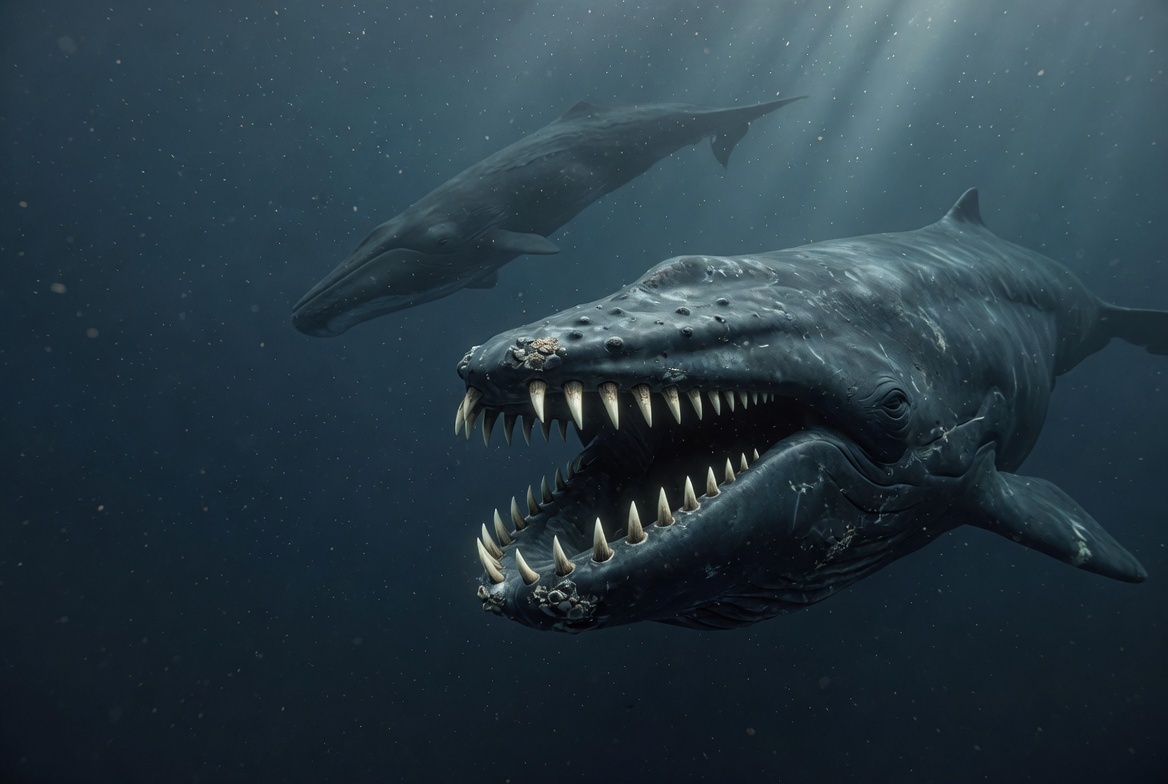
Modern sperm whales are already extraordinary animals. They dive into deep water, use powerful echolocation, and hunt prey in places humans can barely reach. Their size alone makes them feel prehistoric.
But millions of years ago, a very different sperm whale moved through the ocean.
Its name is Livyatan melvillei.
Unlike modern sperm whales, which are famous for feeding largely on squid and other deep-water prey, Livyatan possessed enormous functional teeth in both the upper and lower jaws. Its skull was around three metres long. Some teeth exceeded 36 centimetres in length and reached roughly 12 centimetres in diameter.
These were not decorative tusks. They were weapons built into a powerful bite.
The animal was described from fossils discovered in Peru, in marine deposits dating to the Miocene Epoch.
The remains included a large skull, mandible, and teeth. That combination is important because isolated teeth can be difficult to interpret. A single tooth may suggest the existence of a large predator, but a skull reveals much more about how the animal was constructed.
The fossil showed a whale with a massive head and robust jaws. Researchers recognized that it belonged to an extinct branch of sperm whale evolution sometimes described as macroraptorial (or raptorial) sperm whales. These animals were adapted for seizing large prey with their teeth.
The name Livyatan evokes the Leviathan of old sea-monster traditions, while the species name melvillei honors Herman Melville, author of Moby-Dick.
The naming choice is dramatic. The anatomy earns it.
The most immediately unsettling feature is the teeth. The largest reached more than 36 centimetres in length—which is longer than many human hands from wrist to fingertip—with a diameter of around 12 centimetres.
These teeth were thick, deeply rooted, and built to withstand enormous forces.
Modern sperm whales do have teeth, but their feeding system is not a direct match. Livyatan had large functional teeth in both jaws. Its skull architecture suggests an animal capable of biting and tearing large-bodied prey.
This does not mean every hunting scene in popular artwork is proven. Fossils cannot record an attack, but they do show a predator equipped for a far more forceful feeding style than the squid-focused image many people associate with living sperm whales.
Researchers have proposed that Livyatan may have preyed on medium-sized baleen whales and other large marine vertebrates. That interpretation makes ecological sense.
The Miocene seas contained diverse whales, including forms smaller than many baleen whales alive today. A giant raptorial sperm whale with massive jaws would have had access to prey unavailable to most predators. Its temporal fossae, the areas associated with jaw-closing muscles, were extremely large.
Still, the wording matters. Scientists cannot say that every Livyatan individual specialized in hunting whales. The direct evidence is incomplete. Bite marks, stomach contents, and repeated associations would provide stronger confirmation.
The safest conclusion is that Livyatan was capable of attacking substantial prey and probably occupied an apex-predator role. The idea of whale hunting is a strong scientific interpretation, but it is not a filmed fact.
The Miocene ocean is often imagined as the age of Megalodon. That giant shark has become a global icon, appearing in documentaries, movies, and endless online speculation. Its teeth alone reveal a predator capable of attacking large marine mammals.
Livyatan introduces a more interesting picture. The ocean did not contain only one famous giant; it contained multiple large predators operating in overlapping marine environments.
A massive shark and a raptorial sperm whale may have:
There is no confirmed fossil evidence documenting a dramatic battle between Livyatan and Megalodon. That scenario remains speculative. But the possibility of ecological overlap is real enough to make the Miocene sea feel dangerous in a way modern oceans rarely do.
Large whales were not always the unquestioned giants of the water. Some whales were hunters powerful enough to threaten other whales.
Estimates place Livyatan broadly within the size range of large modern sperm whales. That detail is important because it prevents the animal from becoming a fantasy exaggeration. It did not need to be twice the length of every living whale to be terrifying.
Its danger came from its build:
In other words, Livyatan was disturbing not because it was impossibly gigantic, but because it combined whale-scale mass with predator anatomy. A familiar shape had been rebuilt for a more violent ecological role.
The skull and teeth are the strongest evidence; the soft tissues are less certain.
Paleontologists can estimate the broad body plan from its relationships with other sperm whales, but details such as skin coloration, exact body proportions, the shape of the forehead, and external scars remain interpretive.
Popular images often show a dark whale with a blunt head and exposed teeth. That is a reasonable visual direction, but it should not be mistaken for a photograph. Fossil reconstruction always includes a boundary between evidence and artistic judgment.
The same caution applies to behavior. Livyatan may have used ambush tactics, direct pursuit, group interactions, or solitary hunting. The jaws tell us enough to reject the idea of a passive giant. This was a predator.
Scientists still have major gaps to fill:
New fossils could sharpen the picture. An additional skull might reveal variation within the group, bite-marked bones could clarify prey choices, and more complete skeletons could improve body-size estimates. For now, the teeth remain the clearest message.
The mystery of Livyatan also teaches a broader lesson about paleontology. Marine fossils do not preserve complete stories easily. A large animal may die far from shore, sink into deep water, break apart, and become scattered before sediment covers the remains.
That is why the Peruvian skull matters so much. It preserved enough of the head to establish that Livyatan was not merely a large whale represented by a few unusual teeth. The jaw architecture confirmed a specialized predator.
Whales are often described through a familiar evolutionary arc: land mammals entered the sea, bodies streamlined, and modern forms emerged. The reality is messier.
Different whale lineages experimented with different diets and hunting strategies. The modern ocean contains survivors, not the complete catalogue. Fossils reveal the lost versions.
References: