11
11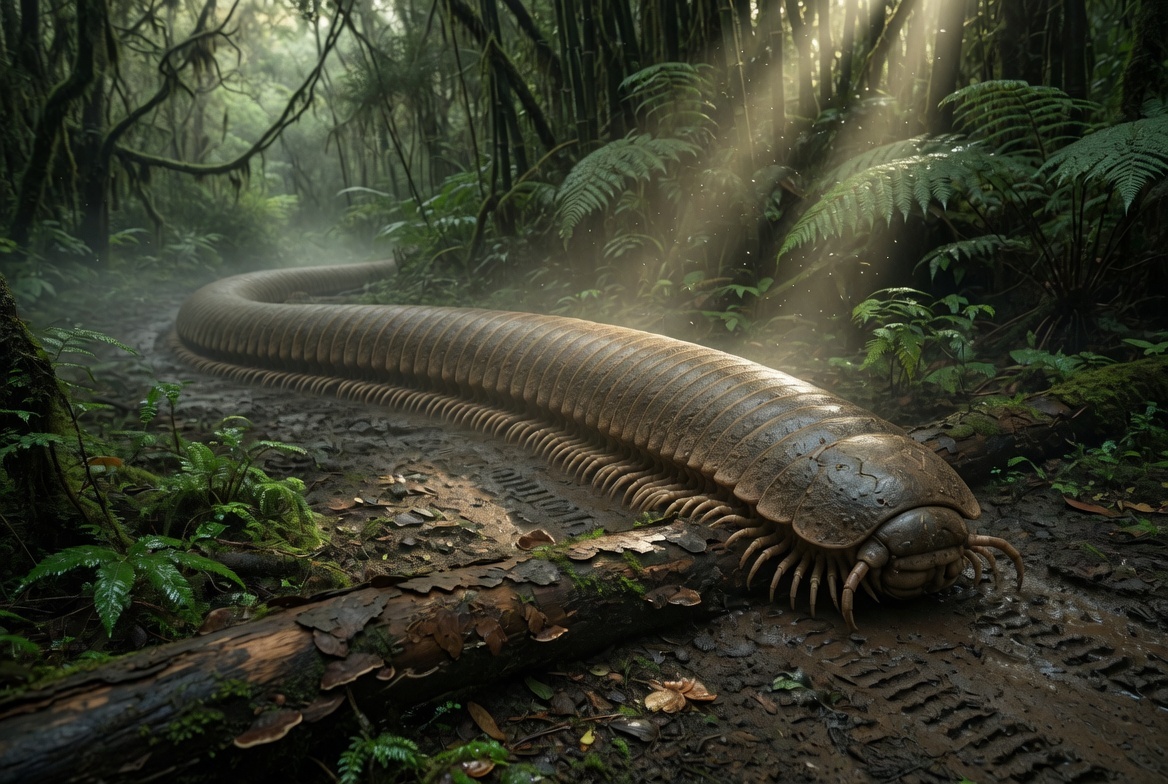
Imagine walking through a damp prehistoric landscape. The ground is dark with moisture. Fern-like plants crowd the edges of shallow channels. Fallen wood lies across the mud. Then something segmented begins moving between the vegetation.
It is not a snake. It is not a reptile. It is an arthropod.
The animal is called Arthropleura, and it is widely regarded as the largest known land-dwelling arthropod in Earth’s history.
Some individuals reached more than two metres in length. Estimates for the largest examples extend toward roughly 2.5 metres or more—closer to the length of a small car than a modern millipede crawling beneath a flowerpot.
One of the most important Arthropleura discoveries came from a fossil exposed on a beach in northern England.
The specimen represented part of a shed exoskeleton, called an exuvium. It measured around 76 centimetres long and 36 centimetres wide, even though it preserved only part of the animal. Researchers used these dimensions to estimate the size of the complete arthropod, suggesting an individual approximately 2.6 metres long and potentially weighing around 50 kilograms.
Fossils like this are rare. Arthropods do not preserve as easily as animals with large internal skeletons. Their external armor may break apart after death or during molting, making a complete, articulated body difficult to fossilize.
That scarcity helps explain why the animal still feels mysterious more than a century after it was first recognized.
Arthropleura is often called a giant millipede. That nickname is useful, but the full scientific picture is more nuanced.
The animal belonged to an extinct lineage related to millipedes and centipedes. Its body was divided into many armored segments, it had numerous legs, and it moved close to the ground.
Recent fossils preserving juvenile heads have helped researchers clarify its anatomy and evolutionary relationships. Those small specimens matter because adult giants often preserve only partial body segments.
The juveniles revealed details of the head, including features connecting Arthropleura with the broader group that includes millipedes and centipedes.
The result is a strange contrast: Some of the most informative fossils from the largest known land arthropod come from individuals only a few centimetres long.
The visual appearance can be misleading. A giant segmented arthropod triggers an immediate horror-movie assumption: venomous bite, aggressive hunting, and a body built to chase prey across the forest floor.
But current evidence does not clearly support that image.
That does not make it harmless in a literal sense. A 50-kilogram armored arthropod moving through dense vegetation would still be an intimidating encounter. But fear factor and feeding ecology are different questions.
The largest known land arthropod may have been a slow-moving ecosystem giant rather than an active predator.
This question has followed Arthropleura for decades. The animal lived during the Carboniferous Period and into the early Permian, when Earth’s landscapes and atmosphere differed from today.
The Carboniferous is famous for giant arthropods. Oxygen levels were high during parts of the period, and many researchers have explored whether elevated oxygen helped some invertebrates reach larger sizes.
That explanation may be part of the answer, but it should not become a simplistic rule. Size is influenced by multiple factors:
The large English specimen is especially interesting because it comes from a time that may not match the peak oxygen conditions often associated with Carboniferous gigantism. This suggests that high oxygen alone may not explain everything.
The landscapes inhabited by Arthropleura were not identical to modern rainforests. Carboniferous ecosystems included large lycopsids, horsetails, seed ferns, and other plants that created dense, humid environments.
Popular reconstructions often place Arthropleura in swampy forests, but the animal may have occupied a wider range of environments, including more open woodland habitats near water.
Trackways provide another window into its movement. Some fossil traces preserve parallel rows of impressions left by many legs crossing ancient sediment. Those tracks reveal an animal moving across the landscape even when its body was not preserved.
A trackway is a ghost of behavior. The animal is gone, but the path remains.
Arthropleura had a broad, segmented body with rigid dorsal plates. That design gave it a visual appearance somewhere between a millipede, a tank tread, and an articulated suit of armor.
The body structure would have provided protection while allowing flexibility. As each segment moved, the animal could bend and navigate uneven ground.
Molting would have been an important part of its biology. Like other arthropods, Arthropleura had an external skeleton. Growth required shedding older armor and replacing it with a larger version. Some fossils may represent these discarded exoskeletons rather than dead bodies.
This creates another paleontological challenge: A shed skin can preserve the shape of an animal without preserving the animal itself. Researchers need to distinguish between remains of a body and pieces of an exuvium.
For years, Arthropleura was famous for its body but poorly understood at the front end. Its head remained elusive, which encouraged dramatic reconstructions. Without a clear head, artists could easily lean toward centipede-like jaws or monstrous interpretations.
Juvenile fossils described from France helped change that picture.
Even though the specimens were small, their preserved heads offered valuable anatomical evidence. Researchers could identify antennae, eye-related structures, and mouthparts that improved the animal’s placement within arthropod evolution.
The head fossils did not make Arthropleura look more terrifying; they made it more scientifically interesting by revealing an evolutionary mosaic.
Researchers still lack the ideal adult specimen: a fully articulated giant with a clearly preserved head, legs, underside, and internal details.
That missing fossil matters. It leaves open questions about growth, reproduction, habitat preferences, and variation between species. It also means reconstructions should remain careful. The broad armored body is well supported. Fine details such as coloration and exact movement speed are artistic interpretations.
The mystery is not a weakness. It is the honest boundary of the evidence.
References: