11
11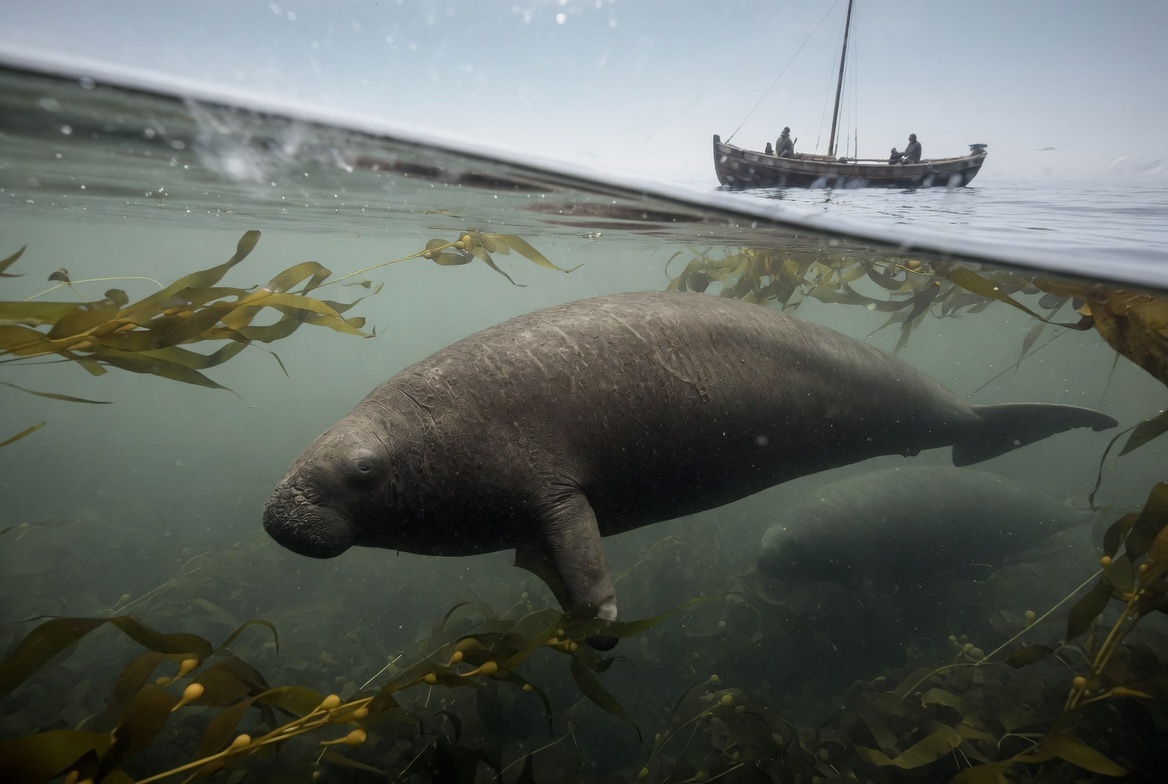
In 1741, members of a stranded Russian expedition near Bering Island encountered an enormous marine mammal feeding in the freezing coastal waters of the North Pacific. The animal moved slowly through dense kelp forests, possessing a heavy body, thick skin, and a lifestyle entirely adapted to the shallow shorelines.
It became known as Steller’s sea cow.
Only 27 years later, it was completely extinct.
The timeline is difficult to process. This was not an animal lost to deep prehistory or erased before humans could document it. Steller’s sea cow survived well into the eighteenth century. European naturalists encountered it, described it, hunted it, and watched its final population vanish within a single human generation.
The animal could reach around ten meters in length and weigh several tonnes. It was related to modern manatees and dugongs, but it occupied a brutally cold environment and grew far larger than any living member of its lineage.
Its extinction was fast, direct, and disturbingly modern.
Steller’s sea cow (Hydrodamalis gigas) belonged to the sirenians, the marine mammal group that includes modern manatees and dugongs. Unlike its living relatives, which thrive in tropical waters, this giant inhabited the icy northern seas, feeding heavily on kelp and other marine vegetation near the shoreline.
The animal’s sheer size made it visually extraordinary:
Because these figures come from historical descriptions and later skeletal interpretations, the exact maximum size should be treated carefully. However, the broad conclusion is secure: this was an immense marine mammal.
Its body was thick, buoyant, and slow-moving. It spent almost all its time in shallow coastal environments where kelp was easily accessible. While those traits made it highly successful in its natural ecosystem, they also made it uniquely vulnerable when humans arrived.
A massive animal living near the surface, moving slowly, and gathering in predictable, shallow waters can become incredibly easy to exploit. Its size offered no protection against boats, harpoons, and relentless hunting pressure.
The animal takes its common name from Georg Wilhelm Steller, a brilliant German naturalist who joined the Northern Expedition led by Vitus Bering. After their ship was wrecked on Bering Island, Steller observed the sea cows firsthand, recording detailed descriptions of their appearance, anatomy, and behavior.
His field notes became some of the only direct scientific observations of the animal while it was still alive.
We know Steller’s sea cow from a tragically narrow historical window. It entered formal scientific awareness shortly before it disappeared forever. There was no long period of careful study, no photographs, no underwater recordings, and no conservation programs.
The species moved from discovery to total extinction before modern ecology even existed as a scientific discipline. Steller’s observations became a final witness statement from an animal already close to the end of its history.
The Commander Islands quickly became critical stopping points for fur traders hunting sea otters. These grueling maritime expeditions required massive amounts of food to survive, and Steller’s sea cows offered an unparalleled source of meat and fat in a single kill.
Historical reporting notes that a single sea cow could feed dozens of men for an extended period. The fat was described as exceptionally useful, tasting like sweet almond oil and resisting spoilage during long voyages in remote waters.
The same features that made the animal impressive also made it a prime target:
Hunting pressure intensified with brutal speed. By 1768, less than three decades after its formal description, the last known Steller’s sea cow was killed. Humans did not need centuries to eliminate the final population; they needed only 27 years.
The final population seen by Steller may already have been a remnant struggling to survive.
Fossil and genetic evidence suggests that Steller’s sea cows once occupied a much broader range across the North Pacific rim, stretching from Japan to California. Over thousands of years, climate shifts and habitat changes gradually reduced the suitable coastal kelp environments they depended on. By the eighteenth century, they were largely restricted to the isolated Commander Islands region.
This context matters because extinction stories are rarely simple. Human hunting delivered the definitive final blow, but the population was already geographically cornered.
A species with a narrow, restricted range has far less room to absorb repeated losses. When its remaining habitat is small and highly accessible, exploitation becomes a rapid death sentence. The animal did not vanish because it was biologically weak; it vanished because its final refuge was exposed.
A landmark 2016 study published in the Proceedings of the National Academy of Sciences explored an additional, indirect mechanism behind the collapse.
In marine ecosystems, sea otters act as a keystone species that helps maintain kelp forests. They do this by preying on sea urchins. If sea otters decline, sea urchin populations expand exponentially and consume kelp forests down to the rock, creating “urchin barrens.”
Fur traders targeted sea otters heavily for their valuable pelts. The study argued that overhunting sea otters damaged the local kelp ecosystems, indirectly contributing to the sea cow’s extinction by starving them out.
While direct hunting of the sea cows remained the primary driver, this ecological disruption made survival impossible. Extinction does not always move in a straight line from hunter to victim. Humans can remove one species and completely destabilize the habitat of another.
Remove enough sea otters, and sea urchins reshape the forest. Damage the forest, and a giant herbivore loses its only food source.
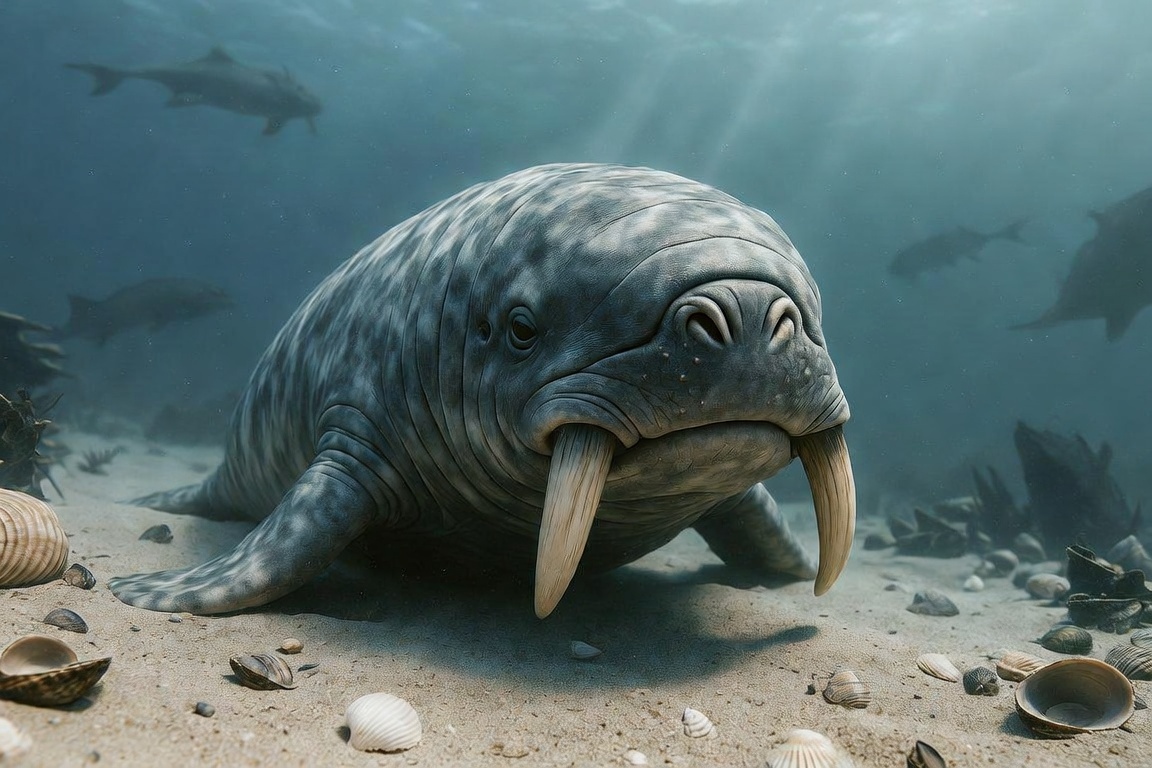
Historical descriptions portray a body masterfully adapted for cold, subarctic water. The skin was remarkably thick, rough, and deeply wrinkled, resembling the bark of an old tree to protect it from sharp ice and rocks.
The animal lacked the prominent teeth expected in large mammals, relying instead on heavy, hardened horny plates in its mouth to crush and process tough marine vegetation. Because kelp grows in shallow coastal waters, the sea cows spent almost their entire lives floating near the surface.
Without photographs, modern reconstructions require caution, combining bone structures, historical texts, and ecological context.
Yet the broad image is hauntingly clear: a massive, dark body moving slowly through the kelp, looking more like a drifting, living island than a fast swimmer. It surfaced amidst the cold ocean mist, its broad, notched tail pushing gently through the water while smaller fish darted through the forest below.
When human boats began appearing more frequently, that calm, predictable movement became its fatal liability.
Because the loss of Steller’s sea cow stands as a monumental warning in conservation history, keeping a clear boundary between verified data and ongoing scientific interpretation is essential.
Steller’s sea cow does not fit the typical narrative of an ancient monster. It had no fearsome teeth, it did not chase prey, and it never attacked ships. Its narrative power comes from a different kind of unease.
A species larger than almost any animal modern humans will ever see survived into the dawn of the modern era. We met it directly. Within decades, we erased it.
The story exposes how quickly a giant can vanish when biology, geography, and human demand align against it. It also challenges the comforting idea that mass extinction is a distant event confined to ancient history. The mid-1700s is not deep time; people wrote books, traded globally, and mapped coastlines, yet one of the world’s largest marine mammals disappeared without a single camera recording its existence.
The final image of the species is quiet. A kelp forest moves with the current near the Commander Islands. Cold light breaks through the grey surface. A massive herbivore feeds peacefully in the shallow water, having survived ice ages, changing coastlines, and a shrinking habitat. Then, human ships arrive.
Steller’s sea cow became a symbol of modern extinction before the world even understood the scale of environmental loss. Its story is not frightening because the animal was dangerous—it is frightening because it was completely defenseless.