11
11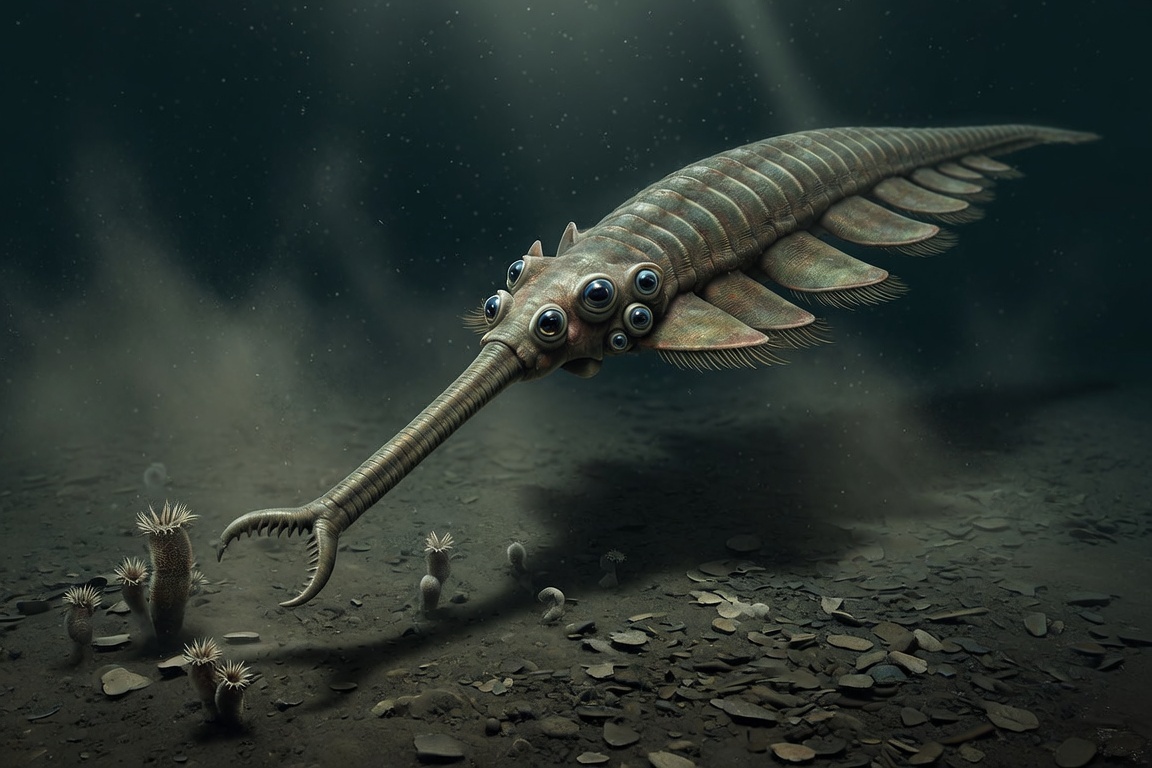
Opabinia regalis is one of the Burgess Shale’s most iconic animals. It had five eyes and a flexible frontal appendage ending in a grasping structure.
The subject feels almost fictional because it sits directly between familiarity and disruption. Viewers recognize part of the shape, story, or setting. Then one detail breaks the pattern completely.
That detail is not invented.
The Royal Ontario Museum describes Opabinia as a flagship Burgess Shale fossil because its unusual morphology resisted easy classification.
Detailed redescription in the twentieth century transformed the animal from an obscure fossil into one of the clearest examples of Cambrian evolutionary experimentation.
The surviving evidence is incomplete, but it is not vague. Researchers can measure, compare, observe, scan, sample, or document specific details. The strongest version of the story begins with those details rather than the loudest internet interpretation.
This matters because strange subjects attract exaggeration quickly:
The evidence deserves a cleaner frame.
The five eyes immediately break expectation. The frontal nozzle adds another layer. Instead of a familiar mouth or claw arrangement, the animal carries a flexible tool extended from the front of the body.
That visual feature is the first hook, but it is not the entire story. Anatomy, environment, history, and scientific context explain why the feature exists and why researchers still care.
A credible reconstruction should make the viewer curious before making any claim.
Opabinia lived in Cambrian marine ecosystems where many body plans looked unlike modern animals. The Burgess Shale preserves those forms unusually well.
Without context, the subject becomes a random oddity. With context, it becomes a window into a larger system: evolution, extinction, deep-ocean adaptation, archaeology, geology, or cosmic structure.
That wider frame is what gives the article weight.
The animal is sometimes treated as a failed experiment. That phrase oversimplifies evolution. Opabinia survived in a real ecosystem and occupied a real ecological role.
The mistake is understandable. Humans interpret unfamiliar evidence using familiar categories. A strange silhouette becomes a monster. A geometric surface becomes a machine. A rare sighting becomes proof of survival. A data anomaly becomes proof of intelligence.
Good science storytelling does not mock that reaction. It corrects it.
These points create the stable foundation. They are the facts strong enough to anchor the headline, thumbnail, Reel, and caption without inflation. The article becomes more compelling when the uncertainty is placed around the facts rather than mixed into them.
These questions remain open because the evidence has limits. Fossils preserve fragments. Deep water hides behavior. Rare animals are difficult to count. Ancient records disappear. Natural systems leave incomplete traces.
An unresolved detail is not a failure. It is the edge of the current evidence.
The fossils reveal the shape clearly while behavior remains partly inferred from anatomy.
This is where the topic stays alive. A complete answer would close the file. A specific unanswered question invites better surveys, deeper dives, improved scans, genetic work, field research, or more careful analysis.
The mystery remains credible because it is defined.
The Reel should reveal the body feature by feature. Five eyes create the first hook. The nozzle creates the second.
The thumbnail should create one clear question. The Reel should reveal the evidence step by step. The article should reward the click with a factual explanation that remains cinematic. This sequence works because the real subject is already strong enough.
The animal is not a fantasy creature. It is a documented fossil that expanded the scientific picture of early animal evolution.
This line should remain visible throughout the article. EdgeCase content works best when viewers feel the mystery but never lose track of which claims are confirmed. Speculation can be discussed, but it cannot be disguised as proof.
Opabinia is memorable because it refuses to look normal even after explanation. The Cambrian ocean contained forms that evolution did not preserve into the present.
The final image is simple: Five eyes scan the seafloor while a flexible appendage reaches downward through the water.
The subject remains memorable because the real explanation does not shrink the mystery. It turns the mystery into evidence.
The story also reveals how easily important details can hide in plain sight. The subject may have existed for millions of years, remained unseen in deep water, survived inside a restricted habitat, or waited inside museum and scientific records for a clearer interpretation.
Better tools do not remove wonder. They sharpen it.
The strongest conclusion remains restrained: Opabinia was a real Cambrian animal, while its exact lifestyle remains partly reconstructed.
References: