11
11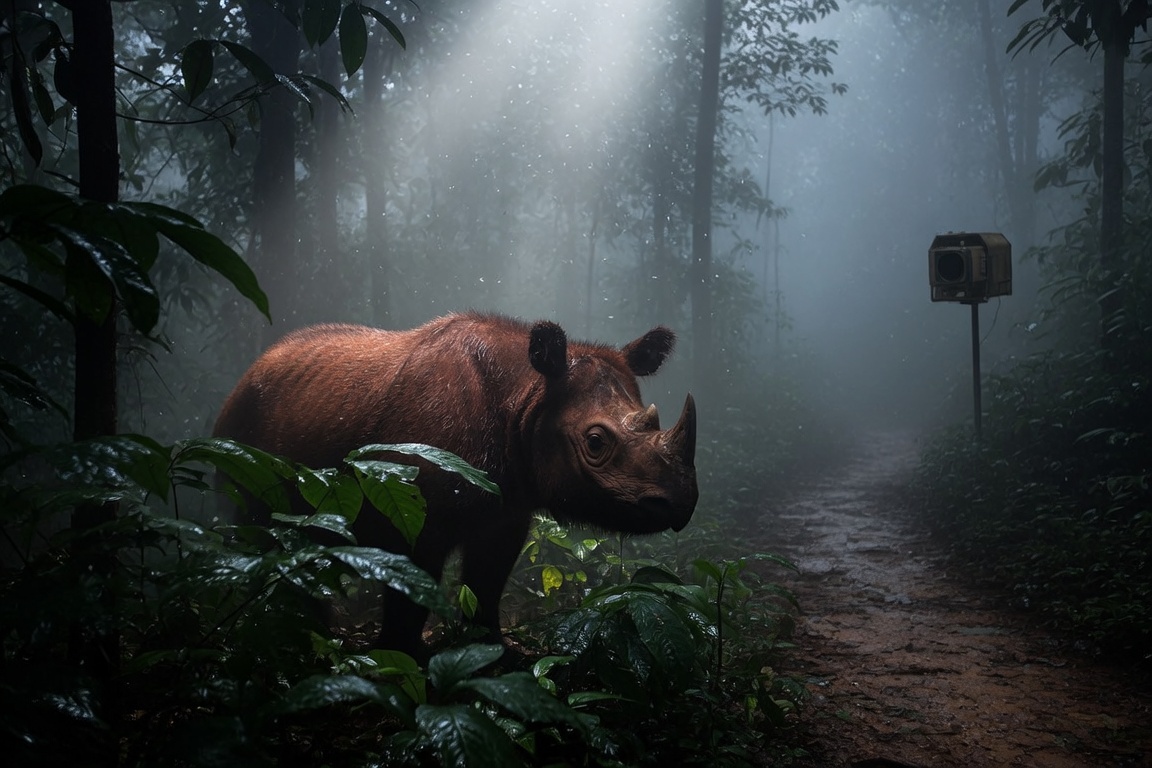
The Sumatran rhino is the smallest living rhino species and the only Asian rhino with a visibly hairy body.
The subject feels almost fictional because it sits directly between familiarity and disruption. Viewers recognize part of the shape, story, or setting. Then one detail breaks the pattern completely.
That detail is not invented.
WWF describes it as the most threatened rhino species, with around 40 surviving in fragmented subpopulations across Indonesia.
The species once ranged widely across South and Southeast Asia. Today it survives only in small, separated groups on Sumatra and Borneo.
The surviving evidence is incomplete, but it is not vague. Researchers can measure, compare, observe, scan, sample, or document specific details. The strongest version of the story begins with those details rather than the loudest internet interpretation.
This matters because strange subjects attract exaggeration quickly:
The evidence deserves a cleaner frame.
The hair immediately changes the familiar rhino image. Wet reddish-brown strands cover the body. Dense vegetation hides an animal that already exists at extremely low numbers.
That visual feature is the first hook, but it is not the entire story. Anatomy, environment, history, and scientific context explain why the feature exists and why researchers still care.
A credible reconstruction should make the viewer curious before making any claim.
Fragmentation creates a reproductive crisis. Animals can remain alive but isolated from potential mates. A population becomes a set of individuals separated by forest loss and distance.
Without context, the subject becomes a random oddity. With context, it becomes a window into a larger system: evolution, extinction, deep-ocean adaptation, archaeology, geology, or cosmic structure.
That wider frame is what gives the article weight.
Poaching is important, but the story is not only about direct killing. Genetic isolation and failure to find mates can push the species downward even when individuals remain protected.
The mistake is understandable. Humans interpret unfamiliar evidence using familiar categories. A strange silhouette becomes a monster. A geometric surface becomes a machine. A rare sighting becomes proof of survival. A data anomaly becomes proof of intelligence.
Good science storytelling does not mock that reaction. It corrects it.
These points create the stable foundation. They are the facts strong enough to anchor the headline, thumbnail, Reel, and caption without inflation. The article becomes more compelling when the uncertainty is placed around the facts rather than mixed into them.
These questions remain open because the evidence has limits. Fossils preserve fragments. Deep water hides behavior. Rare animals are difficult to count. Ancient records disappear. Natural systems leave incomplete traces.
An unresolved detail is not a failure. It is the edge of the current evidence.
Rare forest mammals are difficult to count, and fragmentation creates urgency before the final animals disappear.
This is where the topic stays alive. A complete answer would close the file. A specific unanswered question invites better surveys, deeper dives, improved scans, genetic work, field research, or more careful analysis.
The mystery remains credible because it is defined.
A Reel should use forest gaps and silent trails rather than attack imagery. The danger is separation.
The thumbnail should create one clear question. The Reel should reveal the evidence step by step. The article should reward the click with a factual explanation that remains cinematic. This sequence works because the real subject is already strong enough.
The species is not vanishing because it lacks strength. It is vanishing because surviving animals are too scattered.
This line should remain visible throughout the article. EdgeCase content works best when viewers feel the mystery but never lose track of which claims are confirmed. Speculation can be discussed, but it cannot be disguised as proof.
The Sumatran rhino reveals a painful form of extinction risk: a species can remain alive while the distances between survivors become lethal.
The final image is simple: One hairy rhino moves through wet forest. Somewhere beyond the trees, another may exist too far away.
The subject remains memorable because the real explanation does not shrink the mystery. It turns the mystery into evidence.
The story also reveals how easily important details can hide in plain sight. The subject may have existed for millions of years, remained unseen in deep water, survived inside a restricted habitat, or waited inside museum and scientific records for a clearer interpretation.
Better tools do not remove wonder. They sharpen it.
References: