11
11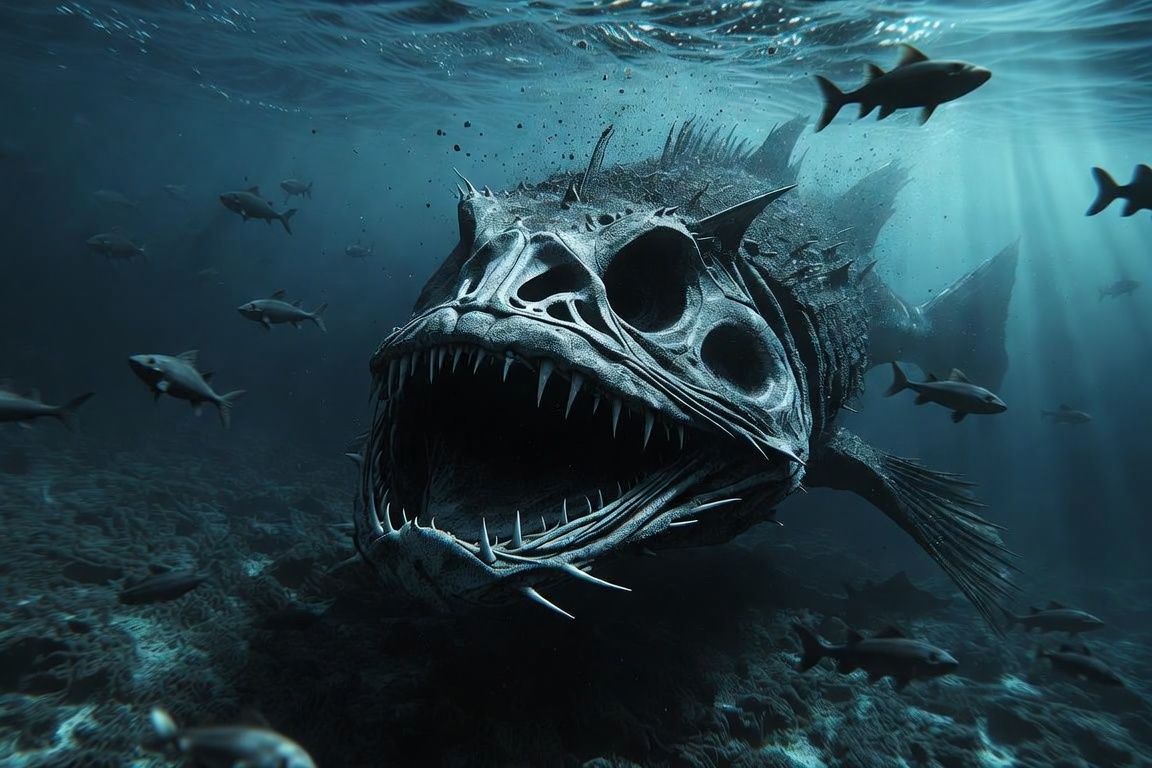
Long before the age of giant marine reptiles, long before mosasaurs, plesiosaurs, and even the first dinosaurs, the oceans already had monsters. But they did not always look like the predators people expect.
Some did not have sleek shark bodies. Some did not rely on rows of replaceable teeth. Some looked more like armored machines dropped into an ancient sea.
Dunkleosteus was one of them.
It lived during the Devonian Period, roughly 419 to 359 million years ago, a time often called the Age of Fishes. This was when vertebrate life in water was exploding into strange new forms. Jawed fish were evolving into predators, armored fish were spreading through ancient seas, and ecosystems were becoming more dangerous than they had ever been before.
Dunkleosteus belonged to a group called placoderms, armored jawed fishes with heavy bony plates around the head and front of the body. These animals were not just “old fish.” They represented one of the first major experiments in large vertebrate predation.
In Dunkleosteus, that experiment became brutal.
Its head was covered in thick armor. Its body behind the armor is less completely known because softer tissues and less mineralized parts did not fossilize as easily. But its skull and jaws tell enough of the story. This was not a gentle animal moving quietly through harmless water. This was a predator whose face was part shield, part trap, part cutting device.
The first thing that makes Dunkleosteus unsettling is its mouth.
Modern viewers expect predators to have teeth. Sharks have teeth. Crocodiles have teeth. Big cats have teeth. But Dunkleosteus did not use teeth in the familiar sense. Instead, its jaws carried sharpened bony plates. These plates formed blade-like edges that could slice into prey.
That detail changes the entire visual of the animal. It was not simply biting with teeth. It was closing a set of armored cutting surfaces. The mouth looked less like a normal fish jaw and more like a mechanical guillotine built into the skull.
Scientific studies of Dunkleosteus feeding mechanics suggest that its skull had a powerful and unusual jaw system. Researchers have modeled its feeding as involving both speed and force.
The jaw could open rapidly, helping create suction, while the bite itself may have delivered serious crushing and slicing power. That combination is terrifying because many predators specialize in one thing. Some are fast. Some are strong. Dunkleosteus appears to have carried elements of both.
This does not mean every pop-science image of Dunkleosteus is perfectly accurate. Size estimates, body shape, and swimming style have all been revised over time as researchers continue studying the fossil evidence. But the core idea remains: Dunkleosteus was a large armored predator with jaws unlike anything alive today.
To understand why Dunkleosteus feels so strange, picture the world before familiar sea life dominated.
There were no whales. No seals. No marine reptiles. No dolphins. No modern sharks as we know them today. The ocean was filled with ancient fishes, armored species, early sharks, invertebrates, and reef ecosystems that looked alien compared with modern tropical seas.
In that world, armor mattered. Many animals carried defensive plates, spines, shells, or hard coverings. Predators had to evolve ways to break through those defenses or exploit softer prey.
Dunkleosteus fit into that arms race. Its own body carried armor, and its mouth carried blades.
This is why the animal feels less like a fish and more like a prehistoric tank. It belonged to an ecosystem where the line between defense and offense was thin. The same body that protected it may also have helped make it more intimidating when it moved through the water.
Scientists cannot watch Dunkleosteus hunt. They cannot prove every detail of its daily behavior. The fossil record gives bones, plates, bite mechanics, and comparisons. The rest comes from careful interpretation.
But even without a perfect record, the surviving evidence is enough to create a vivid scene: murky Devonian water, smaller animals scattering, and a huge armored skull moving forward with its jaw plates ready to close.
The confirmed evidence is that Dunkleosteus was a real placoderm fish from the Devonian, known especially from skull and armor material. Its jaw structure included sharp bony plates rather than normal teeth. Its feeding system has been studied biomechanically, giving scientists clues about how fast and powerful its bite may have been.
The interpretation is how often it hunted large prey, what its full body looked like in motion, how it behaved in different environments, and exactly how dominant it was in every ecosystem where it lived.
Popular media sometimes paints it as an unstoppable monster. The more honest version is better: Dunkleosteus was a highly specialized predator from a world so old that even its familiar parts feel wrong.
It was not a supernatural creature. It was not a myth. It was not a fantasy sea monster. It was a real animal whose preserved skull still looks like something designed for violence.
Dunkleosteus works as an EdgeCase story because it breaks expectations fast. Most people understand a shark. Most people understand a crocodile. But an armored fish with slicing skull plates feels harder to place. It seems ancient in a way that is almost uncomfortable.
The most fascinating part is that its terror comes from real anatomy. The plates, the jaw mechanics, the armored head, the Devonian age, all of it comes from fossil evidence and scientific analysis.
The mystery is not whether the creature existed. The mystery is how it looked alive, how it moved through the water, and what it felt like to be near it in a sea where vertebrate predators were still becoming something new.
Dunkleosteus reminds us that nature did not wait for dinosaurs to become frightening.
Hundreds of millions of years earlier, the ocean had already produced a predator whose face was a weapon.