11
11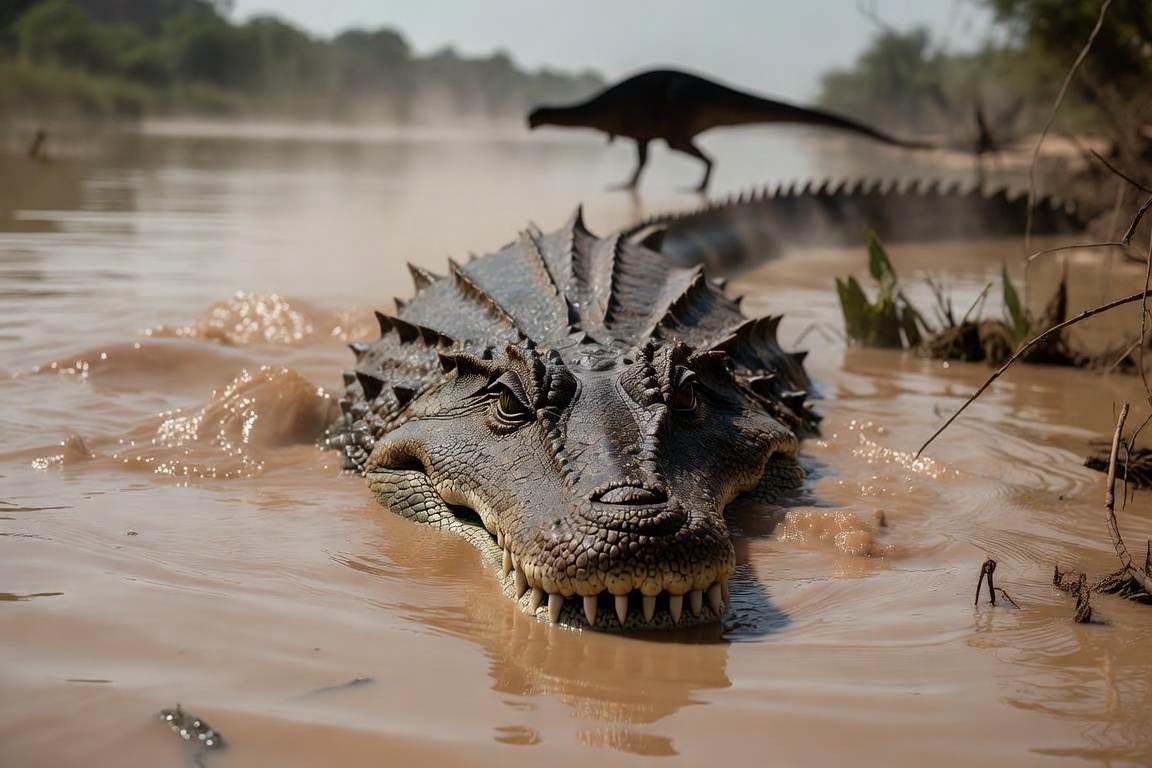
In the age of dinosaurs, danger did not only come from the forest, the floodplain, or the open land. Sometimes, it came from water that looked still.
Sarcosuchus was a giant crocodyliform from the Cretaceous Period, often called SuperCroc. That nickname sounds like a comic-book exaggeration, but the animal behind it was real.
Fossils from Africa revealed a predator with a huge skull, a long snout, heavy body armor, and a body plan built around patience and sudden force.
Unlike a charging land predator, Sarcosuchus did not need to chase everything across open ground. Its greatest weapon may have been concealment. A huge animal hidden under muddy water changes the rules of an ecosystem.
The riverbank becomes a danger zone. Every animal that comes to drink has to gamble with what it cannot see.
That is why Sarcosuchus feels so cinematic. It turns a quiet landscape into a trap.
Sarcosuchus is often compared with modern crocodiles, and the comparison makes sense at first glance. It had a crocodile-like body, a long jaw, eyes and nostrils suited to surface-level watching, and a likely ambush lifestyle.
But it was not simply a modern crocodile enlarged in Photoshop.
It belonged to an extinct lineage of crocodyliforms, relatives of modern crocodilians but not the same animal. Its skull had distinctive features, including a large rounded expansion at the end of the snout. Its body was covered in bony armor called osteoderms.
Fossil evidence indicates it reached enormous size, with some estimates around 40 feet for the largest individuals, though size estimates can shift with methods and specimens.
That size matters because it changes the predator-prey relationship. A small crocodile is dangerous to fish and small animals. A giant crocodyliform can threaten much larger prey, especially at the water’s edge.
This is where the dinosaur connection enters. Sarcosuchus lived in environments where dinosaurs existed nearby. Did it hunt dinosaurs every day? That would be too strong to claim.
But could a giant ambush predator take animals that came too close to the water, including dinosaurs under the right conditions? That is a reasonable ecological possibility.
The most powerful image of Sarcosuchus is not the animal fully exposed. It is the animal almost hidden.
Only the eyes above the water. A ripple moving the wrong way. A long body under brown water. A dinosaur stepping too close to drink.
This is not supernatural horror. It is predator ecology. Modern crocodilians already show how dangerous the waterline can be. They use stillness, camouflage, explosive movement, and strong jaws. Sarcosuchus likely used some similar strategies, though we should be careful not to copy every modern crocodile behavior directly onto an extinct animal.
The fossil record cannot show every ambush. It cannot tell us how often Sarcosuchus hunted versus scavenged. It cannot give a daily menu.
But anatomy can reveal likely capabilities. A giant skull, teeth, aquatic adaptations, and comparison with living crocodilians all point toward a predator that made rivers dangerous.
In an ecosystem filled with dinosaurs, fish, turtles, and other animals, Sarcosuchus did not need to be the fastest thing alive. It only needed to be close enough when something made a mistake.
The confirmed evidence includes skull and skeletal material showing that Sarcosuchus imperator was an enormous crocodyliform from Cretaceous deposits in Africa. Researchers connected with the University of Chicago helped bring the animal into public attention through major fossil discoveries and reconstruction work.
Its size estimates, age, and anatomy have been widely discussed, but like many giant extinct animals, exact maximum size remains tied to available specimens and scaling methods.
The safest framing is that Sarcosuchus was among the largest crocodyliforms known, not that every individual was the maximum size.
Its predatory lifestyle is strongly supported by its skull, teeth, and overall body design. The dinosaur-eating angle should be framed as possible and visually powerful, but not as a guaranteed routine behavior unless a fossil directly preserves that interaction. That distinction keeps the story honest.
Sarcosuchus remains one of the most clickable prehistoric predators because it combines three ideas people instantly understand: crocodile, giant, dinosaur world.
But the real story is better than the nickname. It is not just “big crocodile eats dinosaur.” It is a story about ancient ecosystems where water itself could be a hunting strategy. It is about how a predator can dominate not by speed, but by patience. It is about how danger can be invisible until the last second.
Dinosaurs may have ruled the land, but they still had to drink.
And in some Cretaceous rivers, the thing waiting below the surface may have been Sarcosuchus.