11
11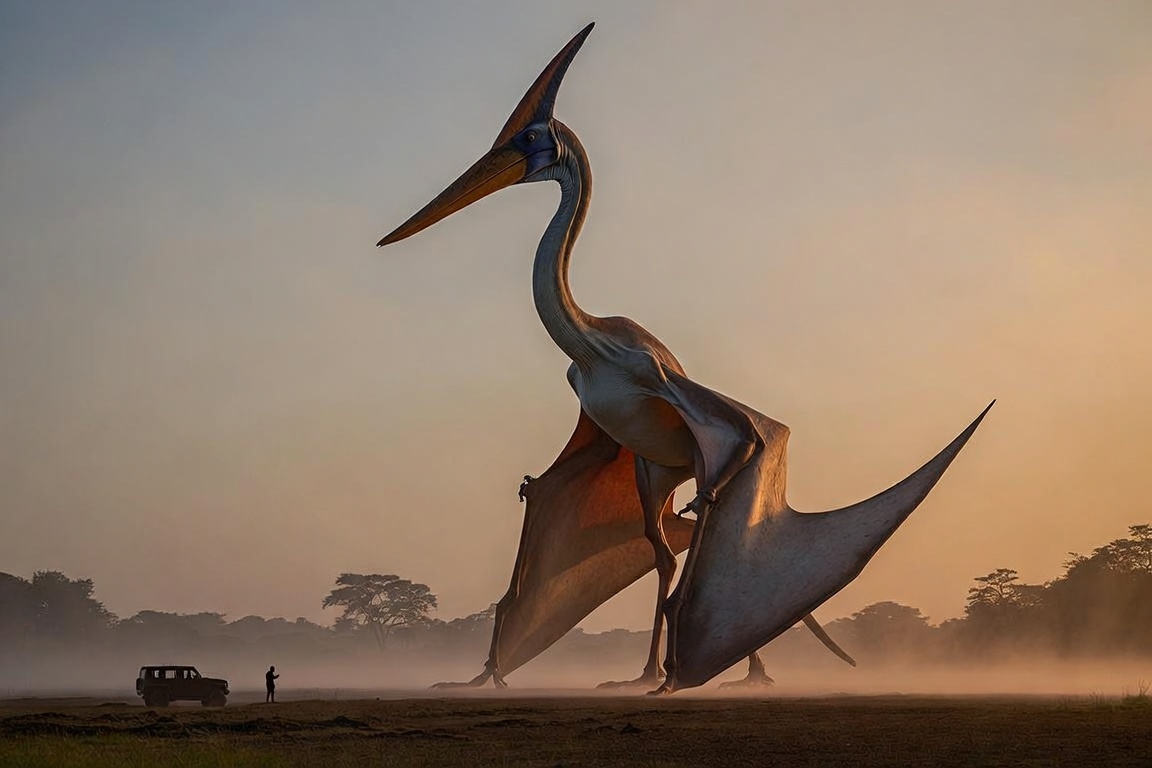
Quetzalcoatlus is one of those prehistoric animals that sounds fake until the fossil record pulls it back into reality.
It was not a dinosaur. It was not a bird. It was not a dragon. It was a pterosaur, part of the flying reptile group that lived alongside dinosaurs for much of the Mesozoic Era.
But Quetzalcoatlus was not just another pterosaur. It was one of the largest flying animals ever known.
The scale is what breaks the brain first. With a wingspan often described as approaching 40 feet in major reconstructions, Quetzalcoatlus was enormous.
Standing on the ground, it may have been as tall as a giraffe.
That single image changes how people think about flying animals. This was not a small reptile flapping over trees. This was a towering creature with folded wings like long limbs, a long neck, and a spear-like beak.
It looked less like a bird and more like a living aircraft that could stare down at a human.
Quetzalcoatlus fossils come from Late Cretaceous rocks in Texas, especially the Big Bend region. During the time it lived, this area was not the dry landscape people see today. It included ancient floodplains and ecosystems shaped by rivers, vegetation, and dinosaur life.
The fossil record for Quetzalcoatlus is incomplete, which is common for pterosaurs. Their bones were lightweight and fragile because flight demands a body built differently from heavy land animals. Fragile bones do not always fossilize well.
That means scientists must reconstruct parts of its life from limited material, comparisons with other pterosaurs, biomechanics, and careful anatomical study.
Still, the evidence is enough to show an animal of extreme size. The questions are about how it lived.
Did it soar for long distances? Did it stalk on the ground? Did it scavenge, hunt small animals, probe for food, or use different strategies depending on environment? Scientists have debated these questions for years.
Some modern interpretations imagine giant azhdarchid pterosaurs like Quetzalcoatlus spending serious time walking on land, using their long necks and beaks in a way that might remind people of giant storks, but stranger and more intimidating.
The flight question is one of the most fascinating parts of the story.
Large flying animals face a brutal physics problem. They need enough muscle and wing area to take off, but they also need to stay light enough to become airborne. For Quetzalcoatlus, researchers have explored launch mechanics, including the idea that it may have used a powerful leap before flapping into flight.
That image is incredible: not a clumsy giant running forever across the ground, but a huge pterosaur vaulting upward using strong limbs, then opening wings into the air.
Not every detail is settled. Flight ability, launch style, and body mass estimates remain areas of scientific discussion. But Quetzalcoatlus is not generally treated as a fantasy creature that could not exist. It is treated as a real animal whose anatomy challenges our intuition about what powered flight can look like.
Dragons ignore physics. Quetzalcoatlus forced physics to get weird.
For decades, many people imagined pterosaurs mainly in the air. But the ground posture of Quetzalcoatlus may be even more unsettling.
On land, it would have moved on all fours, using its folded wings as forelimbs. Its head would have risen high above the ground. Its beak could reach down toward smaller animals.
This creates one of the strongest visual hooks in paleontology: a flying reptile that also looks like a giant terrestrial stalker.
Again, the details of its diet are interpretation. Scientists cannot point to a video of Quetzalcoatlus hunting. But the anatomy suggests it was capable of moving on land and interacting with ground-level food sources. The open environments of Late Cretaceous Texas would have given it space to walk, launch, and feed.
A creature like this did not need to breathe fire to be terrifying. Its real proportions were enough.
The confirmed evidence is that Quetzalcoatlus was a real pterosaur from the Late Cretaceous, known from fossils in Texas. It was enormous and is widely discussed as one of the largest flying animals known. Pterosaurs were flying reptiles, not dinosaurs and not birds.
The interpretation or debate involves:
These are active scientific questions because the fossil record is incomplete and the animal was physically extreme. That distinction is important. The honest story is not weaker. It is stronger. Quetzalcoatlus existed, and even the careful version still sounds impossible.
Quetzalcoatlus is fascinating because it pushes against modern experience. No living bird, bat, or reptile gives us a perfect comparison. We can understand pieces of it, but the whole animal feels like a lost engineering project from deep time.
It stood like a giant. It flew like nothing alive today. It lived above a dinosaur world that was already nearing its final chapter.
The mystery is not whether it was real. The mystery is how an animal that large moved through the world with such an extreme body plan. That is why Quetzalcoatlus remains one of the most visually powerful creatures in prehistory.
It was not a dragon. It was stranger, because it actually happened.