11
11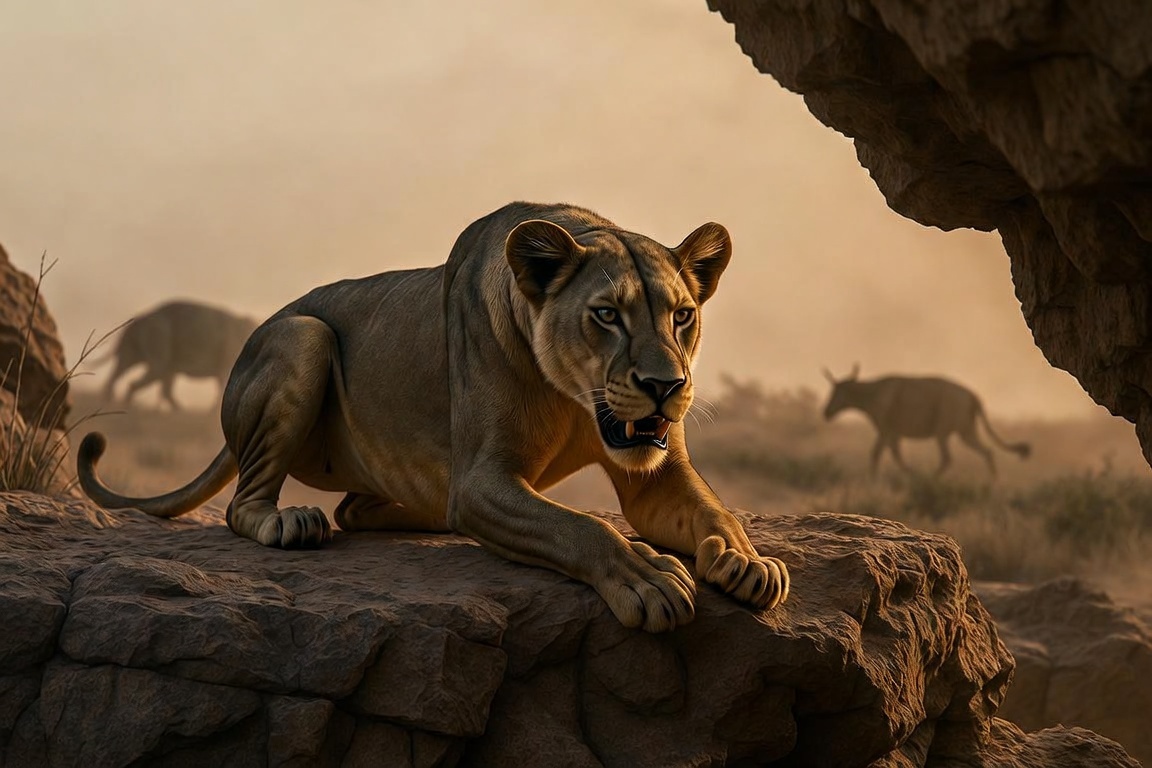
Australia’s prehistoric past was not just kangaroos, wombats, and quiet open plains. During the Pleistocene, the continent held giant marsupials, huge birds, massive reptiles, and predators unlike anything alive today.
Among the strangest was Thylacoleo carnifex, often called the marsupial lion.
That name is useful, but it is also misleading.
Thylacoleo was not a true lion. It was not a cat. It was a marsupial predator, part of a world where mammal evolution followed a different path from the familiar predators of Africa, Europe, or North America.
Instead of becoming a big cat, Australia produced something with its own brutal anatomy: strong forelimbs, curved claws, powerful jaws, and specialized slicing teeth.
It looked familiar enough to be called a lion, but strange enough that the name never fully fits. That mismatch is what makes it disturbing.
The skull of Thylacoleo is one of its most important clues. Its teeth were not arranged like those of a modern lion. Instead, it had enlarged blade-like premolars that worked as slicing tools. This gave it a bite that researchers have long considered highly specialized for meat-eating.
Its forelimbs were also powerful. The animal appears to have had strong grasping ability, and its claws suggest it could hold onto prey, climb, or maneuver with force.
Some studies and discoveries have supported discussion of climbing ability, though exactly how often it climbed or whether it dragged prey into trees remains debated.
The best version of the story is careful: Thylacoleo was a powerful carnivorous marsupial, likely one of Australia’s top mammalian predators. It may have hunted or scavenged large animals. It may have used strength, ambush, and gripping limbs rather than long-distance pursuit.
This makes it feel very different from a cheetah or wolf. It was not necessarily built to run prey down across huge distances. It may have been built to grab, hold, and cut.
Thylacoleo lived in Pleistocene Australia, a world filled with megafauna. This included giant herbivorous marsupials, large flightless birds, huge monitor lizards, and other animals that are now gone.
It was not an empty wilderness. It was a continent of heavy bodies, strange forms, and ecological relationships that vanished before modern science could observe them alive.
In that world, Thylacoleo would have occupied a frightening role.
The common visual is a muscular predator waiting near rocks, trees, or cave entrances. It watches. It grips. It strikes at close range. Whether that exact scene happened in the way artists imagine is interpretation, but the anatomy supports the idea of a serious predator, not a harmless scavenger.
The fossil record also links Thylacoleo to cave sites, especially in Australia’s famous fossil regions. Caves can preserve bones, footprints, and ecological clues. They also create a perfect visual setting: a predator known from darkness, stone, and vanished giants.
The confirmed evidence is distinct from interpretation:
These questions remain open because behavior rarely fossilizes directly. We can make Thylacoleo feel dangerous without pretending every dramatic scene is proven. The animal’s anatomy already does enough work. It does not need fake certainty.
Thylacoleo eventually disappeared along with much of Australia’s megafauna. The timing and causes of these extinctions remain debated, with climate change, environmental shifts, human arrival, and ecosystem disruption all discussed in scientific literature for different animals and regions.
For Thylacoleo, extinction adds another layer of mystery. A predator so specialized depends on an ecosystem that can support it. When the large prey base changes, when habitats shift, when fire patterns or climate change, predators can collapse too.
That gives the story a darker final note. Thylacoleo was not just a monster-like animal. It was part of a lost system. Remove the system, and even the strongest jaws become useless.
Thylacoleo is visually powerful because it is close enough to familiar predators to be understandable, but different enough to feel wrong. It was not a lion, yet the nickname helps people feel the role it played. It was not a tiger, yet its cutting teeth suggest violence. It was not a bear, yet its body may have carried that compact power.
It was Australia’s own answer to large mammalian predation, shaped by marsupial evolution and a continent full of extinct giants.
The real story is that nature built a predator that does not fit neatly into modern categories.
A marsupial with a skull for slicing. A hunter from a vanished world.