11
11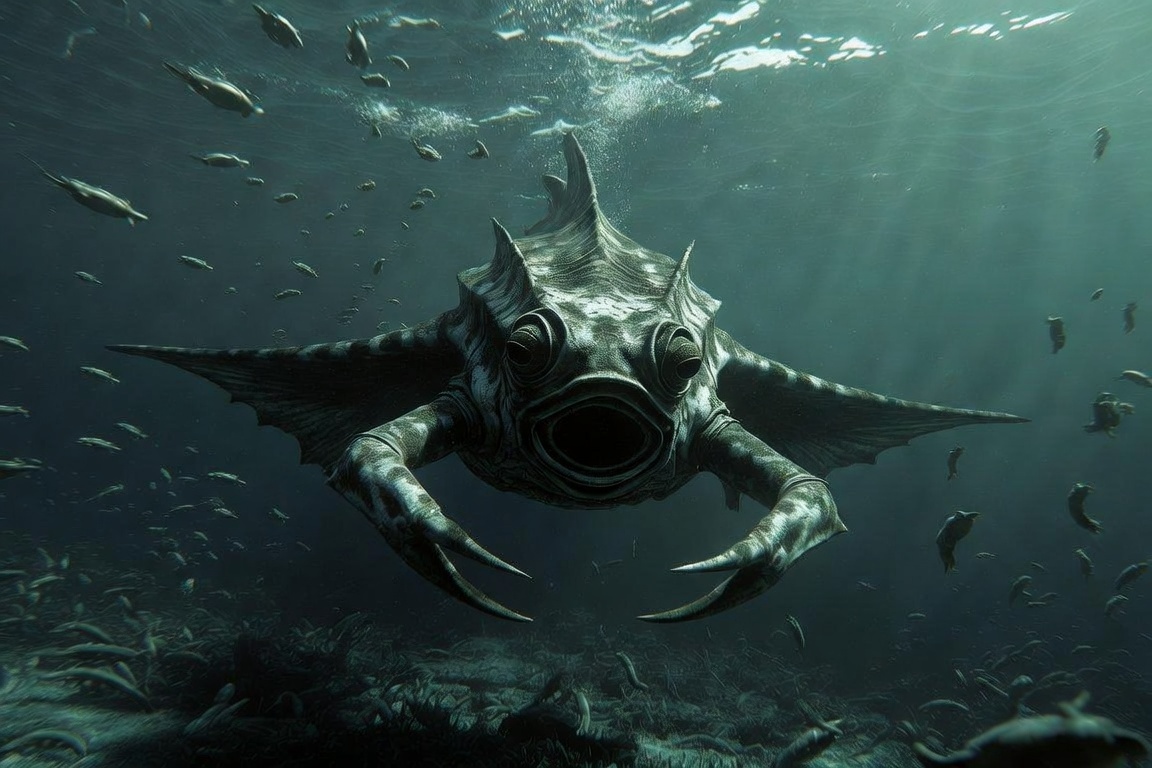
Long before sharks, whales, mosasaurs, or even fish as we know them, the ocean was already dangerous. But the danger did not look familiar. It did not have fins like a tuna or teeth like a great white. It looked experimental, almost unfinished, as if life was testing body plans in real time.
Anomalocaris lived during the Cambrian Period, more than 500 million years ago. This was one of the most important chapters in the history of animal life, when many strange forms appeared in marine ecosystems. The Cambrian seas were full of organisms with body shapes that still feel alien today: spiny animals, armored creatures, soft-bodied forms, early arthropod relatives, and predators unlike anything alive now.
Among them, Anomalocaris became one of the most iconic. Its name means “unlike other shrimp,” which is almost funny because the animal was far stranger than that. Early fossils of its body parts were misunderstood because different pieces were found separately. Its frontal appendages, mouth, and body were not immediately recognized as belonging to the same animal. Over time, paleontologists pieced the puzzle together and realized they were dealing with a massive Cambrian predator.
Anomalocaris had a body that simply does not fit modern expectations. It belonged to a broader group often called radiodonts, extinct relatives near the early arthropod lineage.
To picture this creature, imagine a combination of highly unusual features:
This combination makes the animal visually unforgettable. It was not a fish. It was not a squid. It was not a shrimp.
The confirmed fossil evidence shows that Anomalocaris was real and widespread, with spectacular material known from sites such as the Burgess Shale. Scientists interpret it as an active feeder, though exact feeding behavior has been debated. Some studies question how hard its mouthparts could bite, meaning it may not have crushed the toughest trilobite shells in the dramatic way older reconstructions suggested.
That does not make it less frightening. It makes the story better. Anomalocaris was not a cartoon monster; it was a real animal from a world where predation itself was still being shaped.
The Cambrian Period is famous partly because predator and prey relationships became drastically more complex. Animals developed armor, spines, burrowing behavior, better senses, and new ways to move. Predators, in response, evolved ways to grab, chase, process, or trap prey. The ocean became a biological arms race.
Anomalocaris fits perfectly into that world:
It may have hunted soft-bodied animals or weaker prey, and it was certainly one of the largest active animals in its ecosystem. The important point is not that it was invincible—it wasn’t. The important point is that it showcases an early stage of ocean predation, back when the rules of survival were still being written.
Science rebuilds deep time from fragments, corrections, and strange anatomy. Here is where our current understanding stands:
That uncertainty is not a weakness. It is the hook that keeps the mystery alive.
Before sharks became symbols of ocean fear, before reptiles invaded the sea, before whales learned to hunt in deep water, Anomalocaris was already moving through ancient darkness.
Anomalocaris remains fascinating because it looks like something from another planet, while being entirely real. It came from Earth’s own ocean, from an era when animal life had not yet settled into the familiar shapes we recognize today. It was not a sea monster from legend. It was a spectacular fossil animal with a body plan so unusual that scientists had to reconstruct it piece by piece, fundamentally changing how we view the history of life on our planet.
References: