11
11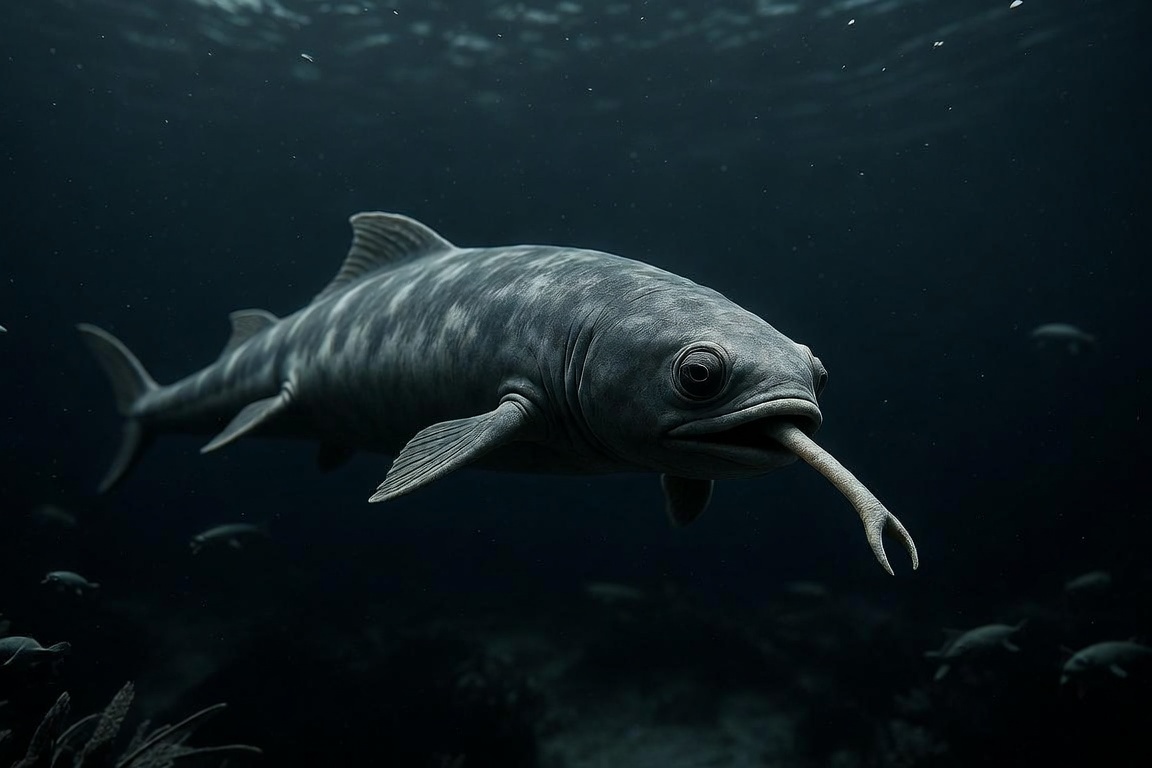
Some fossils are famous because they reveal a clear story. The Tully Monster is famous because it refuses to give scientists one.
Officially known as Tullimonstrum gregarium, the Tully Monster is an extinct soft-bodied animal found in the Mazon Creek fossil beds of Illinois. It lived around 300 million years ago during the Carboniferous Period. The fossils preserve an animal with a body plan so strange that it has triggered decades of debate.
It did not fit neatly into the usual biological categories. It looks partly like several things, but not fully like any of them. Its bizarre anatomy featured:
The Tully Monster is so iconic that it became the state fossil of Illinois. But even with that fame, scientists have not fully settled what kind of animal it was.
Some studies have argued that it may have been a vertebrate, possibly related to lampreys. Other research has pushed back, suggesting the evidence does not clearly support that conclusion. The debate involves features interpreted as a notochord, eyes, body structures, and chemical signatures in fossil preservation.
This is where the story gets good. The Tully Monster is not mysterious because people have no evidence. It is mysterious because the evidence is profoundly difficult to interpret.
Soft-bodied fossils can be tricky. They preserve outlines, tissues, and impressions rather than the hard skeletons that make many animals easier to classify. Depending on how those features were compressed, altered, or chemically preserved, different researchers can interpret the exact same fossil in entirely different ways.
Behavior is even harder to reconstruct than identity.
But exactly how it moved, fed, and behaved remains uncertain. Was it an active hunter? A slow swimmer? A bottom-feeder? A strange vertebrate relative? An invertebrate with misleading features? Scientists continue to test these possibilities.
For storytelling, this is the perfect kind of mystery because it is not fake. It does not require conspiracies or monster claims. The uncertainty is genuinely scientific.
That is what makes the Tully Monster so valuable. It is strange, highly visual, and unresolved, yet completely grounded in real paleontology.
The Tully Monster feels like a biological riddle preserved in stone. It is one of those rare animals where the question “what is it?” is still more powerful than the answer.
The Tully Monster is not huge. It is not a giant predator. It does not have massive jaws or terrifying claws. But it has something better: taxonomic chaos.
It forces scientists and audiences alike to confront a basic truth about fossils. Not every extinct animal comes with a clean, easy-to-read label. Some creatures lived in evolutionary side streets that left no obvious modern equivalent.
References: