11
11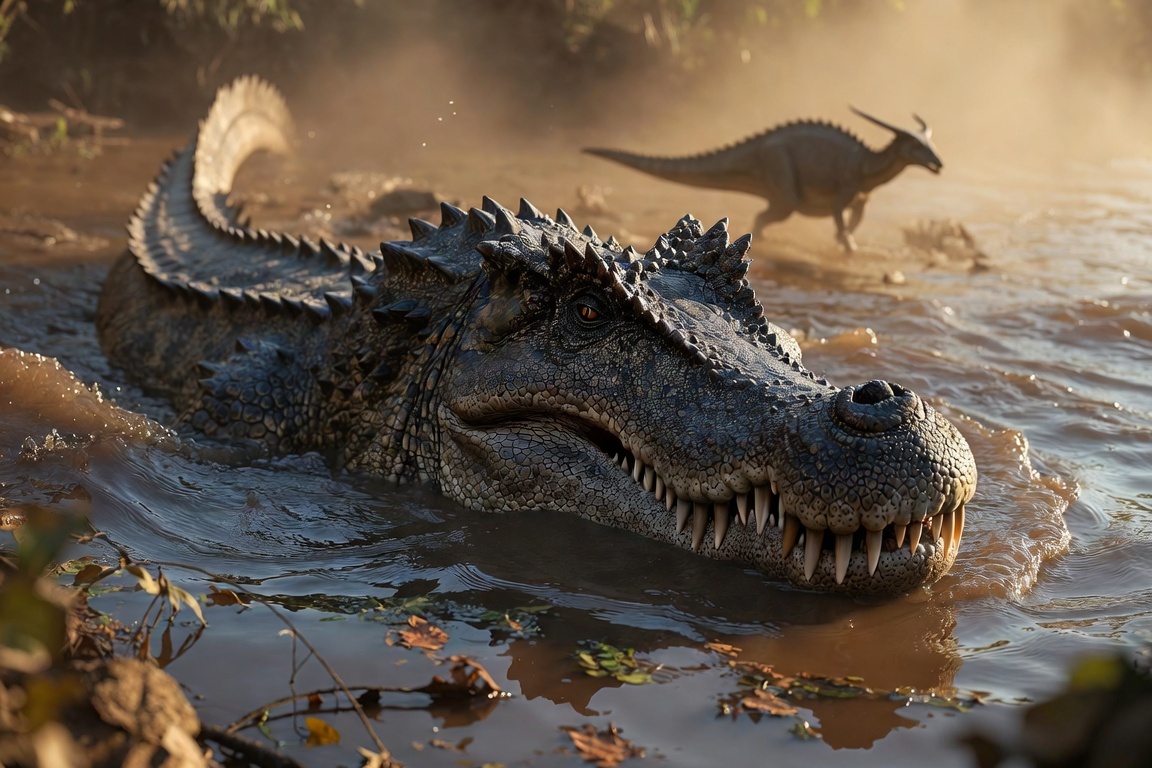
In the Late Cretaceous, danger did not always come from claws on land. Sometimes, it waited under still water.
Deinosuchus was a giant crocodyliform that lived in North America during the age of dinosaurs. Its name means “terrible crocodile,” but it was not simply a modern crocodile enlarged into a movie monster. It belonged to an ancient branch of crocodile-line reptiles, and recent studies have continued to refine how it fits into crocodyliform evolution.
The visual hook is brutal: a huge armored predator hidden in rivers, estuaries, and coastal wetlands while dinosaurs moved nearby. Some Deinosuchus species reached enormous size. Scientific reviews describe Deinosuchus as one of the largest semiaquatic predators in its environments, with large teeth and a body plan suited for ambush.
That does not mean it chased dinosaurs across open land. The more credible image is worse. It did not need to chase. It waited.
Modern crocodilians already show how dangerous patience can be. They use water as cover, expose only the eyes and nostrils, and explode forward when prey gets too close. Deinosuchus likely used a similar ecological advantage, though scientists should be careful not to copy every modern behavior directly onto an extinct animal.
Its teeth were large, thick, and suited for powerful biting. Some public descriptions compare them to bananas in size, which is not just clickbait—it reflects the scale of the fossil material. The jaws suggest an animal capable of seizing large prey and crushing hard tissue.
There is fossil evidence that supports interaction with dinosaurs, including bite marks on dinosaur bones attributed to large crocodyliform predators. The dramatic phrase “dinosaur-killer croc” should be used with care, but the core idea is supported: Deinosuchus lived beside dinosaurs and was large enough to threaten them under the right conditions.
During the Late Cretaceous, North America was divided by the Western Interior Seaway. Deinosuchus fossils are known from multiple regions, and different species have been named from different sides of this ancient world. New phylogenetic research has even challenged older assumptions about whether Deinosuchus sits neatly with alligatoroids or belongs closer to stem crocodylians.
That might sound technical, but it matters. Deinosuchus is not just a giant crocodile fact. It is an active scientific puzzle involving geography, evolution, and gigantism.
The fossil record gives strong clues, but not a complete documentary.
Deinosuchus is terrifying because the scene is easy to imagine.
A dinosaur lowers its head to drink. The surface barely moves. Then the river opens.
No fantasy needed. No supernatural claim needed. The fossil record already gives us a giant ambush predator from the dinosaur world.
The deeper point is even stronger: land animals may dominate headlines, but water changes the power balance. Near a Cretaceous riverbank, the biggest danger might have been the shape you could not see.
References: