11
11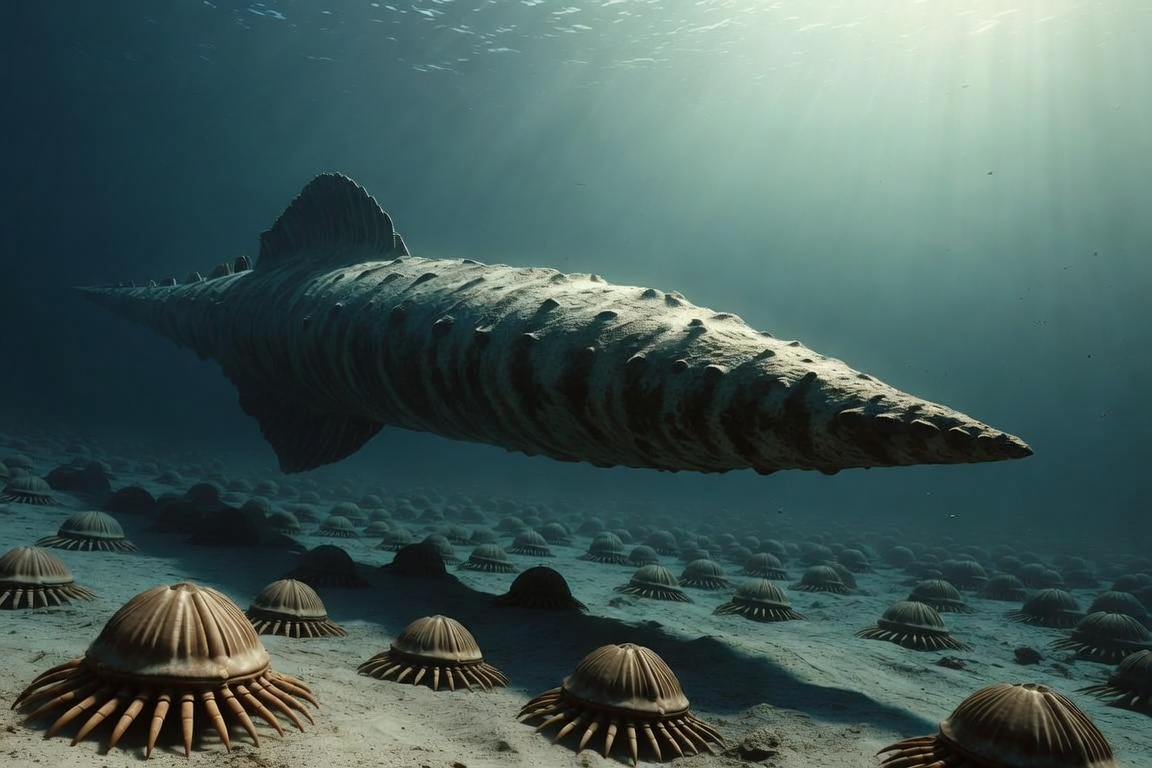
Cameroceras belongs to a world far older than dinosaurs, sharks, or marine reptiles.
It lived during the Ordovician Period, when the oceans were filled with trilobites, brachiopods, early fish, and strange cephalopods carrying external shells. Unlike modern squid and octopuses, many ancient cephalopods lived inside hard shells:
Cameroceras is often used as the iconic image of a giant orthocone cephalopod—a long cone-shaped shell with the animal’s soft body and arms at the opening.
The most dramatic part of Cameroceras is its silhouette. A straight shell stretching through the water feels less like an animal and more like a natural missile.
The living creature would have occupied the open end of the shell, using arms near the mouth to capture food, while its buoyant shell helped control position in the water.
Size claims around Cameroceras are often exaggerated online. The honest approach is to frame it as a large orthocone cephalopod known from fossil shell material, while avoiding fake certainty about extreme maximum length.
The Ordovician seas were rich with bottom-dwelling invertebrates, early vertebrates, and competing predators. In this environment, large cephalopods may have been among the most important hunters.
They were mobile, armed with grabbing appendages, and equipped with hard protective shells. To a trilobite crawling across the seafloor, the shadow of a large orthocone above would have been a real threat.
While the exact feeding behavior cannot be proven in detail, its anatomy perfectly fits a predatory cephalopod lifestyle.
Popular reconstructions often turn Cameroceras into a kraken-like supermonster. However, separating fact from fiction reveals a much more credible animal:
It was a shell-bearing cephalopod from an ancient ocean where the predator shape had not yet become the squid or octopus forms we recognize today.
Cameroceras is powerful because it connects real fossil evidence with sea monster imagery without crossing into fake claims.
Its shape feels legendary—a long spear of shell with tentacles at the front moving through ancient water. But the foundation is paleontology, not folklore.
It reminds us that before modern cephalopods became soft-bodied masters of camouflage, some of their relatives carried huge shells through the sea. The Ordovician ocean had its own monsters, and some of them looked like living weapons.
References: