11
11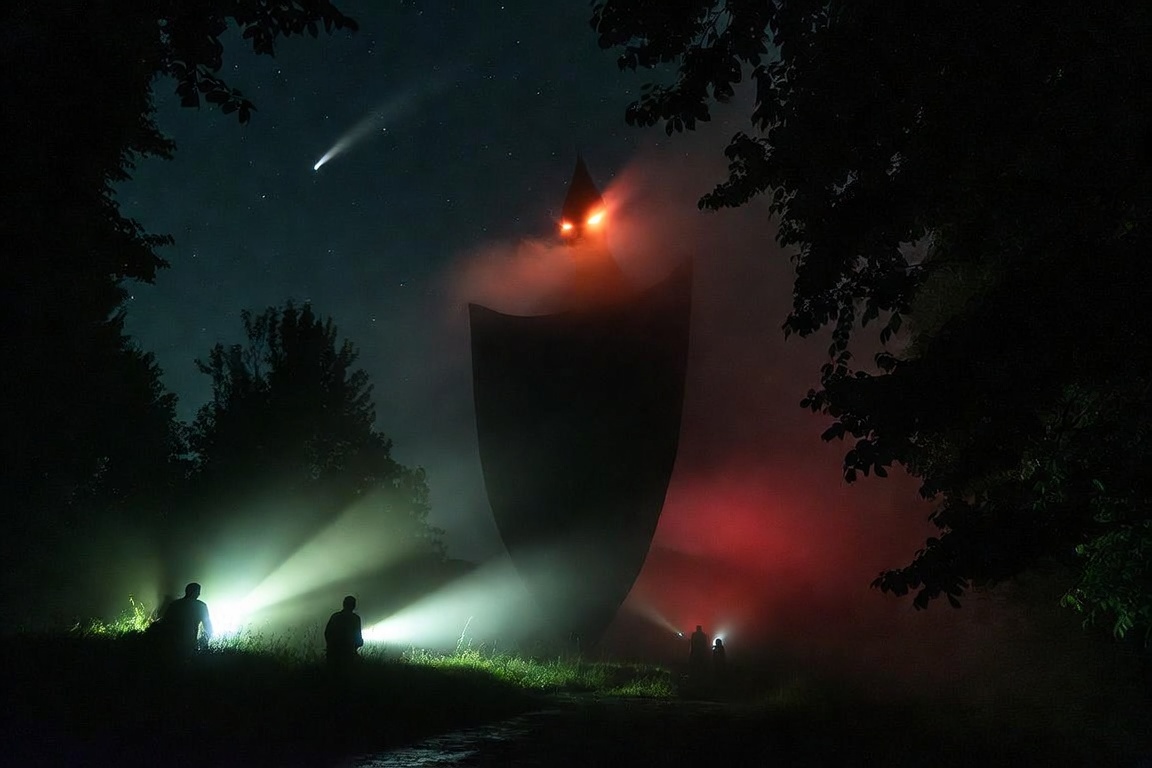
The Flatwoods Monster is one of those cases where the image became more powerful than the evidence. A tall figure. A spade-shaped head. Glowing eyes. A dark metallic shape beneath it. A hilltop in West Virginia. A red light in the sky.
The story began on September 12, 1952, in Flatwoods, West Virginia. Witnesses reported seeing a bright object move across the evening sky, then a group went toward the area where they believed it had come down. What they described next became one of America’s most famous cryptid encounters: a towering figure in the darkness, strange lights, fear, and a sudden retreat.
This is not a story that should be presented as proof of an alien or unknown creature. The honest version is stronger. The Flatwoods case sits at the intersection of eyewitness memory, Cold War anxiety, meteor reports, local folklore, and a very possible natural explanation.
That mix is exactly why it survived.
The classic account describes several witnesses moving toward a hill after seeing a bright light. There, according to the legend, they encountered a tall figure with glowing eyes and a strange head shape. Some versions mention mist, a strong odor, claw-like hands, and a body shape compared to a dark metallic dress or shield.
Those details are visually unforgettable. They are also difficult to verify with certainty. Eyewitness accounts can shift over time, especially when fear, darkness, expectation, and later media coverage enter the story.
What is confirmed is narrower. There was a reported sighting in Flatwoods in 1952. The event became famous through newspapers, local retellings, tourism, and pop culture. The creature is now deeply tied to West Virginia folklore.
What remains unconfirmed is the creature itself.
Many skeptical explanations connect the bright light to a meteor. That matters because a meteor can create a dramatic sky event, especially if seen by people already alert and frightened. Once the witnesses believed something had landed nearby, the night itself became charged with expectation.
The creature has often been explained as a barn owl seen in poor conditions. A barn owl perched in a tree, lit by flashlight, partly hidden by branches, and framed by fear could appear much larger and stranger than it really was. Owls also have pale faces, intense eyes, sudden movements, and unsettling hisses.
This explanation does not require people to be lying. It only requires a human brain doing what it often does under stress: assembling fragments into a threat.
That is one of the most interesting parts of the Flatwoods Monster. The case does not need a fake creature to be fascinating. It shows how a real sky event, a real animal, and real fear can fuse into a lasting legend.
Most cryptids are remembered through vague silhouettes: hairy figures, lake shadows, giant wings, long necks. The Flatwoods Monster is different. It has a highly specific design. The spade-shaped head and dark lower body give it a clean visual identity, almost like a warning sign.
That design helped it spread. Artists could draw it. Museums could display it. Pop culture could reuse it. Over time, the creature became less about one night and more about an image people instantly recognize.
But image is not evidence. That distinction is critical.
The Flatwoods Monster is confirmed as folklore and reported experience. It is not confirmed as a biological animal, alien visitor, or unknown species. The most grounded explanation remains a mixture of meteor sighting, owl misidentification, darkness, and fear.
The Flatwoods Monster works because it is not just a “monster story.” It is a case study in how legends form.
A bright object crosses the sky. Witnesses go looking. A shape appears in the dark. The brain tries to decode it quickly. Newspapers amplify the story. The town remembers it. Decades later, the image becomes stronger than the original event.
That is how folklore becomes durable.
The final mystery is not whether a ten-foot creature stood on a hill in West Virginia. The better question is how a brief night of confusion became a permanent American monster.
The Flatwoods Monster may not prove the existence of anything unknown in the woods, but it absolutely proves that fear, timing, and a strange silhouette can create a legend that refuses to die.