11
11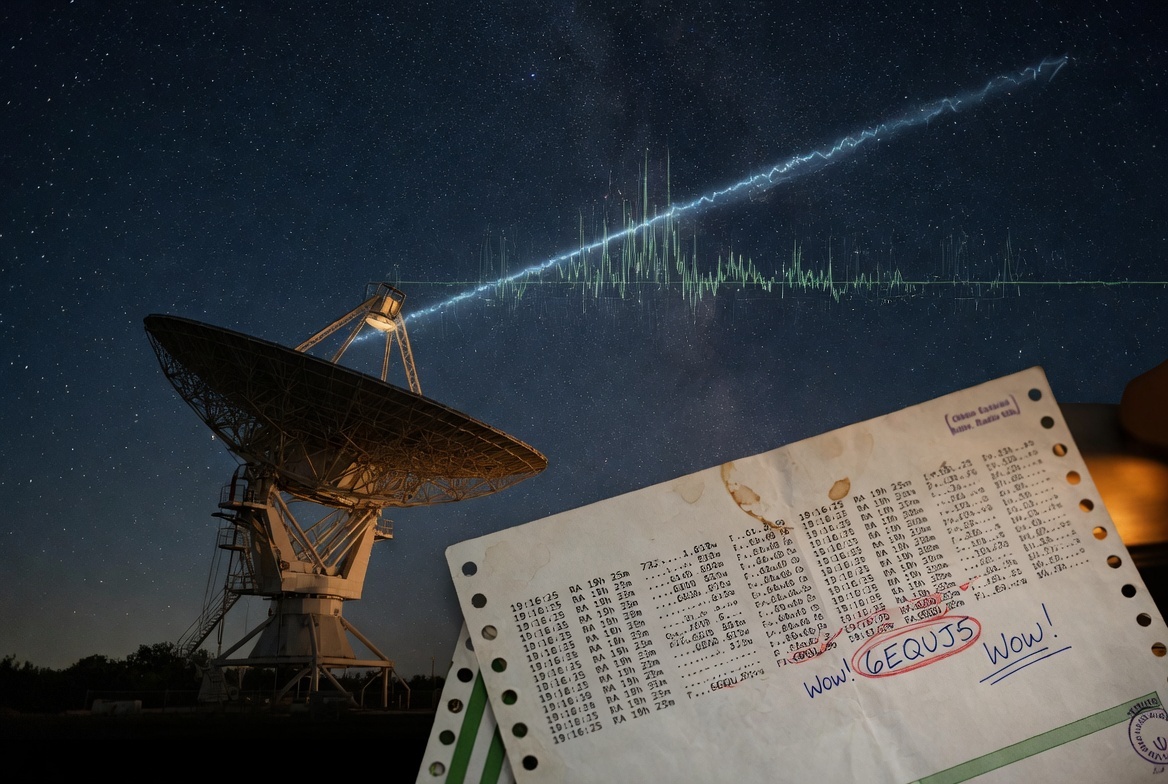
The printout looked ordinary until the numbers rose.
A radio telescope in Ohio had been scanning the sky as part of the search for extraterrestrial intelligence (SETI). On August 15, 1977, the instrument recorded an unusually strong narrowband radio signal. Days later, astronomer Jerry Ehman reviewed the data.
He saw the sequence: 6EQUJ5. He circled it, then he wrote one word beside the line: “Wow!”
The handwritten reaction became the name of the signal. Nearly half a century later, the Wow! Signal remains one of the most famous unresolved events in SETI history.
Then it disappeared. Follow-up observations did not confirm a repeat, and no final explanation has been proven.
The six characters are often misunderstood. 6EQUJ5 was not a decoded transmission or a string of symbols sent from another civilization.
The characters represented signal intensity measured over time.
The telescope system printed one character for each sampled interval. Higher characters reflected stronger values relative to the background noise.
The sequence therefore recorded a curve:
That pattern matters because it resembled the profile expected from a source passing through the telescope beam. A random local interference event might behave differently. But resemblance is not proof. The Wow! Signal has remained interesting precisely because it sits between plausibility and uncertainty.
The instrument was the Big Ear radio telescope operated by Ohio State University. Big Ear did not track one source across the sky like an optical telescope following a planet. Its observing system allowed the sky to drift through the telescope beam as Earth rotated.
The full transit took about 72 seconds, and the Wow! Signal matched that duration perfectly. This gave the event an astronomical-looking shape.
But Big Ear also used two feed horns. A persistent source should have appeared again as the second beam crossed the same location a few minutes later. The signal did not clearly return, and that missing repeat became one of the central problems.
The frequency made the event even more memorable. The signal appeared near the 1420 megahertz region associated with neutral hydrogen.
Hydrogen is the most abundant element in the universe. For decades, SETI discussions have treated the hydrogen line as a potentially meaningful region for communication because an advanced civilization might recognize it as a natural cosmic reference point.
This does not mean every signal near that frequency is artificial. Hydrogen exists naturally across the galaxy, astronomical processes can produce radio emission, and human technology can create interference. The frequency is interesting, but it is not a verdict.
The Wow! Signal had several features that made it difficult to ignore:
These features made it a memorable SETI candidate. But candidate is the correct word. No message content was detected, no spacecraft was seen, and no repeating beacon was confirmed. The signal remains a mystery because the evidence is limited, not because aliens have been proven and hidden.
Researchers have proposed multiple explanations over the years involving human-generated interference or natural astronomical sources.
A SETI Institute article published in 2024 discussed a new natural explanation based on work by researchers examining hydrogen-cloud signals. The hypothesis suggests that a transient energetic event could stimulate bright narrowband emission from a cold hydrogen cloud, producing a signal with Wow!-like characteristics.
This is not a final confirmed solution; it is a proposed astrophysical pathway. The significance lies in showing that a signal resembling a technosignature may arise through unusual natural processes. SETI needs to identify false positives as carefully as it searches for genuine anomalies.
The Wow! Signal is not frozen in 1977. Researchers continue to revisit old observations with modern tools.
A 2025 preprint reported a major re-analysis using previously unpublished Ohio SETI archival data. The authors refined properties including the possible sky location, intensity, and frequency, arguing that an astrophysical origin may be more likely than ordinary radio interference and exploring cold hydrogen clouds as part of the explanation.
Because this research appeared as a preprint, its claims should be framed carefully. Preprints can be valuable, but they can also change through peer review, criticism, and additional analysis. The updated work does not close the case—it makes the case more interesting. A decades-old printout still contains information researchers can reinterpret.
There is a temptation to turn the Wow! Signal into a definitive conclusion: “Aliens contacted Earth” or “Scientists decoded a hidden message.” Those headlines are far stronger than the evidence.
The real story has more tension. A narrowband signal appeared near a frequency SETI researchers considered interesting. It lasted exactly as long as the telescope beam allowed, and it did not repeat clearly. New natural hypotheses remain plausible, and modern re-analysis continues.
The mystery survives because neither the extraterrestrial story nor the natural explanation has reached final confirmation. One signal crossed a telescope beam for 72 seconds and left behind a mystery still active decades later.
References: