11
11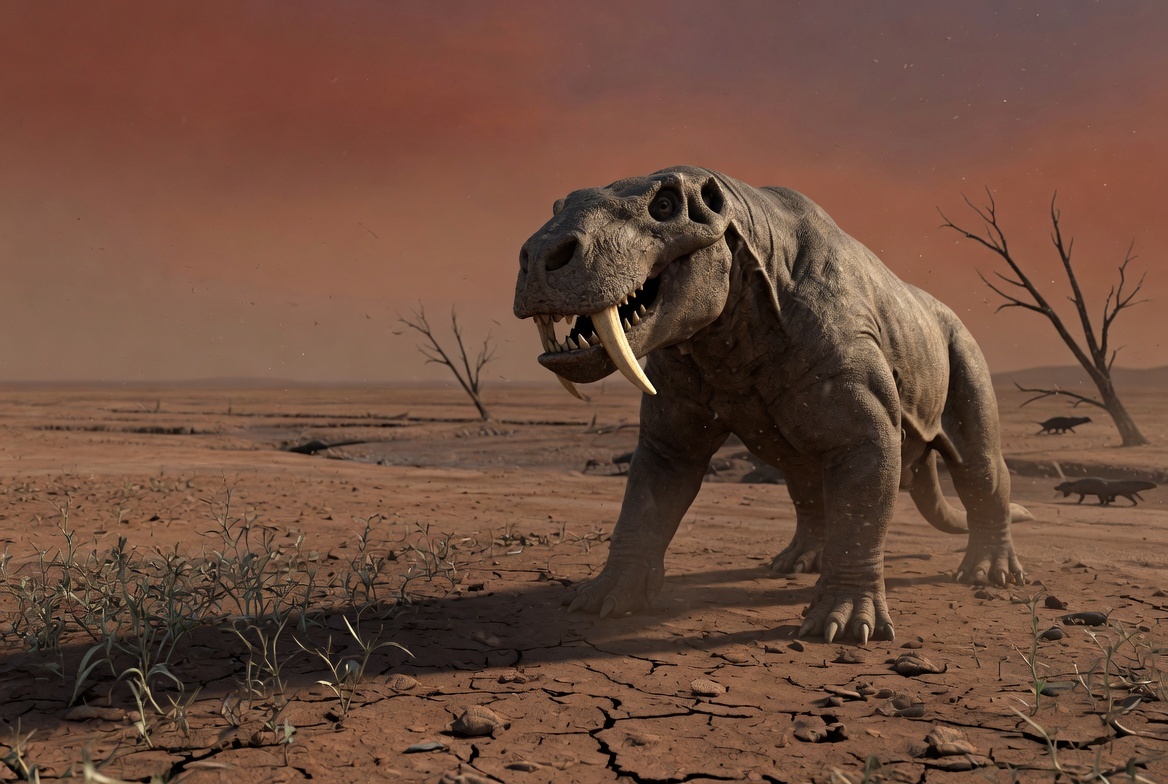
Long before the first dinosaur appeared, the land already had apex predators with faces built for fear.
One of the most dramatic was Inostrancevia.
It belonged to a group called gorgonopsians—extinct saber-toothed synapsids that lived during the Permian Period. Synapsids are part of the broad evolutionary branch that eventually produced mammals, but Inostrancevia was not a mammal and should not be treated as a modern big cat wearing reptile skin.
It was its own kind of animal:
And the world around it was moving toward the largest mass extinction in Earth’s history.
The end-Permian mass extinction occurred around 252 million years ago. It is often called the “Great Dying” because the crisis eliminated an extraordinary proportion of marine species and reshaped life on land.
The causes involved massive environmental disruption, linked to enormous volcanic activity, climate change, ocean chemistry shifts, and cascading ecological stress. The exact sequence remains an active research area, but the broad outcome is not debated:
Gorgonopsians disappeared by the end of the Permian. That makes Inostrancevia more than a scary prehistoric predator. Its fossils provide a view into what happens near the top of a food web when an ecosystem enters crisis.
Inostrancevia was originally known from Russia. Several skulls and near-complete skeletons revealed a large gorgonopsian with an intimidating profile. Depending on the species and reconstruction, it reached roughly three metres in length.
That scale matters. This was not a small specialized hunter moving beneath the feet of larger animals. It occupied the upper levels of the terrestrial food web.
Its saber-like canines are the obvious feature. The teeth were suited to puncturing and damaging prey, but scientists should be cautious about turning every reconstruction into a slow-motion attack scene. Fossils preserve anatomy more reliably than behavior.
The jaws tell us that Inostrancevia was carnivorous. The exact hunting strategy remains partly inferential.
A major twist emerged when gorgonopsian fossils from South Africa were identified as a new species, Inostrancevia africana.
The discovery attracted attention because it expanded the story beyond Russia. The fossils came from rocks close to the end-Permian crisis, revealing a large predator in southern Africa during a time of rapid ecological turnover.
A 2023 study interpreted the South African material as evidence of predator replacement near the extinction boundary. As some top predators disappeared, Inostrancevia appeared in the ecosystem. The original public framing emphasized a remarkable movement across Pangaea.
Later evidence made the timeline more complicated. Fossils from Tanzania and Mozambique suggest Inostrancevia reached southern Africa earlier than the initial story implied. That does not make the discovery less important. It changes the scientific question. The genus may have had a broader southern presence before the final crisis.
Science-mystery content often becomes weaker when it freezes the first dramatic explanation and ignores later research. Inostrancevia is a perfect example.
The exciting version is not that one predator suddenly crossed a continent at the last possible moment. That interpretation may be too simple. The more credible story is that fossil discoveries are gradually revealing a wider distribution across Pangaea, while the youngest records still show gorgonopsians living dangerously close to the end of their lineage.
A 2025 description of material from Mozambique added anatomical observations and biostratigraphic context for Inostrancevia africana. Each fossil changes the map, and each map changes the extinction narrative. The mystery evolves as evidence improves.
Gorgonopsians belonged to the therapsid branch of synapsids. They were not dinosaurs—they lived long before dinosaurs.
They were also not simply reptiles in the everyday sense, even though older popular language sometimes calls them “mammal-like reptiles.” The phrase can be useful as a rough introduction, but it oversimplifies evolutionary relationships.
Gorgonopsians had skull and jaw features distinct from both modern mammals and familiar reptiles. Their bodies occupied a strange visual space:
Evolution explored the saber-tooth solution more than once. Inostrancevia was one of the earliest large examples.
Long canines create a problem as well as an advantage. They can puncture deeply and damage soft tissue, but they also need to avoid breaking.
A predator with enlarged sabers cannot use its mouth exactly like a bone-crushing animal built around thick teeth. It may need to control the angle and force of the bite.
Researchers reconstruct gorgonopsian feeding behavior by studying skull shape, tooth form, muscle attachment areas, and comparison with other predators. The safest conclusion is that Inostrancevia used its canines to attack substantial prey, though the exact sequence of a kill remains uncertain.
A realistic predator is more interesting than a fantasy monster because its anatomy imposes rules.
Late-Permian landscapes contained herbivorous therapsids, dicynodonts, smaller carnivores, amphibians, and other animals living under increasing environmental pressure.
Apex predators depend on everything below them:
When ecosystems destabilize, the top predator may appear powerful while becoming increasingly vulnerable. That is why Inostrancevia works as a symbol of the Great Dying. Its teeth suggest dominance, but its geological position suggests fragility. No predator stands outside the food web.
It is easy to market Inostrancevia as a nightmare cat-reptile from before the dinosaurs. That hook works visually, but it misses the more interesting point.
The animal was part of a complicated evolutionary branch. Its fossils now connect regions across southern Africa and Russia. Its timeline overlaps with ecosystem collapse, and its final chapter remains under active revision as new specimens appear.
The real mystery is not whether it looked terrifying—the skull answers that immediately. The deeper mystery is how apex predators responded while the world beneath them failed.
References: