11
11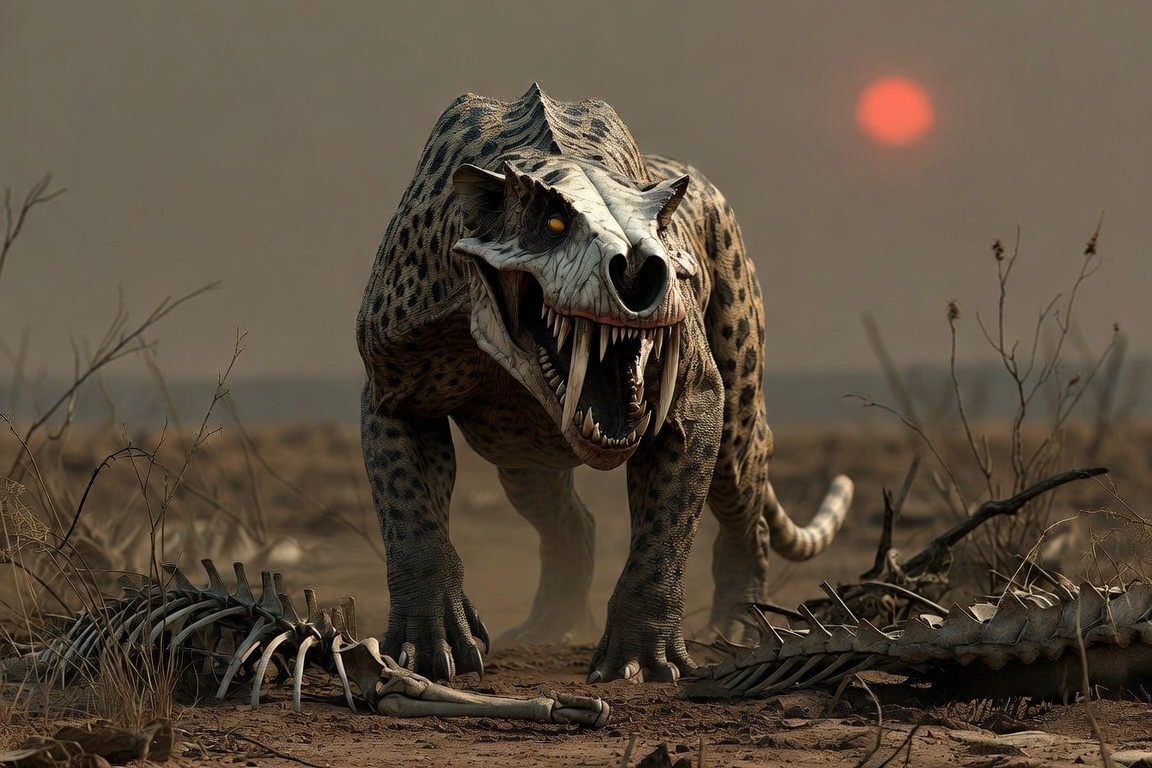
Inostrancevia was not a dinosaur. It was not a mammal in the modern sense. It belonged to a group called gorgonopsians, saber-toothed synapsids that lived during the Permian Period, long before the rise of dinosaurs.
That makes it instantly strange. Synapsids are part of the broader evolutionary line that eventually led to mammals, but gorgonopsians were not furry cats or wolves. They were their own extinct experiment in predation: powerful bodies, huge skulls, and long canine teeth that made them look like something caught between reptile and mammal.
Inostrancevia was one of the most famous gorgonopsians. It had massive saber-like teeth and a predator profile that feels almost cinematic. But the most powerful part of its story is not just anatomy. It is timing.
Inostrancevia lived around the end of the Permian, near the greatest mass extinction in Earth’s history.
The end-Permian extinction, sometimes called the Great Dying, was the most severe known extinction event. It devastated marine and terrestrial life. Volcanism, climate change, ocean chemistry disruption, and ecosystem collapse all played roles in the disaster.
This is the world that gives Inostrancevia its dark atmosphere. Imagine a predator built for dominance, walking through ecosystems under extreme stress. Food webs were changing. Species were vanishing. Environments were becoming harsher. Even powerful predators were vulnerable when the foundation of life began to fail.
Recent research has added more intrigue by suggesting some gorgonopsians had wider geographic stories than previously understood, with predator replacement and ecosystem disruption near the extinction boundary. The details are technical, but the visual is clear: saber-toothed predators operating in a world that was falling apart.
When people hear “saber-toothed,” they usually imagine Smilodon. But saber teeth evolved multiple times in different groups. Gorgonopsians were doing it long before cats existed.
Inostrancevia‘s canines were not decorative. They were part of a predatory skull built to attack other animals. Exactly how it used those teeth is interpreted from anatomy and comparison with other carnivores, but the overall signal is clear: this was a serious predator.
It likely hunted large herbivorous animals of the Permian world, though specific prey relationships depend on location and fossil context. Like all extinct predators, its exact behavior cannot be filmed or directly proven. But its skull tells a story of biting, seizing, and killing.
The important correction is that Inostrancevia should not be called a dinosaur. It belongs to an earlier and different world, one that makes dinosaurs feel almost modern by comparison.
The end-Permian extinction reminds us that even apex predators are only as strong as the ecosystems beneath them. That is the real horror of this animal. Not that it had saber teeth. The darker idea is that a creature so dangerous still could not escape a dying planet.
Inostrancevia is not just visually powerful because of its teeth. It is powerful because it represents predation at the edge of collapse. Many prehistoric predators are framed as rulers of their worlds. Inostrancevia may have been one too. But its world did not last.
References: